
Learning Objectives
- Understand the concept of population and niche
- Describe the J and S population growth patterns
- Outline the meaning of carrying capacity
Part 1: Population and Niche
Definition:
“A population is a group of organisms of the same species living in the same area at the same time, and which are capable of interbreeding”
The Concept of Niche
First of all, the niche is not just the habitat! A niche describes the particular set of abiotic and biotic conditions and resources on which an organism or a population depends.
- influence the growth, survival and reproduction of a population, including how food is obtained.
- For example, the niche of an elephant includes everything that defines this species such as its…:
- habitat (forest and grasslands),
- interactions between members of the herd (touching each other with their trunks, rubbing their bodies against one another, calling to each other),
- what it feeds on (grasses, small plants, bushes, fruit and twigs),
- when it feeds (elephants can spend three quarters of the day eating) and so on.
An ecological niche is the role of a species in an ecosystem where, when and how an organism lives.
- An organism’s niche depends not only on where it lives (its habitat) but also on what it does.
- No two species can have the same niche because the niche completely defines a species
The 2 categories of ecological niches:
- The fundamental niche describes the full range of conditions and resources in which a species could survive and reproduce = potential role a species plays if it had no competition
- The realised niche describes the actual conditions and resources in which a species exists due to biotic interactions = its realistic role after considering competition
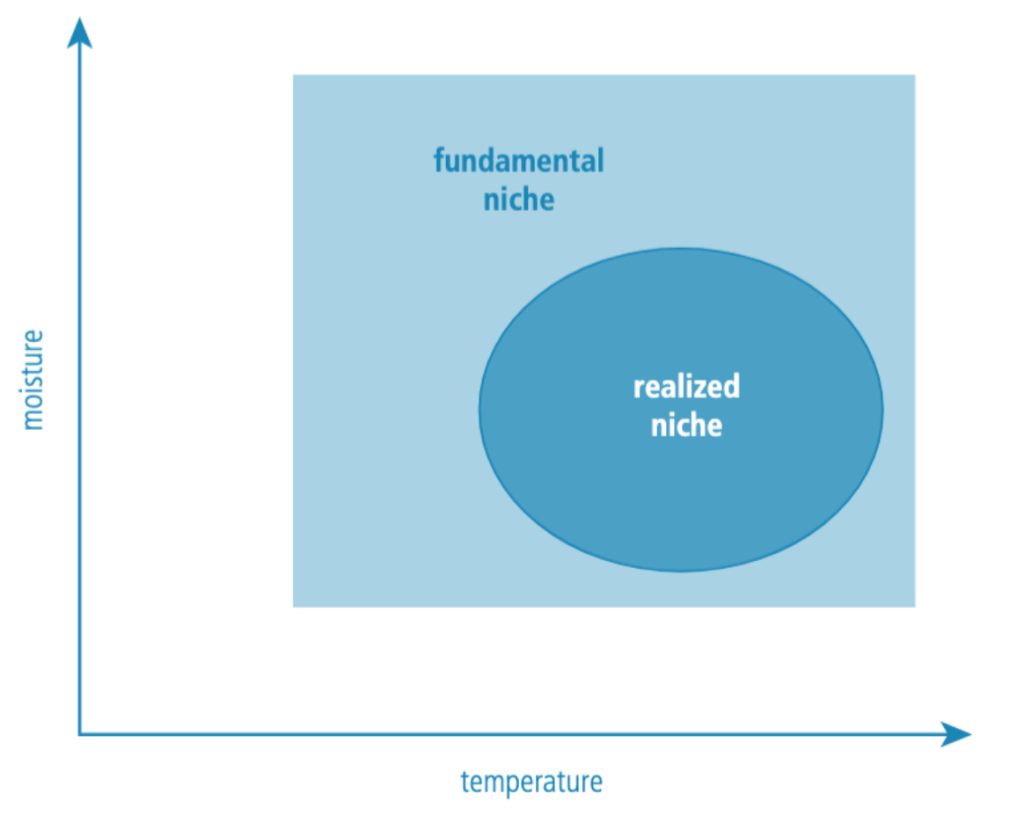
[AHL only]
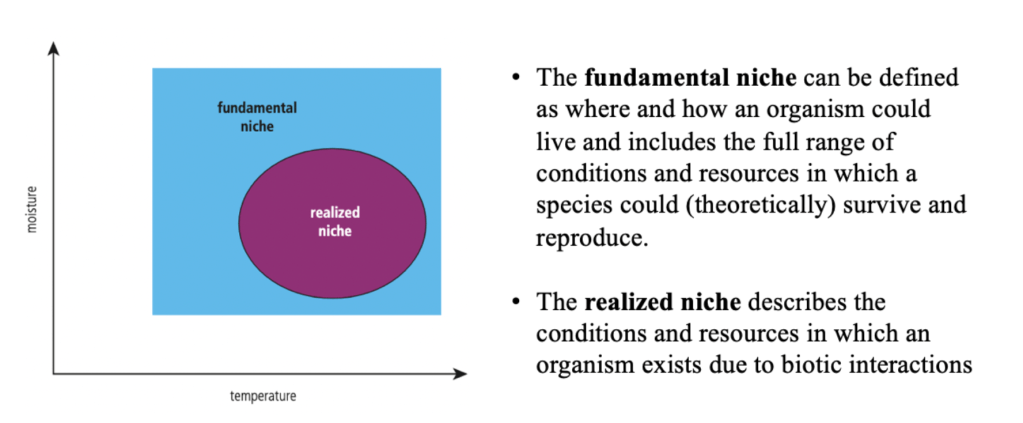
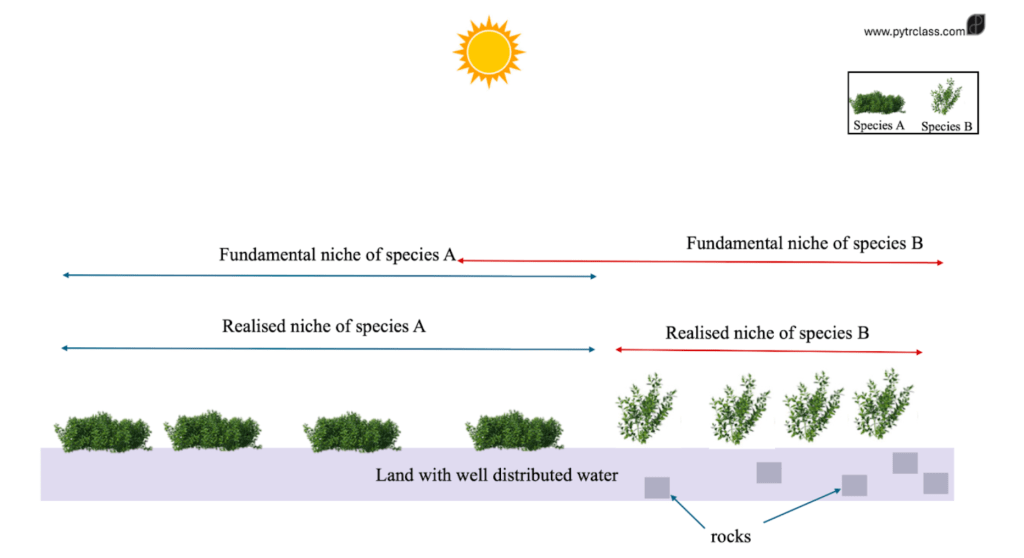
In theory (or fundementally)…
- A species would be able to play its roles and depending on certain abiotic factors.
- For example, a grass (in theory) should be able to grow and cover a field with good amount of abiotic factors
In reality…
- Some species may not be able to show its theorised role.
- This may be due to competitions, human activities etc.
- The actual role is now called the realised niche
- For example, due to competition, a certain species (less like to succeed in competition) won’t be able to spread out its population
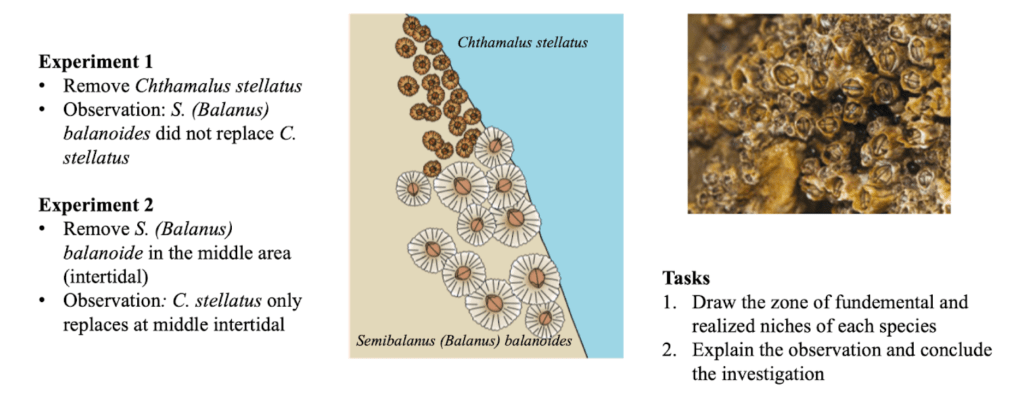
Activity 1:
- Life cycles vary between species in reproductive behaviour and lifespan
- Species can be classified according to how rapidly they reproduce and the degree of parental care they provide
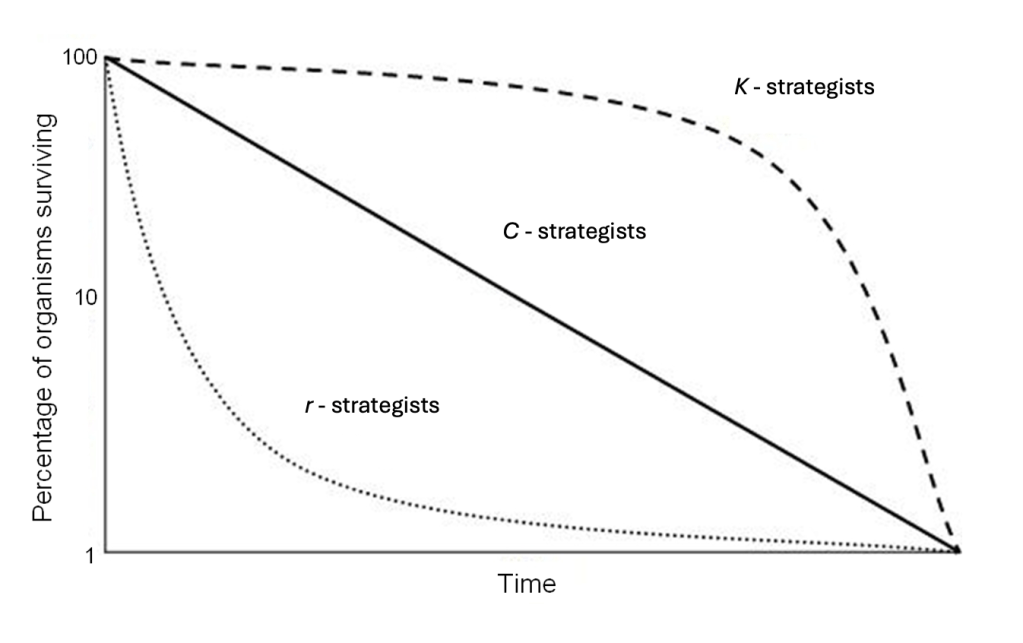
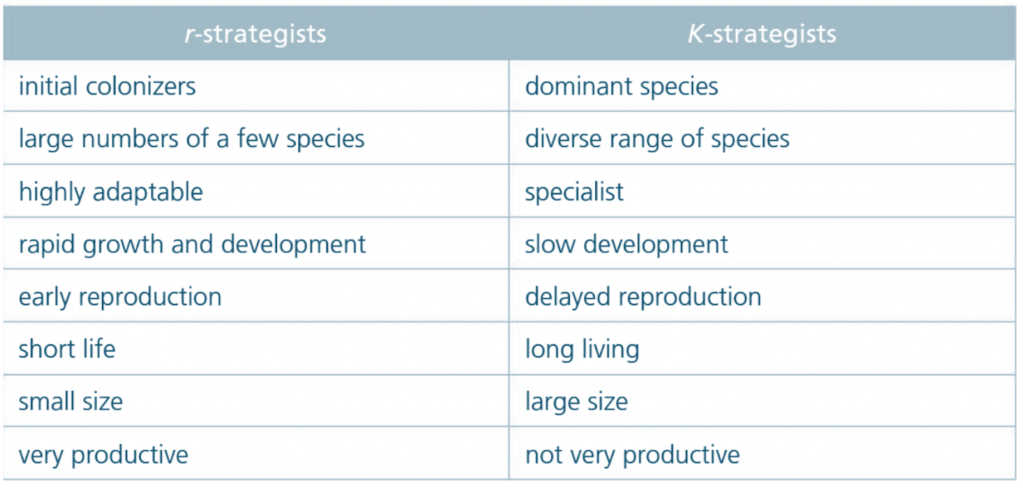
- Species with periods of rapid growth followed by decline tend to inhabit unpredictable, rapidly changing environments and are called opportunistic species, r-strategists, or r-species
- Slow-growing organisms tend to be limited by the carrying capacity (K) of an environment and are known as K-strategists or K-species
- K-strategists inhabit stable environments and have lower reproductive rates but better competitive ability
- K-species have long life spans, large body size, and develop slowly
- K-species produce very few, often exceptionally large, offspring that mature slowly and receive substantial parental care
- Elephants and whales are examples of K-species
- Due to low birth rates, K-species are vulnerable to high death rates and extinction
- r- and K-species have reproductive strategies suited to pioneer and climax communities respectively
- In predictable environments with stable resources, there is little advantage to rapid growth
- Evolution in such environments favours species that maximize natural resource use and produce few offspring with high survival probability
- Disturbed habitats with rapidly changing conditions favour species that respond quickly, develop fast, and reproduce early
- These colonizer species often exhibit high productivity and strong dispersal ability to reach disturbed areas
- Ecological studies provide crucial information on species’ classifications, niche requirements, and life cycles
- This information helps assess the extent of human impacts on species
- Human impacts on life cycles include climate change-induced temperature shifts that affect plant life cycles, subsequently influencing animal life cycles
- Many species’ life cycles are synchronized with those of others and with seasonal patterns
- Human-driven climate change may disrupt these synchronized plant and animal life cycles
Part 2: Population Growth
Population growth = shows increase in the number of individual of a species over time. This increment can either be…
- Exponential or
- Limited by carrying capacity
Each species has a strategy to maintain the growth over many generations
- r – strategist
- K – strategist
Factors affecting growth:
- Density-dependent factors operate as negative feedback mechanisms regulating the population and leading to stability.
- Predator–prey relationships are a good example of density-dependent control.
- Density-independent factors are generally abiotic. The most important ones are extremes of weather (drought, fire, hurricanes) and long-term climate change. Others include geophysical and geological events such as earthquakes and volcanic eruptions and the tsunamis that can result from them. Their impacts include an increase in the death rate and a reduction in the birth rate, especially of smaller individuals.
- The response depends, in part, on the frequency and severity of the event. Density-independent factors can operate alongside density-dependent factors.
- Density-independent factors may have significant influence on population size, but it is the density-dependent factors that tend to regulate the population around the carrying capacity. In addition to competition for limited resources, these factors include the increased risk of predation and the transfer of pathogens in dense populations
Population growth has 2 patters: J is a population growth that has no limit; S is a population growth limited by certain factors. S growth has carrying capacity.
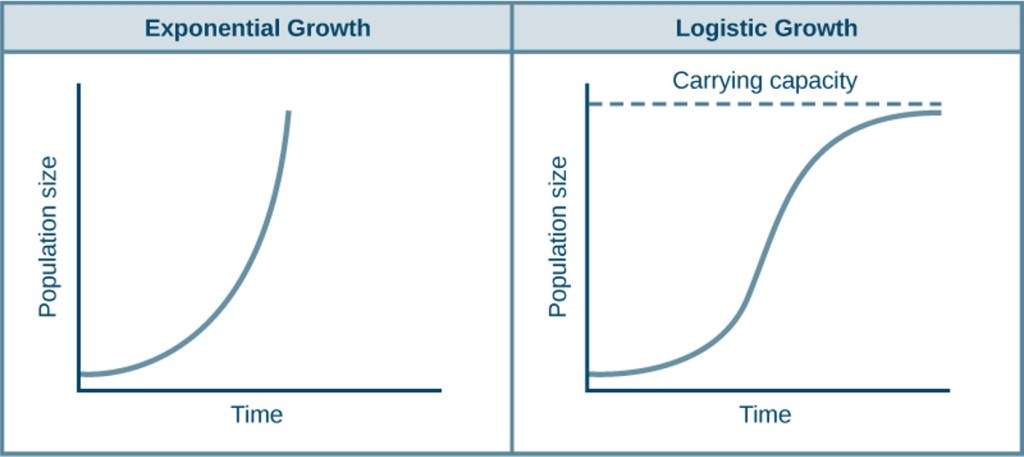
Limiting factors slow population growth as it approaches the carrying capacity of the system. Limiting factors for…:
- for animals: space, food, mates, nesting sites and water
- for plants: light, nutrients, water, CO2 and temperature
Populations have an upper level or extent to the number of individuals that can be sustained in each environment. Carrying capacity is the term used to describe the maximum number of individuals of a species that can be sustained by an environment. The carrying capacity represents the population size at which environmental limiting factors limit further population growth. The carrying capacity of a population is affected by various limiting factors, such as:
- the availability of food and water
- territorial space
- Predation
- Disease
- availability of mates
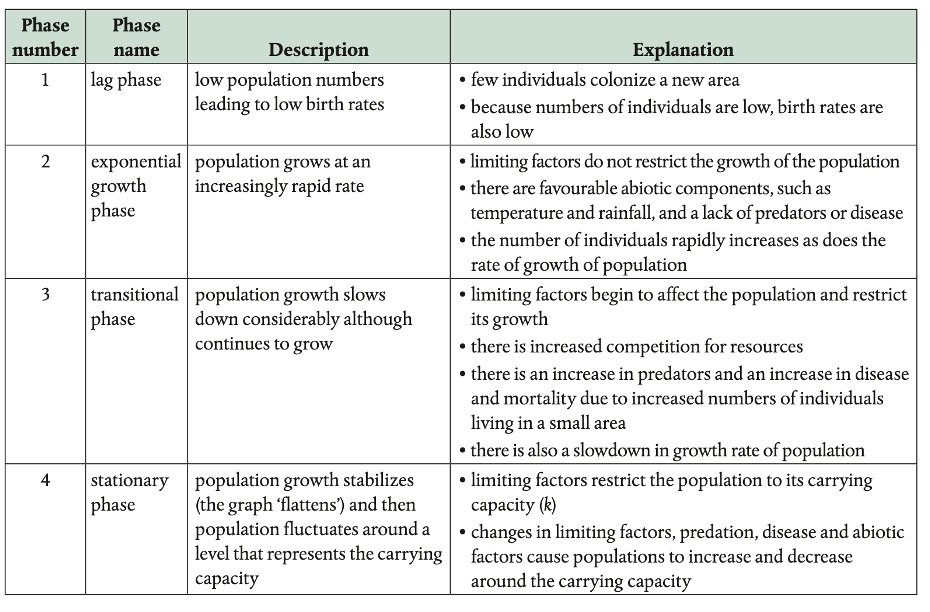
Question: Describe the stages in S shape curve
Challenges in Estimating Human Carrying Capacity
Carrying capacity is the maximum number of individuals that an area can sustain or accommodate. This is highly influenced by the biocapacity, the Earth’s ability to regenerate natural resources for the population. Assessing the environmental carrying capacity for human populations is complex due to several factors:
- Humans rely on a wide range of resources, making it difficult to quantify overall consumption.
- When a resource becomes scarce, alternative resources can often be used as substitutes.
- Lifestyle choices influence the amount and type of resources needed.
- Technological advancements continuously alter both resource availability and consumption patterns (e.g., renewable energy reducing reliance on fossil fuels).
- Global trade allows resource importation, making populations less dependent on local resource availability.
Subscribe to get access
This section is exploring further using research on carrying capacity using a graph
![ESS 8.1.3 [AHL] Biocapacity and Environmental Migration](https://mypytrclass.com/wp-content/uploads/2025/12/image-4.png?w=1024)


![ESS 8.3.4 [AHL] Photochemical Smogs and Tropospheric Ozone](https://mypytrclass.com/wp-content/uploads/2025/12/image-1.png?w=1024)
 PYTR Class