
Learning objectives
- Understand the examples of abiotic factors
- Evaluate different ways of measuring abiotic factors
- Explain biotic factors of an ecosystem
Introduction
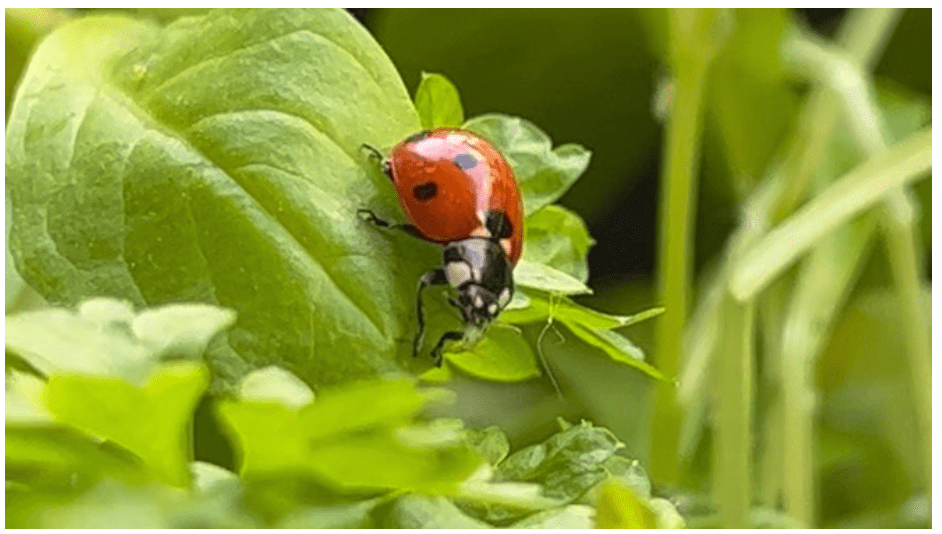
Take a look at the photograph on the left, everything that you see and might not see can be the factors for an ecosystem to be self-sustaining
Let’s list down what present in this ecosystem! We can clearly see a ladybug, aphids and some vegetation. These are living things are are interacting with each other in many different ways. These living things are now categorised as the biotic factors.What we can’t see in this photograph is non-living factors or components or also known as the abiotic factors. These are essential parts of an ecosystem to be sustaining. For example, the vegetation requires water, CO2 and light to carry out photosynthesis. In addition, it also requires nutrients such as nitrates and phosphates from the soil to grow. On the other hand, the animals require oxygen to respirate (the plants also respirate in the dark). The relative humidity and temperature in this ecosystem seem to be at the optimal level for this ecosystem to self-sustain itself
Habitat
Abiotic Factors
Abiotic factors are the non-living components of an ecosystem that influence the living organisms within it. These factors help shape the environment and determine which species can survive and thrive.
Examples of Abiotic Factors in an Ecosystem:
- Temperature – Affects metabolism and survival of organisms.
- Light (Sunlight) – Essential for photosynthesis in plants and regulates biological rhythms.
- Water Availability – Determines which organisms can live in a habitat and influences plant growth.
- Soil Composition & pH – Affects nutrient availability and plant distribution.
- Air & Oxygen Levels – Essential for respiration in animals and decomposition in ecosystems.
- Humidity – Influences evaporation rates and transpiration in plants.
- Salinity – Affects osmoregulation in aquatic organisms, especially in marine and freshwater ecosystems.
- Wind – Impacts seed dispersal, plant pollination, and evaporation rates.
- Altitude & Atmospheric Pressure – Influences oxygen availability and climate conditions.
Abiotic factors interact with biotic factors (living organisms) to create a balanced and functional ecosystem.
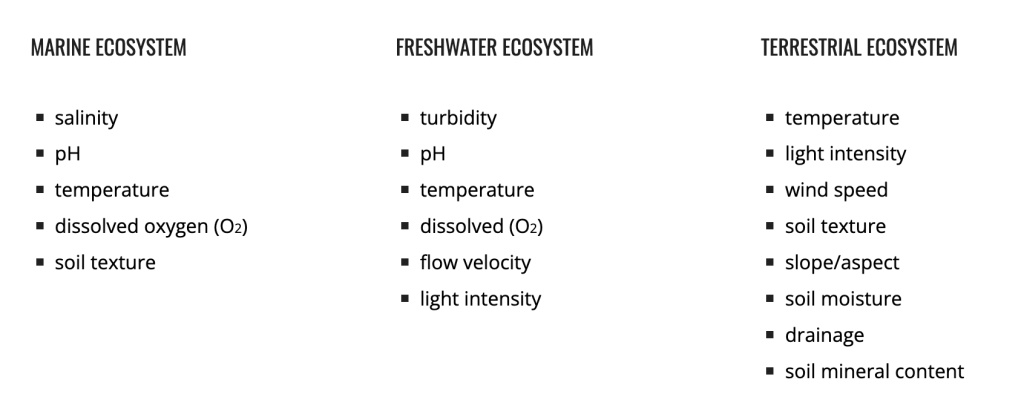
Examples of abiotic factors in different groups of ecosystems
In overall, all abiotic factors can be measured. The measurement are often quantitative but sometimes can be qualitative. Quantitative measurement is often more preferred as this will allow data interpretation using graphical methods that show patterns.
Based on the above podcast, summarise the evaluation into a table. This will be very useful in choosing which method to use in investigating the abiotic factors in an ecosystem.
Question: Evaluate the measure of describing abiotic factors [4]
Biotic Factors of an Ecosystem
Biotic factors are the living components of an ecosystem that interact with each other and influence the environment. These factors include all organisms, from microorganisms to large animals and plants, and their relationships within the ecosystem.
Types of Biotic Factors:
- Producers (Autotrophs) – Organisms that produce their own food through photosynthesis (e.g., plants, algae) or chemosynthesis (e.g., certain bacteria).
- Consumers (Heterotrophs) – Organisms that obtain energy by feeding on other organisms:
- Herbivores – Eat plants (e.g., deer, rabbits).
- Carnivores – Eat other animals (e.g., lions, hawks).
- Omnivores – Eat both plants and animals (e.g., bears, humans).
- Decomposers & Detritivores – Break down organic matter and recycle nutrients (e.g., fungi, bacteria, earthworms).
- Symbiotic Relationships – Interactions between species, such as:
- Mutualism (both species benefit, e.g., bees and flowers).
- Commensalism (one species benefits, the other is unaffected, e.g., barnacles on whales).
- Parasitism (one species benefits, the other is harmed, e.g., ticks on mammals).
- Predation & Competition –
- Predators control prey populations, maintaining ecological balance.
- Competition occurs when organisms vie for the same resources (food, water, shelter).
Role of Biotic Factors in an Ecosystem:
Biotic factors drive energy flow, nutrient cycling, and population dynamics, shaping the ecosystem’s structure and stability. Their interactions determine biodiversity and the overall health of the environment. No two species can inhabit the same ecological niche in the same place at the same time. If many species live together, they must have slightly different needs and responses so they are not in the same niche
![ESS 8.1.3 [AHL] Biocapacity and Environmental Migration](https://mypytrclass.com/wp-content/uploads/2025/12/image-4.png?w=1024)



![ESS 8.3.4 [AHL] Photochemical Smogs and Tropospheric Ozone](https://mypytrclass.com/wp-content/uploads/2025/12/image-1.png?w=1024)

 PYTR Class