
Learning Objectives
- Summarise the information about the term biosphere and biomes
- Describe the concept of species using a case study of the arctic seagulls
- Outline the limitations of the concept species
- [Skill]: Apply dichotomous key
The Biosphere
- Support all livings (biotic factors) depending on locations
- Contains all resources and input of energy that are crucial for living things
- This is achieved by the interaction between lithosphere, hydrosphere and atmosphere
- These are the basic abiotic factors

- Biome is a large area characterised by:
- vegetation
- soil
- climate
- wildlife.
- Five major types of biomes are:
- aquatic
- grassland
- forest
- desert
- tundra
- Some biomes can be further divided into the following categories:
- freshwater
- marine
- savanna
- tropical rainforest
- temperate rainforest
- taiga
Concept of Species
Definition:
“a species is a group of organisms that can interbreed and produce fertile offspring”
- Individual organism is a member of a species
- Sometimes, two species breed together to produce hybrid offspring. A hybrid may survive to adulthood but cannot produce viable gametes and so is sterile. Examples include:
- Horse (Equus caballus) + donkey (Equus asinus) à Mule
- Male tiger (Panthera tigris) + lioness (Panthera leo) à Tigon
- Female tiger + male lion à Liger
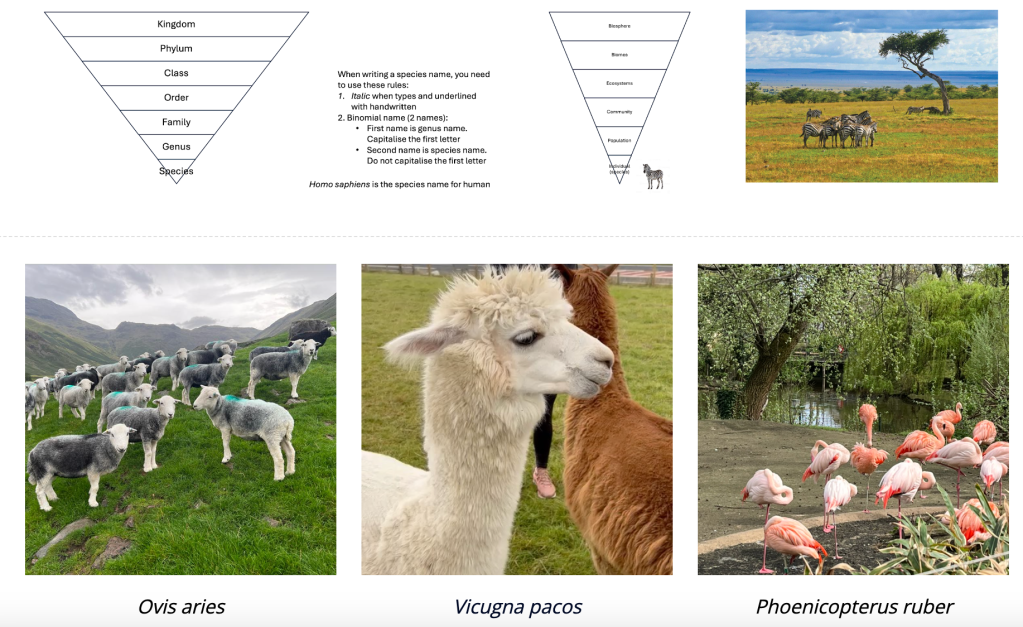
Limitation to the species concept:
- Cannot clarify whether geographically isolated populations belong to the same species
- Cannot classify species in extinct populations
- Cannot account for asexually reproducing organisms
- Cannot clearly define species when barriers to reproduction are incomplete

Subscribe to get access about dichotomous key
Read more of this content when you subscribe today.
This subscription section is going to explore the concept of dichotomous key an exercises. This section will also outline the limitations of dichotomous key
DNA profiling in dichotomous keys
- Organisms can also be classified based on their specimens in a herbarium
- Museums often use DNA profiling techniques to identify differences between specimens.
- More accurate way of determining the identity of an organism than using only its physical appearance.
![ESS 8.1.3 [AHL] Biocapacity and Environmental Migration](https://mypytrclass.com/wp-content/uploads/2025/12/image-4.png?w=1024)



![ESS 8.3.4 [AHL] Photochemical Smogs and Tropospheric Ozone](https://mypytrclass.com/wp-content/uploads/2025/12/image-1.png?w=1024)
 PYTR Class