
Learning objectives
- Define habitat, community and ecosystem
- Explain the term tipping point
- Outline the relationship and interaction between populations and within a population
Terminologies
Community
A community is a group of several populations living and interacting with each other in an ecosystem. A community is many species living together, whereas the term population refers to just one species
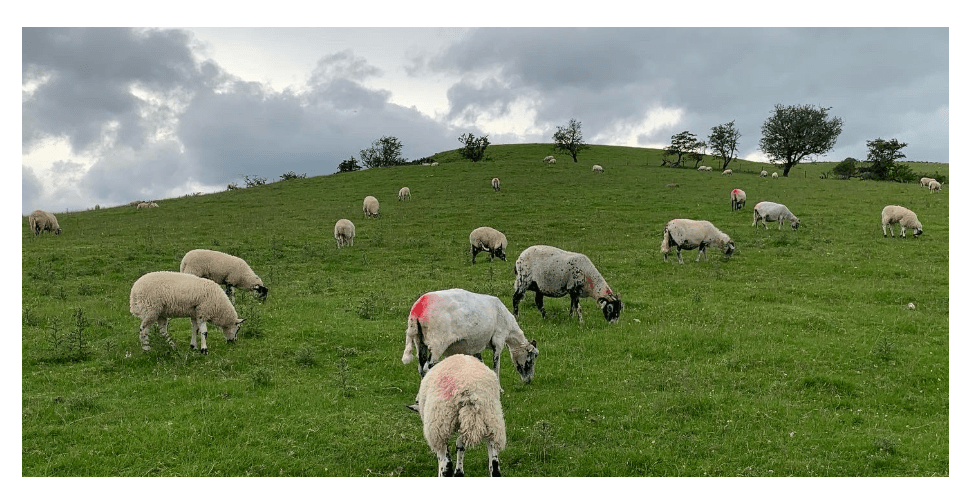
A population of sheep, eating grass. Note that there are a few species of grass in the field. This means that there are a few populations of grass in this ecosystem. At the hilltop, there is a population of tree. All these populations occupy the same space and time. This allows them to interact in the ecosystem.
Habitat
- A habitat is the location in which a community, species, population or organism lives.
- A habitat of a species includes geographical and physical locations and the type of ecosystem required to meet all environmental conditions needed for survival

For example, pandas live mainly in temperate forests high in the mountains of southwest China, where they subsist almost entirely on bamboo. They must eat around 26 to 84 pounds of it every day, depending on what part of the bamboo they are eating. They use their enlarged wrist bones that function as opposable thumbs.
Ecosystem
- An interdependent organisms (the biotic component) and the physical environment (the abiotic component) with which it interacts.
- Ecosystems are open systems
- Both energy and matter can enter and exit the system. These can be lost (law of thermodynamics) or passed to another ecosystem
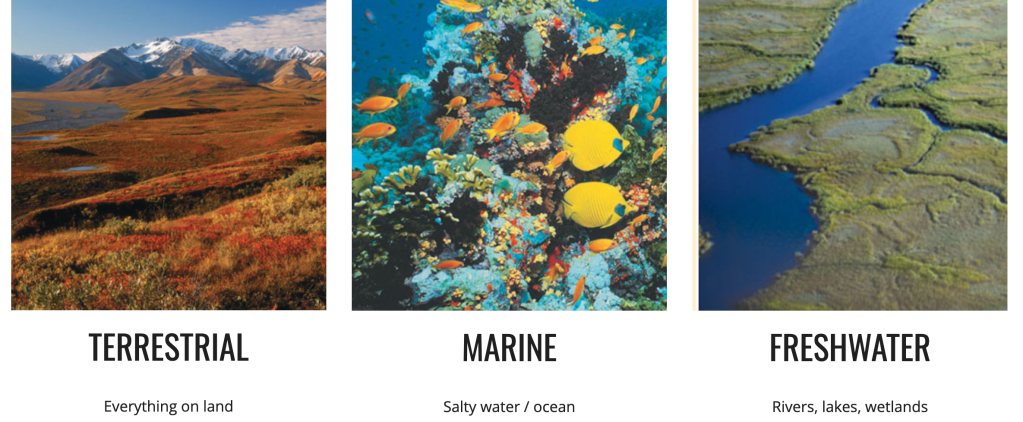
- There are three major types of ecosystem:
Sustainability is a natural property of ecosystems
- Ecosystem are in their steady-state equilibrium.
- Energy released (leaving an ecosystem) from cellular respiration is balanced by the input of the solar energy
In general, a sustainably ecosystem shows these features:
- Balanced energy and carbon recycling
- Input from solar energy. Energy is used by plants and other photosynthetic organisms to convert carbon dioxide molecules to glucose (sugar) molecules.
- Sugar is used in cellular respiration (with or without oxygen). Energy is obtained by breaking down the sugar molecules. As energy is used and heat is lost, carbon dioxide is released back to the atmosphere. The sugar molecules can also be used to increase biomass (growth in terms of the size of the organism).
- As an organism dies, their carbon based matters are decomposed by decomposers (such as bacteria and fungi) and carbon is returned to the atmosphere. Note that decomposition includes cellular respiration.
- Water cycle
- Water falls of as rain from the cloud. This is called precipitation. Water molecules can also precipitate in a form of snow although is is caused by crystallisation of water vapour in the atmosphere.
- As water reached the soil and water bodies (rivers, lakes, oceans etc), the water is now available for uptake by organisms. Plant would take up water for photosynthesis and respiration (and other metabolic processes) while animals drink water for cellular respiration (and other metabolic processes). The water molecules will be returned to the environment in a form of waste materials (such as pee and sweat) and as water vapour (by products of respiration)
- Nutrients recycling
- Nutrients such as nitrates are recycled in an ecosystem. The recycling involves several biotic and abiotic factors.
- Nitrogen cycle for example involves the conversion of atmospheric nitrogen to nitrates in the soil. This requires large energy such as the lighning and nitrogen fixing bacteria in the soil and roots of plants. Once nitrates are formed, they are now available for intake by plants for plant growth. The nitrates will later be consumed by the consumers along a food chain. As consumers die, their nitrates will be returned to the soil during decomposition process.
Throughout the above sustainable processes, matters and energy are also passed to another ecosystem. For example:
- Rain may carry some nutrients by runoff to another habitat
- Nutrient leaching transfers nutrients underground from one ecosystem to another
- Energy and matter transferred from marine to terrestrial. For example, birds consumer fish
Part 1: Competition
Subscribe to get access
Read more of this content when you subscribe today.
Part 2: Herbivory and Predation
Herbivory
- Herbivory is an interaction in which an animal consumes a plant.
- The animal that feeds on plants is known as a herbivore.
- Example: The hippopotamus grazes on vegetation at night when it is cooler.
- During the day, hippopotamuses remain in rivers to prevent overheating.
- The carrying capacity of a herbivore’s habitat depends on the availability of plant resources.
- Areas with more abundant vegetation can support larger herbivore populations.
- Conversely, regions with scarce plant resources have a lower carrying capacity for herbivores.
Predation
- Predation is an ecological relationship where one organism (predator) hunts, kills, and consumes another organism (prey).
- Predators play a crucial role in regulating prey populations and maintaining ecosystem balance.
- Predation can drive natural selection, favoring adaptations in both predators (e.g., sharper teeth, camouflage, speed) and prey (e.g., defensive mechanisms, mimicry, group behavior).
- The population sizes of predators and prey are interdependent, often following a cyclic pattern where an increase in prey leads to an increase in predators, followed by a decline in prey due to predation pressure.
- Some predators are specialists, feeding on a specific prey species, while others are generalists, consuming a variety of prey.
- Apex predators are at the top of the food chain with no natural predators, helping to control lower trophic levels.
- Predator-prey dynamics can be influenced by environmental changes, human activities, and the introduction of invasive species.
Keystone Species
- Keystone species are crucial for ecosystem stability; their absence can lead to ecosystem collapse.
- They play a significant role in maintaining ecosystem sustainability and species interactions.
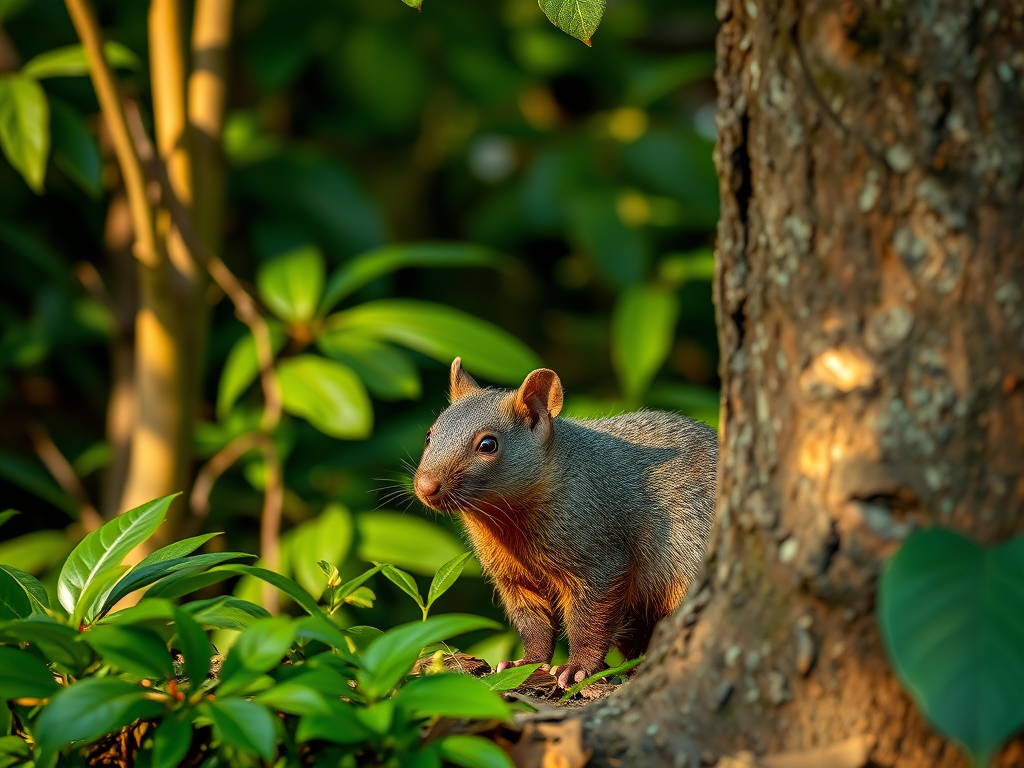
- Example: The agouti, a rodent in South and Central American tropical forests, is vital for the reproduction of the Brazil nut tree (Bertholletia excelsa).
- The Brazil nut tree is one of the tallest trees in the Amazon, growing up to 50 meters.
- The agouti is the only animal capable of opening Brazil nut seed pods due to its strong teeth.
- It buries seeds for later consumption, allowing some to germinate and grow into new trees.
- Without the agouti, the Brazil nut tree population would decline, affecting species that rely on it, such as harpy eagles that use the trees for nesting.
- Brazil nuts are valuable for local economies, providing income and serving as a protein-rich food source.
- Their extracted oils are widely used in cosmetic products.
- Keystone species are difficult to identify, and many remain undiscovered.
- Conserving entire ecosystems rather than individual species helps preserve complex ecological interactions, including keystone species.
Question: Analyse if all apex predators are a keystone species using named examples
Read more of this content when you subscribe today.

Part 3: Symbiosis
Symbiosis refers to a close and long-term biological interaction between two different species. These relationships can be beneficial, harmful, or neutral for the species involved. The main types of symbiotic relationships are:
1. Mutualism (+/+)
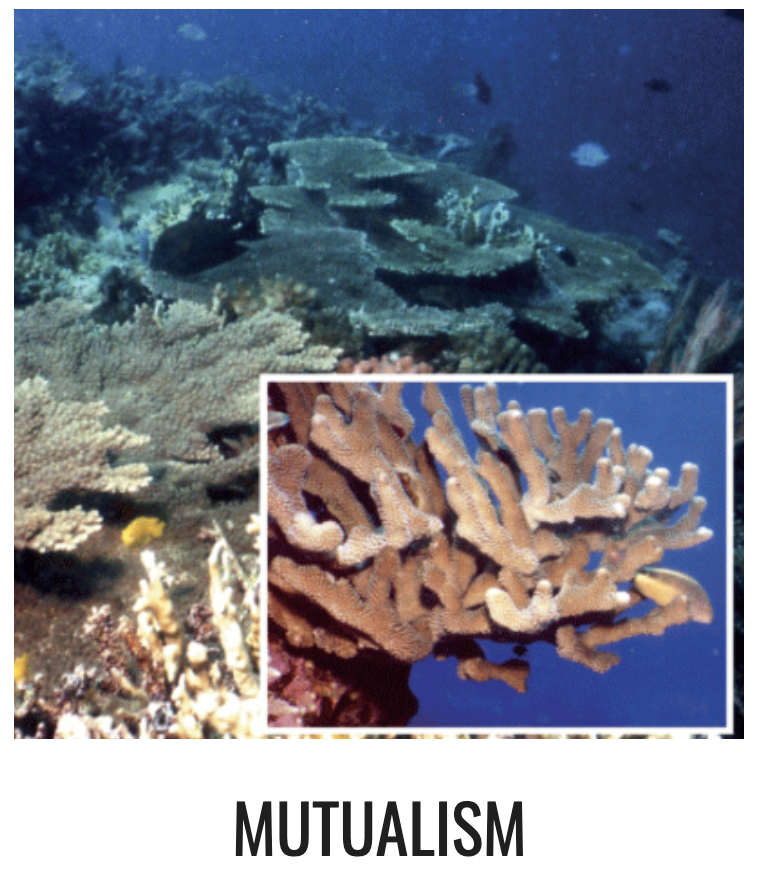
Corals provide the zooxanthellae with a protected environment, and the coral polyp cells produce carbon dioxide and water that the zooxanthellae need for photosynthesis. The zooxanthellae use energy from the sun to turn the carbon dioxide and water into oxygen and help the coral to remove waste
- Both species benefit from the relationship.
- Example: Bees and flowers – Bees get nectar for food, and flowers get pollinated.
- Example: Clownfish and sea anemones – Clownfish receive protection, and the anemone benefits from cleaning and nutrients.
2. Commensalism (+/0)

Two species in which one species obtains food or other benefits from the other without either harming or benefiting the latter
- One species benefits, while the other is neither harmed nor helped.
- Example: Barnacles on whales – Barnacles gain transportation and food access, while the whale is unaffected.
- Example: Epiphytic plants on trees – Orchids grow on tree branches to access sunlight without harming the tree.
3. Parasitism (+/-)
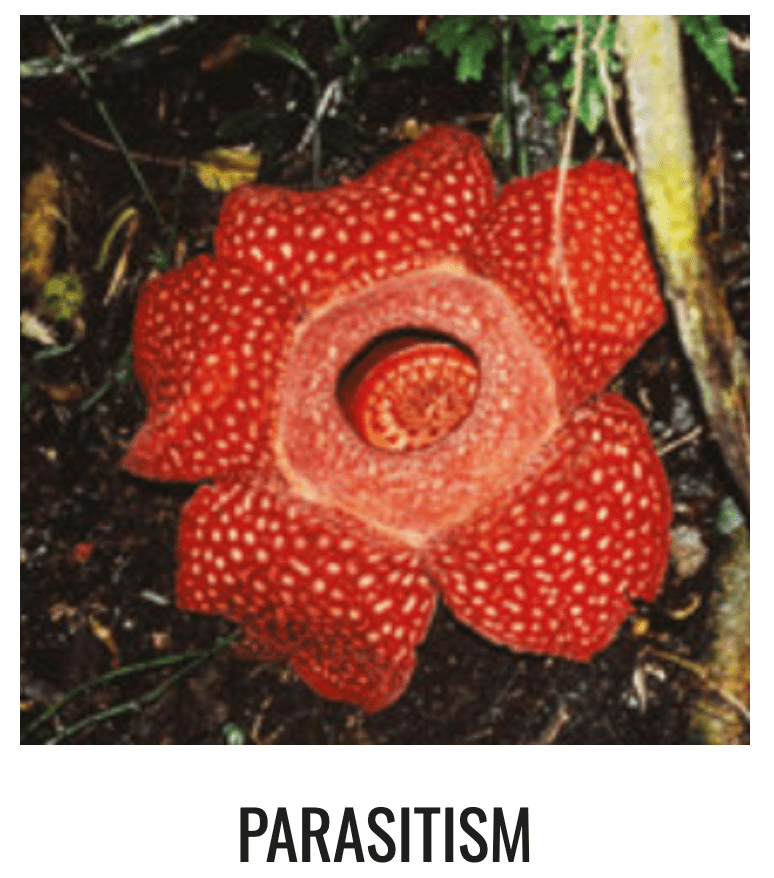
Rafflesia produce the world’s largest flowers but lack leaves. Without leaves, they are unable to photosynthesise, so they rely on nearby Southeast Asian vines (Tetrastigma species) to extract the sugars necessary for their growth.
- One species (parasite) benefits, while the other (host) is harmed.
- Example: Ticks on mammals – Ticks feed on the host’s blood, weakening it.
- Example: Tapeworms in humans – Tapeworms absorb nutrients from the digestive system, harming the host.
Each type of symbiotic relationship plays a role in shaping ecosystems and maintaining biodiversity.
Part 4: Pathogenic
Pathogenic Relationship in the Ecosystem
- A pathogenic relationship occurs when a pathogen (disease-causing organism) infects a host, often harming or weakening it.
- Pathogens can be bacteria, viruses, fungi, or parasites that invade a host organism.
- This relationship is a form of parasitism, where the pathogen benefits while the host suffers.
- Pathogens can reduce population sizes, affecting food chains and ecosystem stability.
- Some pathogens are species-specific, while others can infect multiple species, spreading through ecosystems.
- Examples include:
- Plasmodium (malaria-causing parasite) infecting humans and mosquitoes.
- Mycobacterium tuberculosis causing tuberculosis in mammals.
- Fungal infections devastating plant populations (e.g., Phytophthora infestans causing potato blight).
- Pathogenic relationships can drive natural selection, as hosts evolve resistance and pathogens adapt to survive.
- In balanced ecosystems, natural predators, immune responses, and environmental factors help regulate pathogen populations, preventing outbreaks.
![ESS 8.1.3 [AHL] Biocapacity and Environmental Migration](https://mypytrclass.com/wp-content/uploads/2025/12/image-4.png?w=1024)



![ESS 8.3.4 [AHL] Photochemical Smogs and Tropospheric Ozone](https://mypytrclass.com/wp-content/uploads/2025/12/image-1.png?w=1024)
 PYTR Class