

Learning Objectives
- Outline the meaning of maximum sustainable yield (MSY)
- Outline ecological efficiency
- Outline the entropy of an isolated system
Part 1: Maximum Sustainable Yield (MSY)
Annual sustainable yield
- Biomass and Energy Gain: The annual increase in biomass or energy for a natural resource, such as a crop, results from growth and recruitment.
- Silviculture: The management and treatment of forests to enhance and sustain their productivity.
- Maximum Sustainable Yield (MSY): The highest possible extraction rate of a resource without depleting its stock over time.
- Sustainable Harvesting: Ensuring resource use does not reduce the original natural capital.
- Application of MSY: Can be calculated for both natural ecosystems and managed systems like agriculture and forestry.
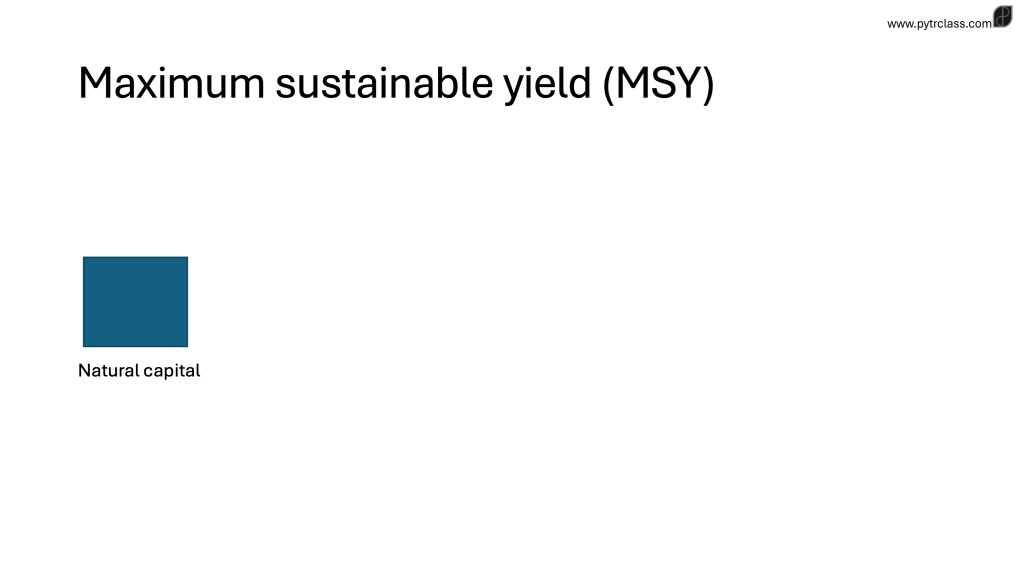
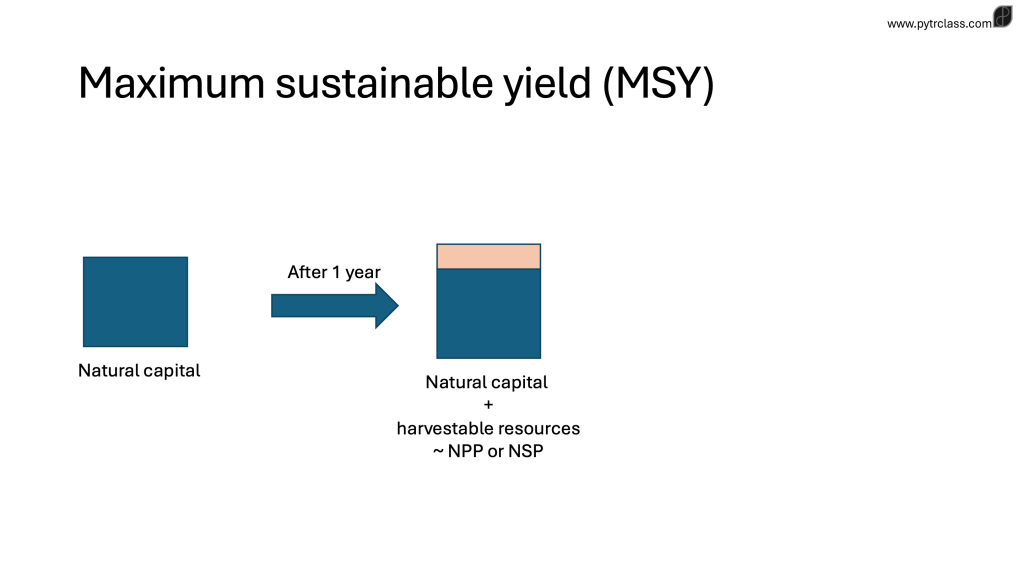
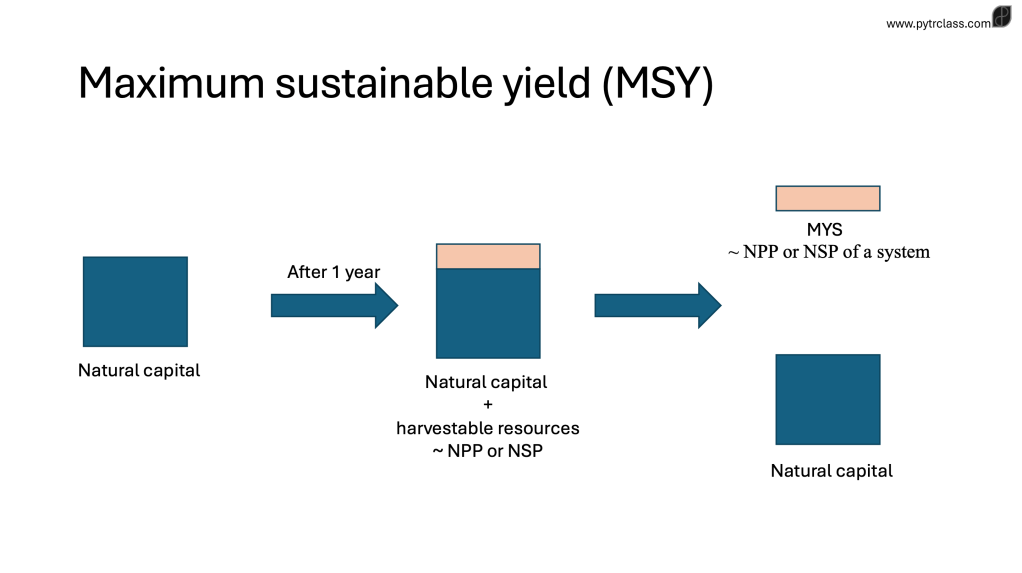

Question: Explain why sustainable yields are higher for lower trophic levels
Answer:
Sustainable Yield and Trophic Level Efficiency in Food Production
Sustainable yield (SY) is a measure of the rate at which natural capital, or natural income, increases and can be utilized without depleting the original stock or hindering its ability to replenish. For exploitation to be sustainable, it must not reduce long-term productivity, ensuring that resources remain available for future use. In agriculture, the annual SY of a given crop can be estimated by assessing the yearly biomass or energy gained through growth and recruitment, including the migration of new species into the system.
SY tends to be higher at lower trophic levels, as these levels are closer to the primary source of energy—the Sun. In terrestrial ecosystems, most food is harvested from producers (plants) and herbivores, as they are more energy-efficient food sources compared to organisms higher in the food chain. Crop-based food production, also known as arable farming, is significantly more energy-efficient than livestock farming because crops, being primary producers, directly capture and store solar energy. As a result, they contain a greater proportion of the Sun’s energy compared to animals at higher trophic levels, such as livestock, which depend on consuming other organisms.
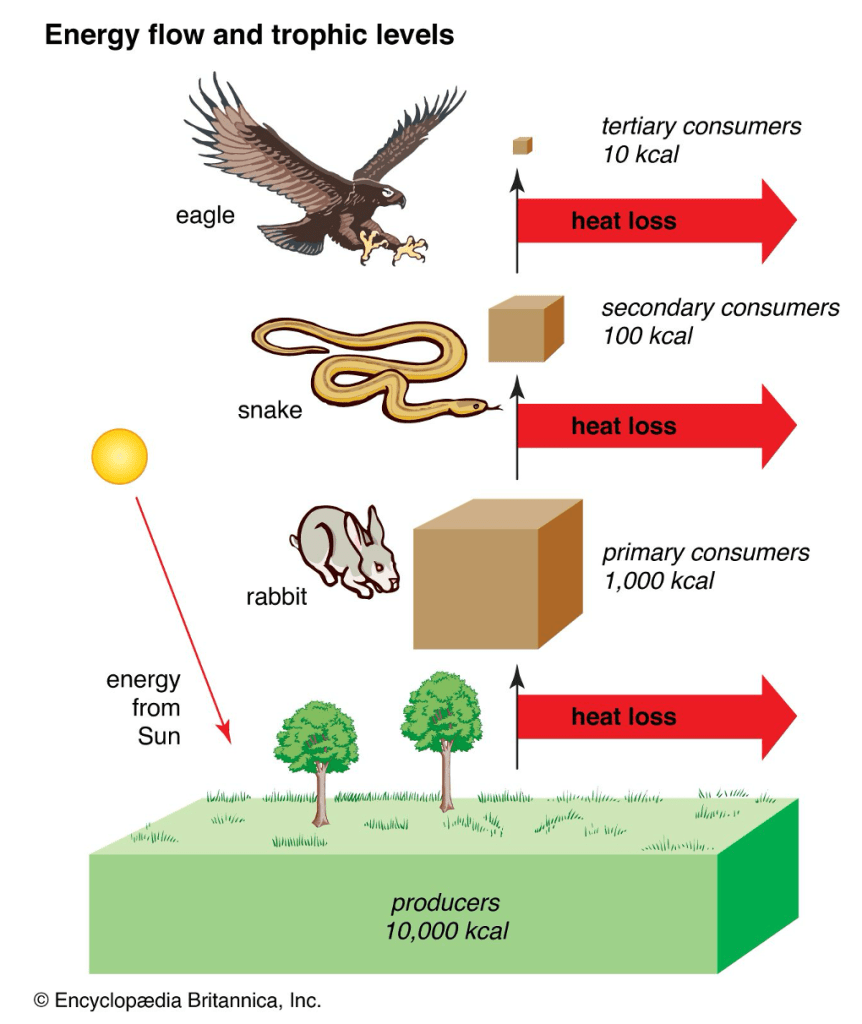
Organisms at lower trophic levels retain a larger percentage of the original energy that entered the food chain through photosynthesis. With each step up the trophic hierarchy, energy is lost as heat, undigested matter, and metabolic waste. This means that a given area of land can sustain a greater number of organisms if they consume food from lower trophic levels—either directly from plants or from herbivores that feed on crops—since less energy is lost in the transfer between levels.
For this reason, sustainability in food production is more attainable when humans prioritise consuming organisms from lower trophic levels, particularly plant-based foods. By reducing reliance on higher trophic-level organisms, such as carnivorous livestock, energy loss within the food chain is minimised, leading to more efficient resource use and a greater capacity to feed a growing global population while maintaining ecological balance.
Part 2: Efficiency and Entropy

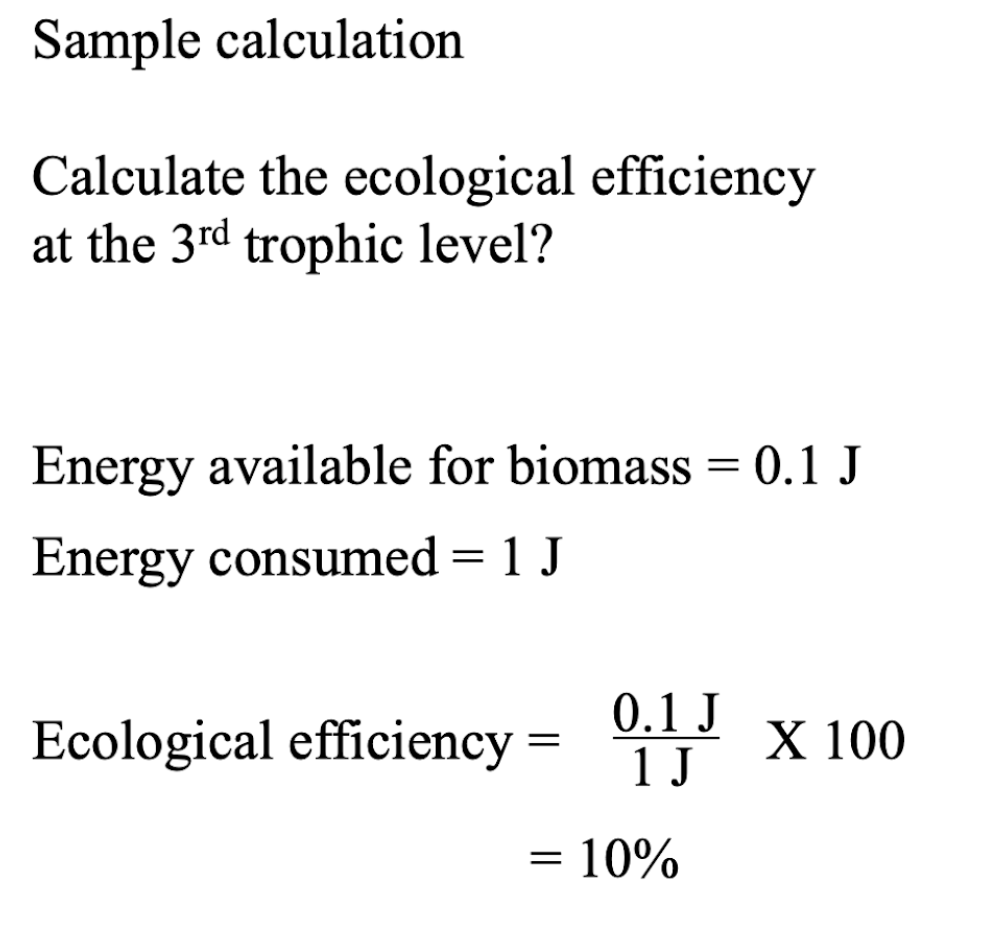
An energy-flow diagram showing the flow of energy through an ecosystem. Storages (boxes) and flows (arrows) vary in width and are proportional to the amount of energy being transferred.
Part 3: Entropy of an isolated systems
Entropy refers to disorder.
- According to the second law of thermodynamics, entropy within a system increases as biomass moves through ecosystems.
- This rise in entropy, caused by energy transformations, reduces the energy available for performing work.
- As available energy decreases, disorder (entropy) increases.
- In any isolated system, where no external energy is added, entropy naturally tends to increase.
- The universe itself can be viewed as an isolated system where entropy is constantly rising, leading to a point, billions of years in the future, when no usable energy will remain.
- Living systems maintain a high level of organisation and low entropy by promoting a net increase in entropy, primarily through processes like cellular respiration.
![ESS 8.1.3 [AHL] Biocapacity and Environmental Migration](https://mypytrclass.com/wp-content/uploads/2025/12/image-4.png?w=1024)


![ESS 8.3.4 [AHL] Photochemical Smogs and Tropospheric Ozone](https://mypytrclass.com/wp-content/uploads/2025/12/image-1.png?w=1024)
 PYTR Class