
Learning Objectives
- Outline the roles of C in the ecosystem
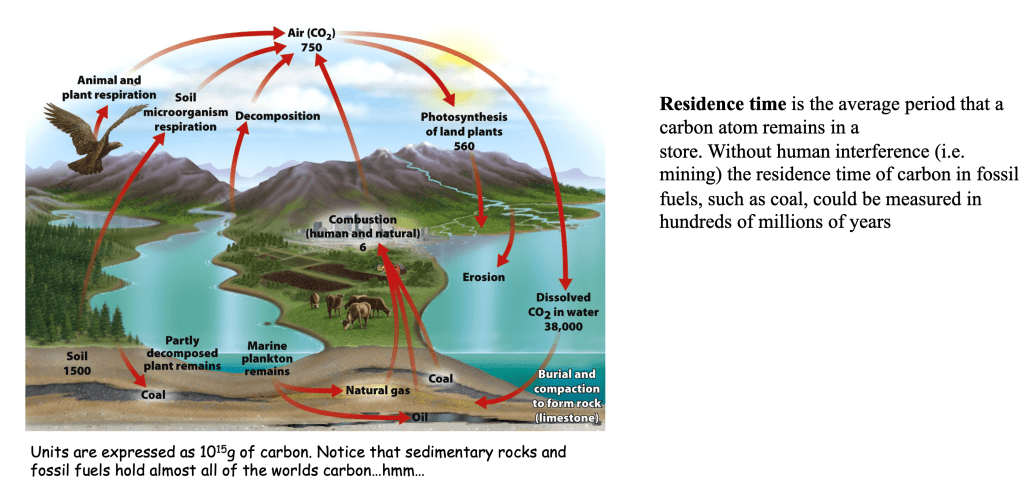
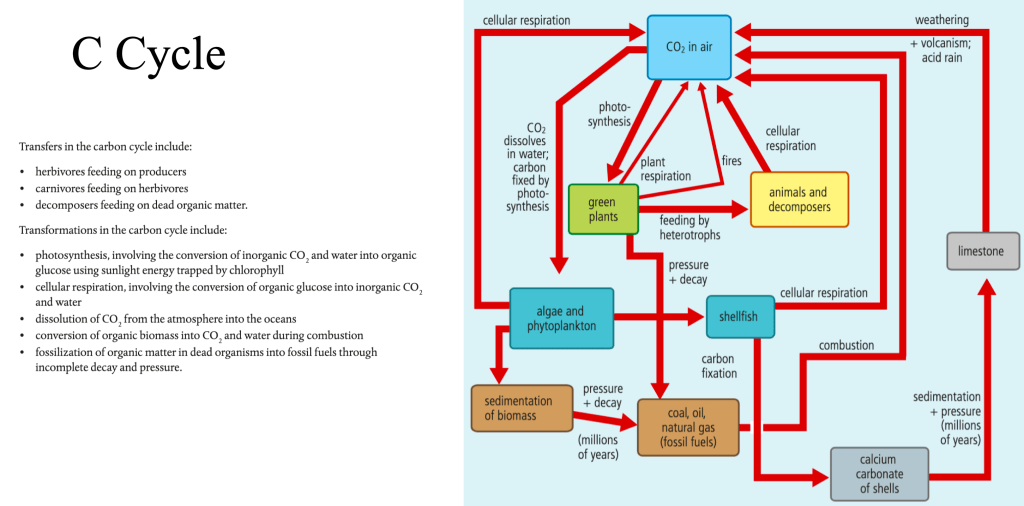
- Describe C cycle
- Outline carbon sink and sources
- Outline ocean as a carbon sink
- [AHL] Describe the lithosphere as a carbon sink
Part 1: Introduction to Biogeochemical Cycles
- Matter moves between ecosystems, biotic & abiotic environments, and organisms, unlike energy
- Biogeochemical cycling involves: Biological, geologic and chemical interactions
- Five major cycles: Carbon, Nitrogen, Phosphorus, Sulfur and Water (hydrologic)
- Cycles of nutrients in ecosystems are called biogeochemical cycles. In the IB, we are covering these in topic 2:
- carbon cycle (both SL and HL) and
- nitrogen cycle (HL only).
The cycling of nutrients is essential in the maintenance of ecosystems because nutrients provide the chemical elements needed for biological molecules.
- Carbon is needed for carbohydrates, fats and proteins
- Nitrogen is needed for proteins
The factors influencing nutrient storage and transfer include:
- The extent and type of weathering
- Overland runoff and soil erosion
- The amount of rainfall
- Decomposition rates
- The type of vegetation (woody perennial species retain nutrients longer than annuals)
- The age and health of plants
- Plant density
- The occurrence of fire
Part 2: Carbon Cycle
Activity 1
Subscribe to get access
Read more of this content when you subscribe today.
Part 3: Carbon Storage
Carbon sequestration
Carbon sequestration is the natural capture and storage of CO 2 from the atmosphere by physical or biological processes such as photosynthesis. Trees sequester carbon naturally by absorbing CO2 and converting it into biomass. Organic matter is fossilised into coal, oil and natural gas.
Ecosystems as stores, sinks or sources of carbon

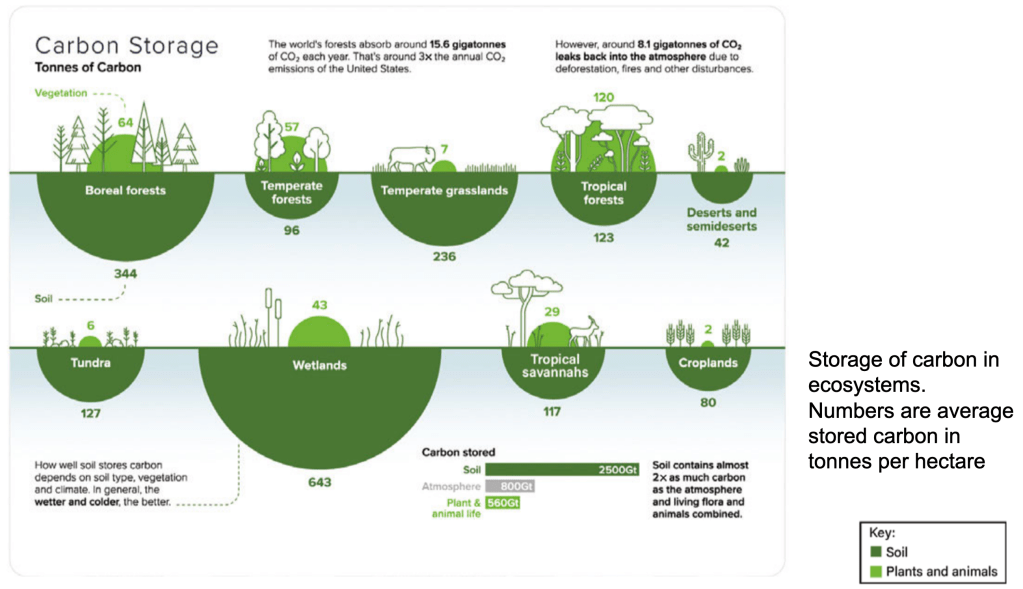
The infographic above shows that soils store more carbon than its vegetations
Oceans as a carbon sink
- CO2 moves from the atmosphere to the ocean by a process called diffusion.
- CO2 dissolved in the surface of the ocean can be transferred to the deep ocean in areas where cold dense surface waters sink.
- This process carries CO2 molecules to great depths in the ocean where they may remain for centuries.
- The level of CO2 diffusion also determines the acidity of the oceans
Ocean Acidification
- CO2 dissolves in water to form hydrogencarbonate ions and hydrogen ions, which make the water more acidic.
- Increases in the concentration of dissolved CO2 , therefore, cause ocean acidification, which in turn harms marine animals
- Coral reefs are made of calcium carbonate (CaCO3).
- A decrease in pH, meaning an increase in acidity, can lead to reduced calcification rates and destruction of coral reefs as the acid reacts with the alkali coral skeleton.
- Small decreases in pH can also interfere with calcium carbonate deposition in aquatic mollusc shells, which are also made from calcium carbonate
Alleviating the effects of human activities
on the carbon cycle
- Low carbon technologies. These are renewable energy resources such as solar heating, air-source heat pumps, ground-source heat pumps, biomass heating, solar panels, photovoltaics (PV), and wind turbines.
- Reduction in the use of fossil fuels. A reduced combustion of fossil fuels will reduce CO2 emissions.
- Reduction in soil disruption. The majority of carbon in ecosystems is stored in soil, so conserving soils is an important way of reducing carbon emissions.
- Reduction in deforestation. Trees are an important store and sink of carbon, so
- maintaining forest ecosystems maintains the equilibrium of the carbon cycle.
- Carbon capture through reforestation and artificial sequestration. Carbon capture is the process of capturing CO2 and depositing it where it will not enter the atmosphere
Part 4: The Lithosphere as a Carbon Sink
Subscribe to get access
Question: Describe The Lithosphere as a Carbon Sink
![ESS 8.1.3 [AHL] Biocapacity and Environmental Migration](https://mypytrclass.com/wp-content/uploads/2025/12/image-4.png?w=1024)



![ESS 8.3.4 [AHL] Photochemical Smogs and Tropospheric Ozone](https://mypytrclass.com/wp-content/uploads/2025/12/image-1.png?w=1024)
 PYTR Class