
Learning Objectives
- Summarise the distribution of biomes
- Explain the tricellular model of atmospheric circulation
- Outline how the ocean currents distribute the resulting heat around the world
Part 1: Climate vs Weather
Distinguishing Climate and Weather
- Climate influences the distribution of organisms in the biosphere and refers to the long-term patterns and extremes of atmospheric conditions over a period of approximately 30 years. It includes factors such as temperature, rainfall, wind patterns, humidity, cloud cover, and air pressure.
- In contrast, weather describes the short-term state of the atmosphere, ranging from a single moment to a period of a few days to a week. It considers the same atmospheric variables as climate but over a much shorter timeframe.
- Both climate and weather are influenced by factors such as atmospheric and ocean circulation, latitude, altitude, distance from the sea, prevailing winds, aspect, and human activities.
- Until the end of 2020, the widely accepted reference period for calculating climate statistics was 1981–2010, a 30-year timeframe deemed sufficient for identifying long-term trends. However, this approach has been questioned for several reasons:
- The 30-year dataset is too short to capture long-term climate variability.
- The 1981–2010 period was a time of climate change, making it less representative of stable historical trends.
- A 30-year record is insufficient to estimate rare extreme events, such as 50-year maximums or 100-year return events, which require a longer dataset for accurate prediction.
Part 2: Distribution of Biomes
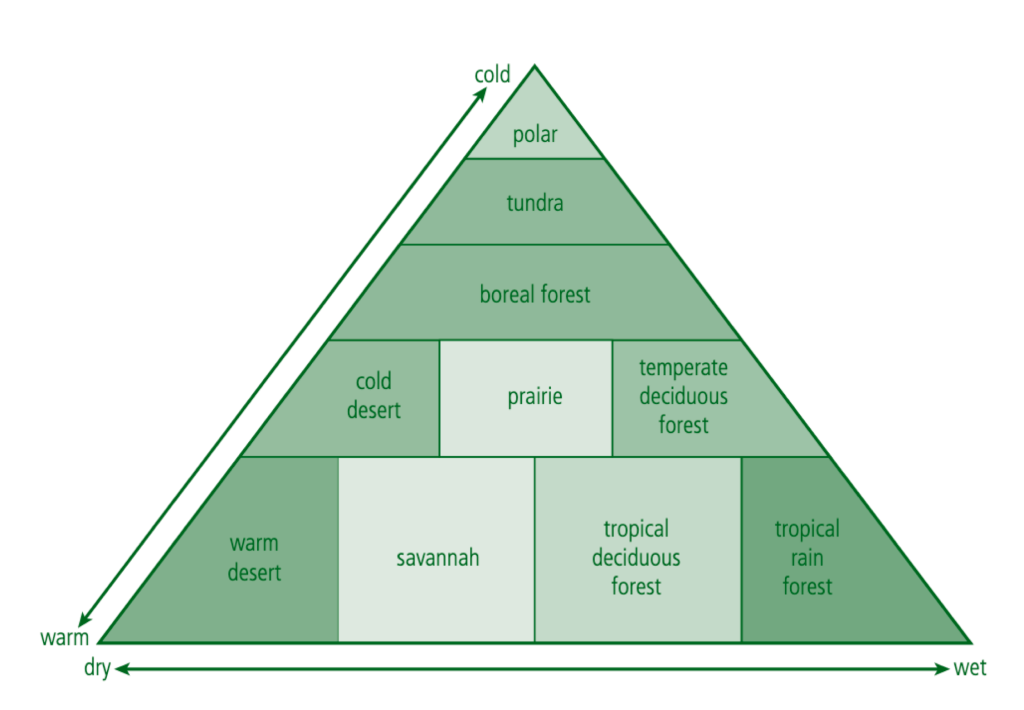
Biomes
Tropical Rainforests
Tropical rainforests experience constant high temperatures (around 26°C) and heavy rainfall (over 2500 mm per year), creating ideal conditions for plant growth. Found near the equator between the Tropics of Cancer and Capricorn (23.5° N and S), they receive consistent sunlight year-round, leading to high photosynthesis and net primary productivity (NPP). These forests contribute 40% of global terrestrial NPP. They host an exceptionally high biodiversity, with some areas containing up to 480 tree species per hectare, compared to only a few species in temperate forests. Despite their productivity, nutrients are mainly stored in trees, while soil nutrients are quickly recycled. However, deforestation and logging disrupt this cycle, causing soil erosion and loss of biodiversity, which can take thousands of years to recover.
Temperate Forests
Temperate forests occur between 40° and 60° N in regions with seasonal variations in temperature and sunlight. These forests contain evergreen trees, which retain leaves year-round, and deciduous trees, which shed leaves in winter to survive frost. Rainfall varies between 500 and 1500 mm per year, and the climate influences whether the area supports forest or grassland. Productivity is lower than in tropical rainforests due to a shorter growing season, but temperate forests still rank second in global NPP. These forests have fewer tree species than tropical rainforests, often being dominated by just a few species. Their structure is simpler, with less vertical stratification, resulting in fewer ecological niches and lower biodiversity. Unlike tropical rainforests, nutrients are not limiting, as leaf litter decomposes efficiently, enriching the soil.
Deserts
Deserts, covering 20–30% of Earth’s land surface, are located around 30° N and S, where dry air descends after losing moisture over the tropics. These regions have extremely high daytime temperatures (up to 49°C) and very low precipitation (under 250 mm per year). Nights can be cold, sometimes reaching 0°C, creating challenging survival conditions. The lack of water limits photosynthesis, leading to low productivity and sparse vegetation. Desert plants, such as cacti, have xerophytic adaptations like water-storing stems, reduced leaves (spines), deep or extensive root systems, and thick cuticles to minimize water loss. Desert soils are nutrient-rich but lack moisture, and decomposition is slow due to arid conditions. Animal life is highly adapted, with reptiles and burrowing mammals being the most common due to their ability to conserve water and tolerate extreme temperatures.
Tundra
Tundra is found at high latitudes where low insolation and freezing temperatures dominate most of the year. Water is often locked in ice, making it scarce for plant growth. Low light levels, cold temperatures, and little precipitation restrict photosynthesis and productivity. Soil is often covered by permafrost, limiting plant root penetration and nutrient cycling. Peat bogs store large amounts of carbon due to slow decomposition. Arctic tundra, mainly found in the North Polar region, experiences harsh winters (as cold as –50°C), leading to minimal biological activity. In summer, 24-hour sunlight increases temperatures, allowing for a brief growing season (around 6 weeks). Vegetation consists of small, hardy plants like mosses and grasses, while animals have adaptations such as thick fur and large body sizes to minimize heat loss.
Grasslands
Grasslands, covering 16% of Earth’s surface, occur where precipitation is too low for forests but high enough to prevent desert formation. They exist in both temperate (e.g., Great Plains, Russian Steppes) and tropical regions (e.g., African Savannah). Positioned where Polar and Ferrel cells meet, they receive moderate rainfall, balanced with evaporation. Decomposing plant matter enriches the soil, but cooler climates slow decomposition. Many grasses survive by growing beneath the soil surface, remaining dormant in winter and resuming growth when conditions improve.
Part 3: Tricellular Model of Atmospheric Circulation
Question: Explain how abiotic factors can be affected by the tricellular atmospheric circulation
Read more of this content when you subscribe today.
Part 4: Ocean Currents
The oceans cover roughly 70% of the Earth’s surface and play a crucial role for humans. They influence climate by regulating atmospheric conditions. Warm ocean currents carry water from the equator toward the poles, while cold currents move water from cold regions to the equator. For example, the Gulf Stream transports 55 million cubic meters of water per second from the Gulf of Mexico to north-west Europe. Without it, the region would have a climate closer to sub-Arctic conditions. The cold Peru current brings nutrient-rich waters to the surface due to offshore winds. Additionally, the ocean’s global conveyor belt circulates water, transferring heat from tropical areas to colder regions.
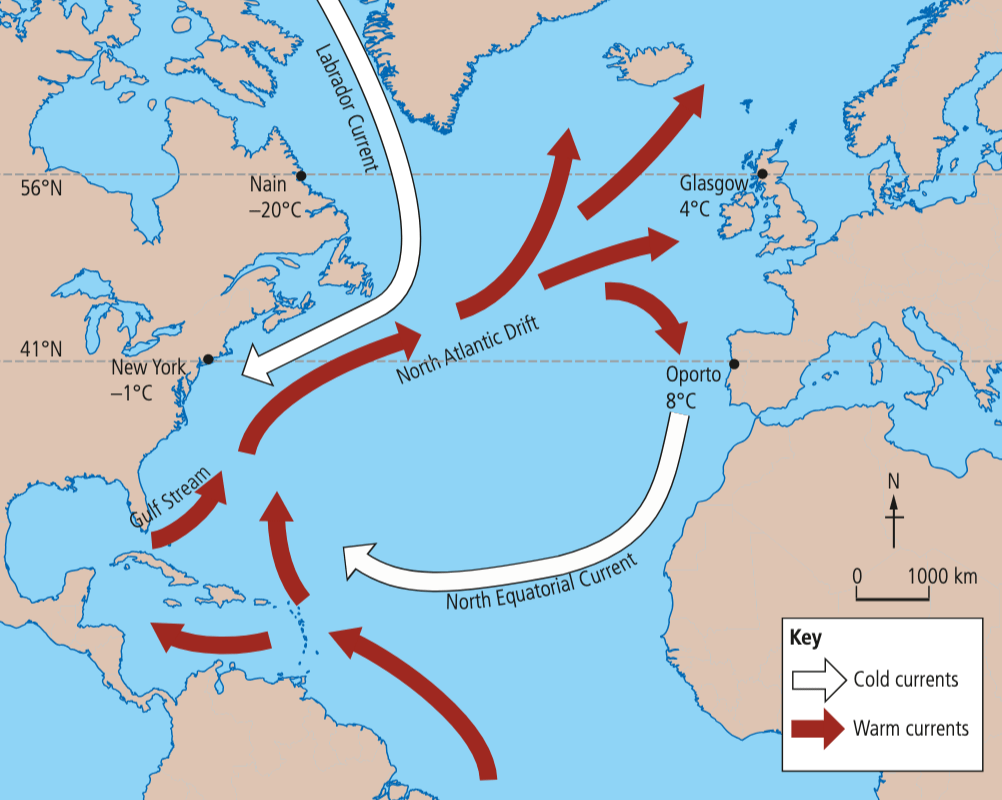
Subscribe to get access to the AHL level: The Conveyor Belt
Read more of this content when you subscribe today.
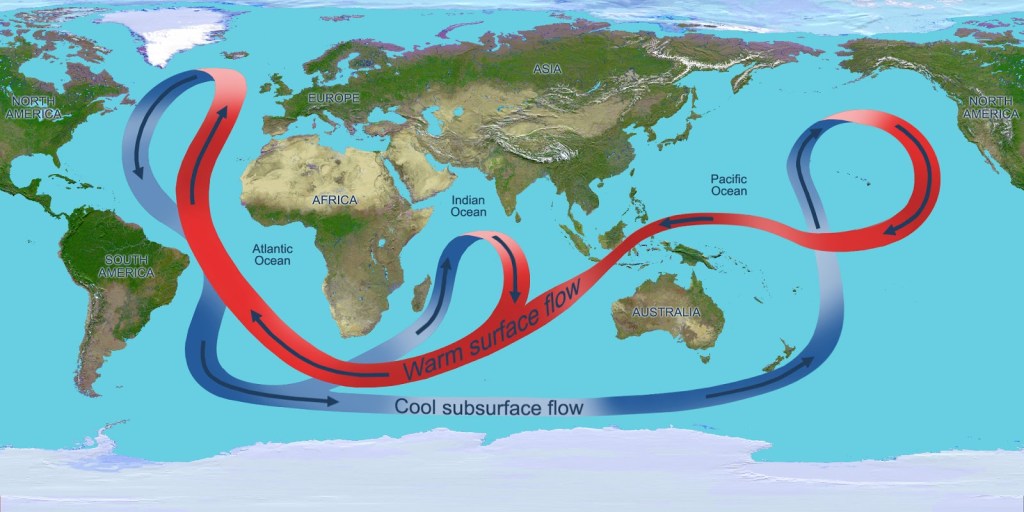
Learning Material
Subscribe to get access
Read more of this content when you subscribe today.
![ESS 8.1.3 [AHL] Biocapacity and Environmental Migration](https://mypytrclass.com/wp-content/uploads/2025/12/image-4.png?w=1024)



![ESS 8.3.4 [AHL] Photochemical Smogs and Tropospheric Ozone](https://mypytrclass.com/wp-content/uploads/2025/12/image-1.png?w=1024)
 PYTR Class