
Learning Objectives
- Analyse how global warming is leading to shifts in biomes
- Outline 3 general patterns of climate types
Global warming is leading to shifts in biomes
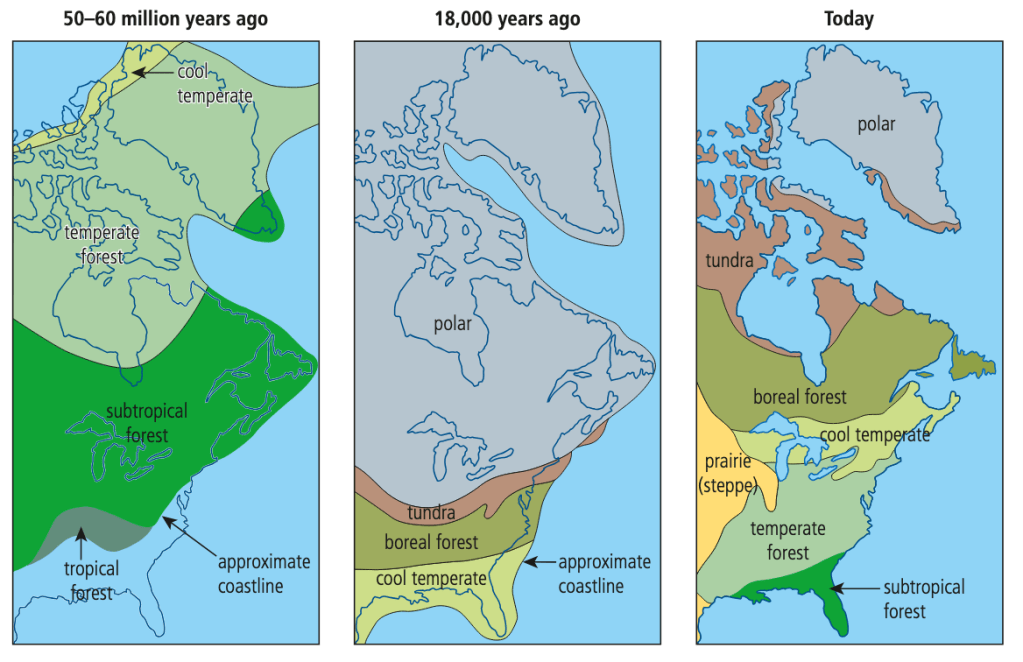
The distribution of biomes is influenced by factors such as temperature, sunlight, and precipitation. An increase in CO2 and other greenhouse gases raises the average global temperature (Topic 6), which subsequently impacts rainfall patterns. These climatic changes, in turn, affect the distribution of biomes.
Studying climate change in Earth’s geological history helps us understand how biomes might shift with rising global temperatures in the future. Models predict that biomes will undergo a latitudinal shift, moving north or south relative to the equator. Additionally, biomes will likely migrate up mountain slopes (altitudinal shift). Low-lying biomes, like mangroves, may be lost as a result of rising sea levels.

- Climate change can result in shifts in weather patterns and rainfall, affecting both quantity and distribution.
- Climates may become more extreme and unpredictable, with more frequent severe weather events (e.g., hurricanes) as atmospheric patterns are disrupted.
- Agriculture will be impacted, as droughts reduce crop yields and decreasing water resources make irrigation more difficult in many areas.
- Crop-growing areas may shift, with movements occurring north and south from the equator.
- Recent models predict significant changes to wheat-growing regions in the USA, with many becoming unviable by 2050, potentially harming the economy.
- Changes in crop types may be necessary, and alterations in water resources could either limit or enhance crop production depending on the region and local weather conditions.
Three general patterns of climate types
Climate varies widely across the globe, with distinct climate types influenced by latitude, which affects temperature and rainfall. Three general climate patterns are linked to biome types:
- Tropical: Found near the equator, between the Tropics of Cancer and Capricorn, characterised by high temperatures and rainfall. Tropical rainforests are located in regions such as South America, Africa, northern Australia, and Southeast Asia.
- Seasonal: These regions receive high rainfall (over 1000 mm annually) but experience a distinct dry season. Examples include forests in the Congo, Central America (Panama and Nicaragua), the Indian subcontinent, Indochina, and northern Australia.
- Equatorial: Characterised by consistently high temperatures and monthly rainfall of at least 60 mm, with annual precipitation often exceeding 2000 mm. These areas have greater diurnal temperature variation than annual temperature variation and lack distinct seasons, although some periods may be wetter than others.
- Temperate: These regions have moderate mean annual temperatures, with warmest months above 10°C and coldest months above -3°C. They experience four seasons with significant temperature changes between summer and winter. Temperate climates are found in western Europe, parts of the USA, eastern China, Argentina, southeastern Brazil, and eastern Australia. Subtypes of temperate climates include:
- Maritime (mild, wet winters and dry summers)
- Continental (greater temperature extremes, found in the interior of continents like Russia and Canada).
- Polar: Cold regions where temperatures don’t exceed 10°C in any month. These areas are often windy, with little precipitation and long cold winters. Found primarily in the Arctic and Antarctic, as well as northern Canada, Russia, Greenland, and high-altitude regions like the Himalayas. Only small plants such as mosses and lichens can survive here. Polar biomes support animals that feed on aquatic organisms, such as polar bears in the North and penguins in the South. Tundra biomes, located above the tree line and below the Arctic ice cap, feature permafrost and nutrient-limited soils.
Climate zones track changes in conditions and help us understand the distribution of plants and animals, identifying species at risk from habitat loss. They also guide farmers and gardeners in choosing the best plants for their regions. The biome expected based on temperature and rainfall patterns may not form as anticipated due to secondary factors or human activities such as logging, habitat destruction, agriculture, the loss of apex predators, or pollution.
Bingo Game
Learning Material
Activity
Subscribe to get access
Read more of this content when you subscribe today.
![ESS 8.1.3 [AHL] Biocapacity and Environmental Migration](https://mypytrclass.com/wp-content/uploads/2025/12/image-4.png?w=1024)



![ESS 8.3.4 [AHL] Photochemical Smogs and Tropospheric Ozone](https://mypytrclass.com/wp-content/uploads/2025/12/image-1.png?w=1024)
 PYTR Class