
Learning Objectives
- Describe the term zonation
- Outline the use of transect to investigate zonation
- Describe the process of succession
- Describe the term “seral stages” and “climax community”
- Explain the changes in succession time
Zonation
“Zonation describes the variation in biological communities along an environmental gradient”
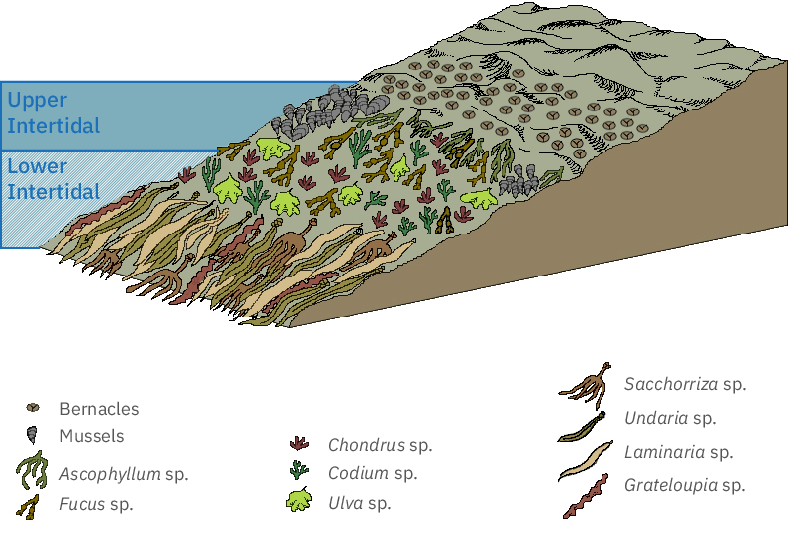
On rocky shores, distinct zones extend from the lower to the upper shore, each characterised by specific plant and animal distributions.
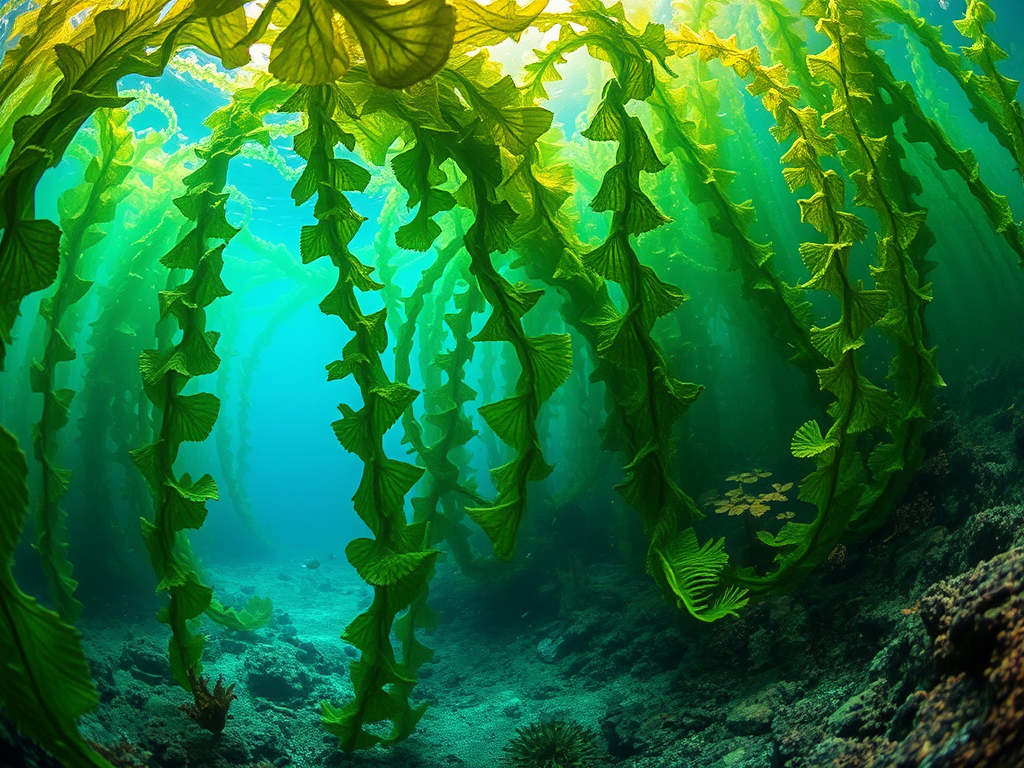
Example: Seaweeds, in particular, exhibit clear zonation patterns
- Species that are more resistant to water loss, such as channel wrack, thrive on the upper shore.
- Species that are less tolerant of desiccation, like kelp, are found on the lower shore, where they remain submerged for longer periods.
Using Transect to Investigate Zonation
- Zonation measurement involves recording biotic and abiotic factors at fixed heights along a transect.
- A transect is established using a long tape measure, running along the vertical gradient of study (across different zones).
- A cross staff is used to move a set vertical distance (e.g., 0.6 m) up the transect.
- The staff is placed vertically at each sample location, and a sighting point at 0.6 m above the ground is used to determine the next sampling point.
- Biotic and abiotic factors are recorded at each height interval along the gradient.
Succession
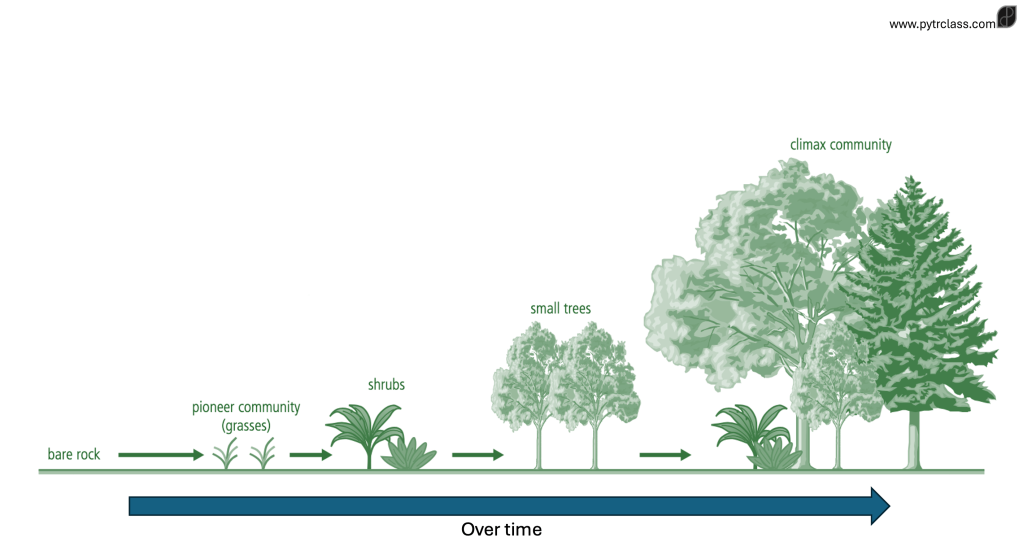
Ecosystems are dynamic systems that undergo changes in community composition over time and across different environmental gradients. These variations can be influenced by factors such as altitude, latitude, or proximity to the sea on a rocky shore, leading to spatial changes in biodiversity. Additionally, ecosystems evolve as they develop from early stages to more complex and stable communities, which represents a temporal change.
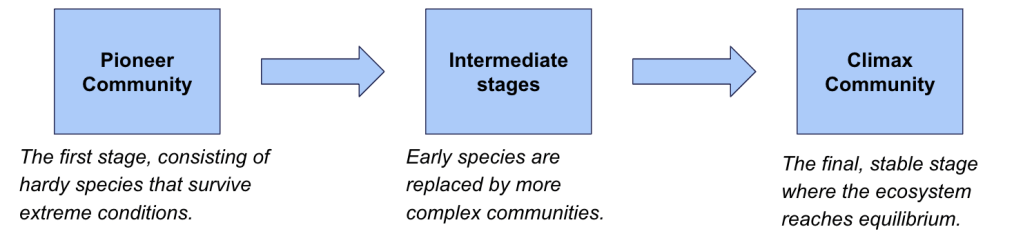
One of the most significant long-term ecological processes is succession, which describes the gradual development of an ecosystem from an uncolonized or disturbed state to a more stable and mature community. Succession is categorized into distinct stages, with each stage referred to as a seral stage. The pioneer community represents the first stage of succession, consisting of hardy species that can survive extreme environmental conditions. As succession progresses, these early species are replaced by more complex communities, culminating in the climax community—the final, stable stage in which the ecosystem reaches equilibrium.
Types of Succession
Succession can occur in two main forms:
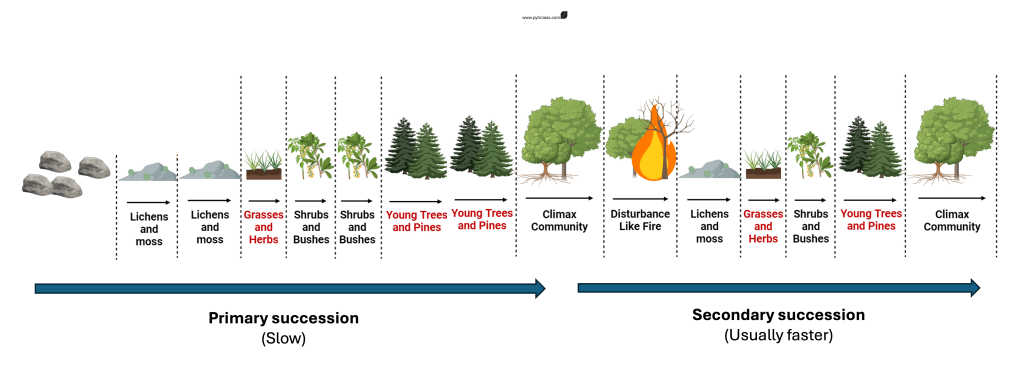
- Primary Succession – This occurs on previously uncolonized surfaces, such as newly formed volcanic rock or glacial deposits. In these environments, there is no pre-existing soil, and life begins with pioneer species like lichens and mosses, which can withstand harsh conditions.
- Secondary Succession – This takes place in areas where an existing community has been disturbed or destroyed, such as after a forest fire, flood, or human activity. Since soil and seed banks are already present, secondary succession happens much faster than primary succession.
Soil and Nutrient Accumulation
As succession advances, the amount of organic matter in the ecosystem increases. This occurs due to the decomposition of plants and organisms, which enriches the soil with nutrients. Soil-dwelling organisms, such as earthworms, help break down dead plant material, enhancing soil structure and moisture retention. The accumulation of organic matter creates richer, more fertile soil, supporting a greater diversity of plant and animal life.
Succession is a fundamental ecological process that drives the gradual transformation of ecosystems over time. Whether occurring in newly formed landscapes (primary succession) or recovering disturbed environments (secondary succession), this process follows a predictable sequence of species replacement, soil formation, and increasing biodiversity. Through succession, ecosystems become more complex, stable, and resilient, ultimately reaching a climax community that reflects the long-term equilibrium of the environment.
Seral Stages and Climax Community
Seral Stages in Succession
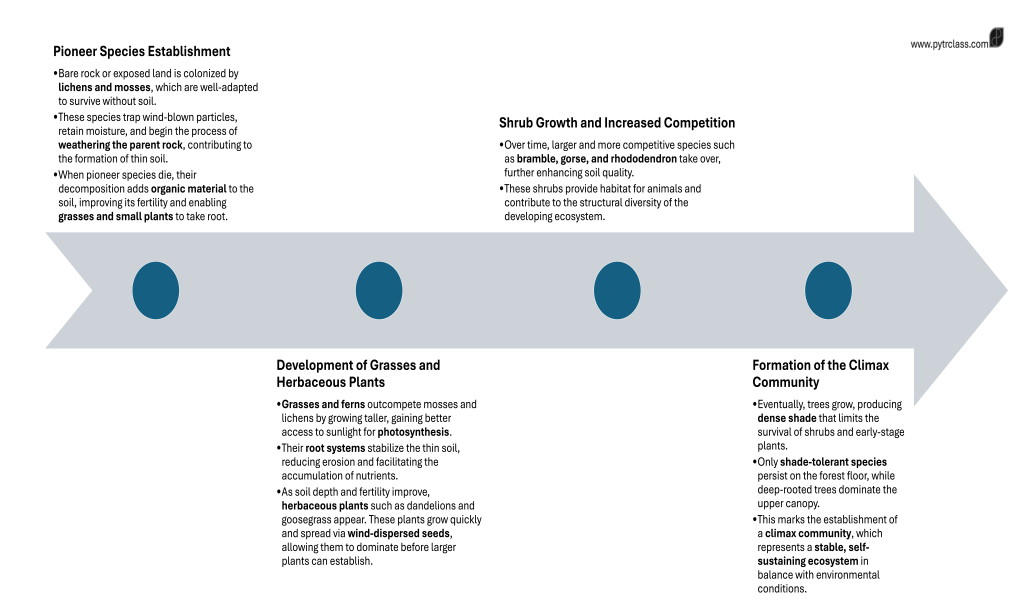
- Each transitional community within an ecological succession is known as a sere.
- As succession progresses, each seral stage modifies the environment in a way that facilitates the establishment of the next community.
- This transition occurs through competition between species, ultimately leading to the formation of a stable climax community.
For example, mosses contribute to soil formation on bare rock, gradually creating conditions that support the growth of larger plants. Over time, these changes enable a more diverse and complex ecosystem to develop.
Climax Communities and Ecosystem Stability
Ecosystem stability refers to an ecosystem’s ability to withstand and recover from changes. Most ecosystems function as negative feedback systems, meaning they have built-in mechanisms that regulate ecological balance and prevent destabilisation.
Ecosystems that reach the later stages of succession tend to be more stable due to their greater species diversity and complex food webs. This complexity provides resilience, as species can switch to alternative food sources if their primary food supply declines. Additionally, as succession advances, organic matter accumulates, enriching the soil and supporting nutrient cycling in a self-sustaining manner.
A climax community maintains a state of steady-state equilibrium, where inputs and outputs of matter and energy continue, but the overall system remains relatively constant.
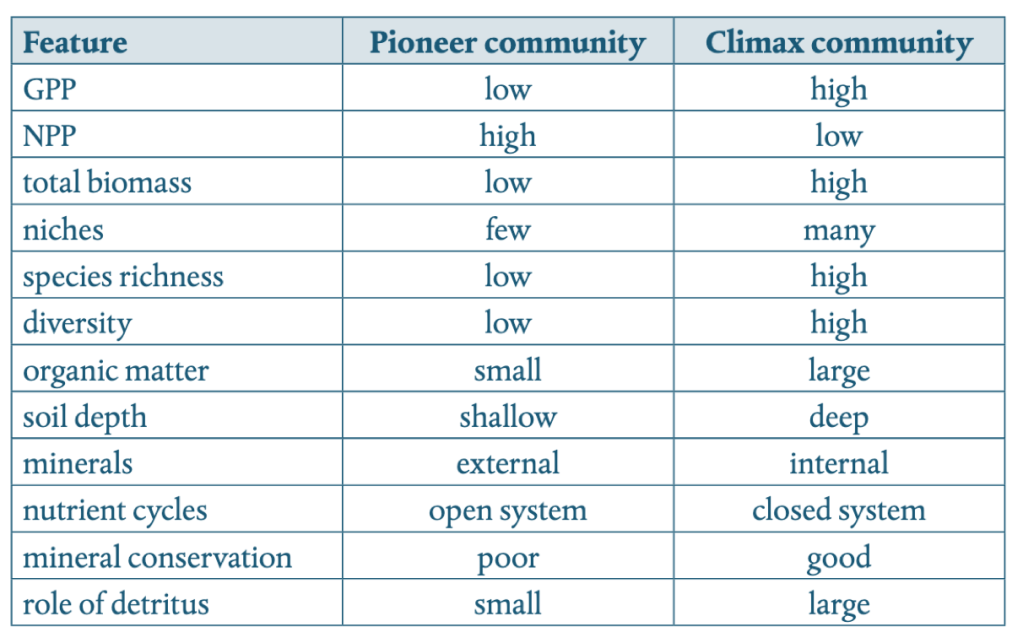
Compared to earlier stages of succession, a climax community is characterized by:
- Greater biomass
- Higher species diversity
- Improved soil conditions (e.g., increased organic matter and deeper soil)
- Enhanced soil structure, leading to better water retention and aeration
- Taller and longer-living plant species
- Increased community complexity and stability
- Diverse habitats
- Maintenance of steady-state equilibrium
Alternative Stable States
There is no single climax community for a given ecosystem. Instead, ecosystems can exist in multiple stable states, influenced by factors such as climate, soil properties, and random natural events over time. These variables shape the final composition of a mature ecosystem, meaning that different regions may develop distinct climax communities under similar conditions.
Different types of succession occur depending on the specific environment being colonised:
- Lithosere – Succession that takes place on bare rock.
- Hydrosere – Succession occurring in freshwater habitats.
- Xerosere – Succession that develops in dry environments, such as sandy areas.
| Feature | Pioneer Community | Climax Community |
|---|---|---|
| Definition | First community to colonize a barren or disturbed area | Final, stable, and self-perpetuating community in ecological succession |
| Species Composition | Few, simple, hardy species (e.g., lichens, mosses, grasses) | Many complex, well-adapted species (trees, shrubs, diverse animals) |
| Adaptations | Tolerate extreme conditions, fast growth, rapid reproduction | Specialised adaptations, slower growth, efficient resource use |
| Biodiversity | Low | High |
| Soil Quality | Poor soil; little organic matter | Rich, well-developed soil with high humus content |
| Nutrient Cycling | Slow and inefficient | Rapid and efficient nutrient recycling |
| Energy Flow | Low energy capture; simple food chains | High energy capture; complex food webs |
| Vegetation Structure | Simple structure, low biomass | Complex structure with multiple layers and high biomass |
| Environmental Conditions | Harsh, unstable (extreme temperatures, limited water) | Favourable, stable microclimate |
| Ecological Stability | Low stability; community easily disturbed | High stability; resistant to environmental changes |
| Timeframe | Early stage of succession; short-lived | Final stage of succession; long-lasting and stable |
Subscribe to get access the 2.5.1 Zonation and Succession exercise
Class Exercise with Marking Scheme
Explanation of Changes in Succession Time
Soil consists of inorganic and organic components, water, and air. Inorganic materials come from rock weathering, while organic matter includes living organisms and decayed material. In primary succession, soil is initially absent. Pioneer plants break down rock and contribute organic matter as they decompose, forming the first soil layers. As succession continues, increased biomass enhances soil development, allowing larger plants to take root and stabilise the ecosystem.
In early succession, mineral cycling is an open system, with elements like carbon and nitrogen entering and leaving the ecosystem. As succession progresses, nutrient cycling becomes more closed, with minerals cycling within the system. Nutrients move from the soil to living organisms and return through decomposition, sustaining the ecosystem.
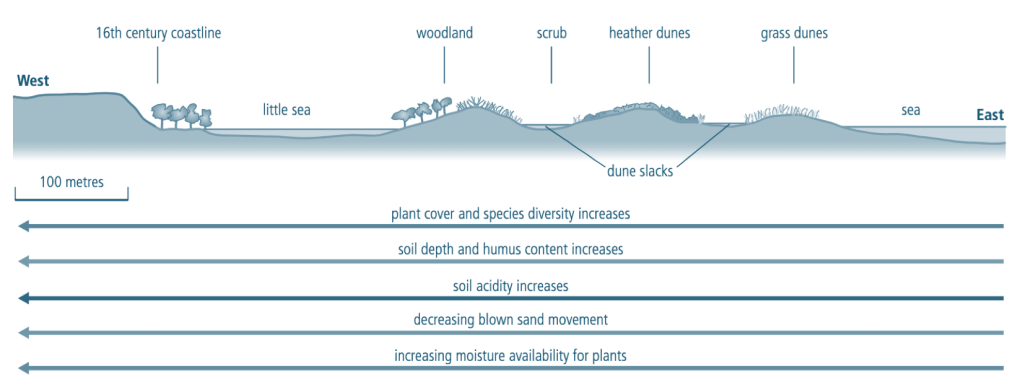
Succession increases diversity, enhancing resilience and stability. Human Interference can disrupt succession, reducing resilience and stability.
Ecosystem Stability & Resilience is an ecosystem’s ability to tolerate disturbances depends on its diversity and resilience. Resilience is defined as the capacity of a system to resist tipping points and maintain stability through equilibrium. Factors Influencing Resilience:
- Diversity: A higher number of species increases resilience.
- Storage Size: Larger resource storages slow down ecosystem shifts.
Human Impact: Reducing diversity and storages lowers resilience. Example – Tropical Rainforests:
- High biodiversity makes them resilient.
- Logging and fires reduce resilience, causing slow recovery.
Example – Natural Grasslands:
- Low diversity but high resilience due to underground nutrient storage.
- Recover quickly after fires.
- Fires and elephants help maintain grasslands by preventing forest encroachment.
Notes and Quiz
![ESS 8.1.3 [AHL] Biocapacity and Environmental Migration](https://mypytrclass.com/wp-content/uploads/2025/12/image-4.png?w=1024)



![ESS 8.3.4 [AHL] Photochemical Smogs and Tropospheric Ozone](https://mypytrclass.com/wp-content/uploads/2025/12/image-1.png?w=1024)
 PYTR Class