
Learning Objectives
- Define and distinguish between the properties of elements, compounds and mixtures (types of mixtures and separation techniques)
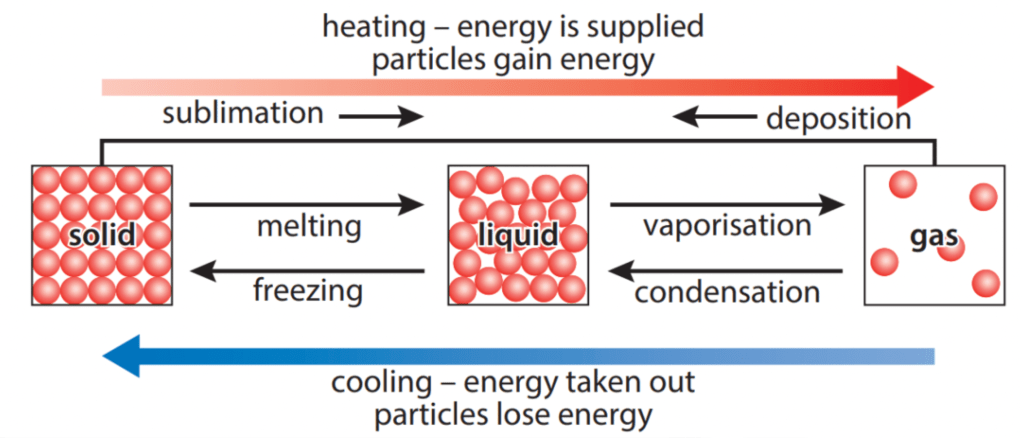
- Distinguish the different states of matter and explain the process interchanging the states
- Interpret the observable changes in physical properties and temperature during changes of state
- H ∝ KE of particles
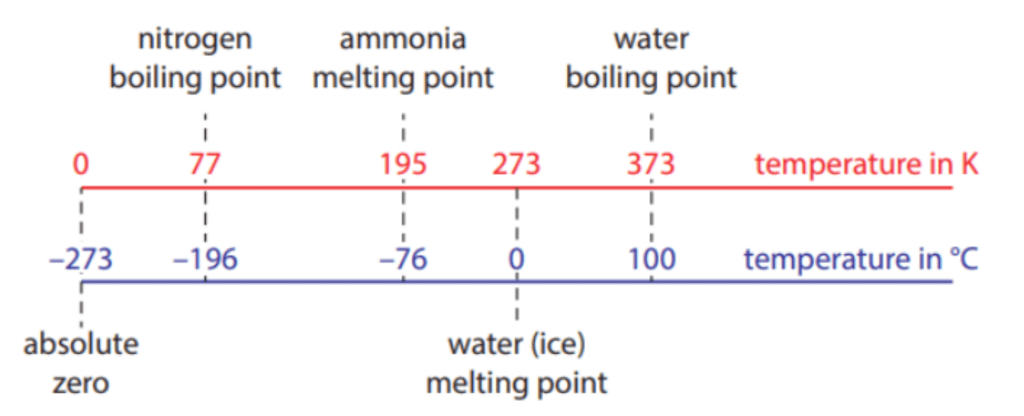
- Convert K to oC
- Use state symbols (s, l, aq, g) in chemical equations
Part 1: Elements, Compounds and Mixtures
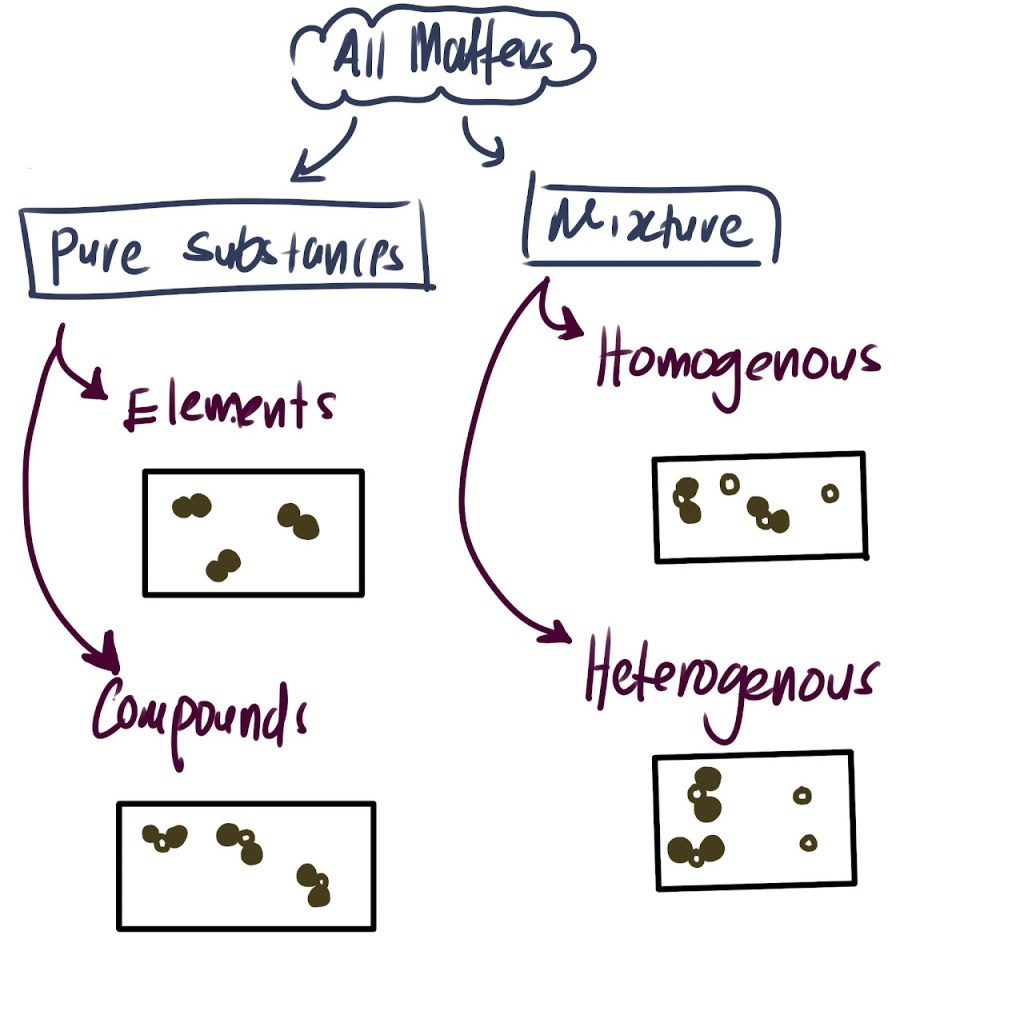
All matters can be found in two major compositions:
- Pure substances
- Pure substances can exist in their elemental forms or as compounds
- Elements are the simplest unit of all matters which cannot be chemically broken into smaller matters. Each element has its own chemical symbol
-
- Note that atoms can be broken down into smaller subatomic matters by nuclear reactions. This is not a chemical reaction
- Compounds are made by chemically bonded atoms of different elements in a fixed ratio.
- This ratio is used in the chemical formula. For example, the ratio of sodium to chlorine in its salt is 1:1 ratio. Hence the chemical formula of sodium chloride is NaCl
- Mixtures
- Mixtures are formed when a substance mixes with another substance but unable to form a new compounds
- As the result, the two components co-exist.
- The two components may be able to interact with each other resulting in a homogenous (even) distribution. This is now called a solution.
-
- Homogenous mixture in liquid phase often exhibit clear or see through property. For example, sugar (sucrose) solution is a clear colourless solution.
- Homogenous mixture in solid state is called solid solution. It occurs when solid components are uniformly or systematically distributed in the network. This can occur in ionic lattice (such as doped semiconductors) and metallic structure (such as alloys)
- If the two components cannot interact and rather repel each other, two separate phases can be observed. This is called heterogenous mixture.
-
- Heterogenous mixture in liquid phase often exhibit non-see through or opaque (cloudy or milky) property. For example, milk is a heterogenous mixture as the components in milk (lactose, protein, fat and others) cannot interact
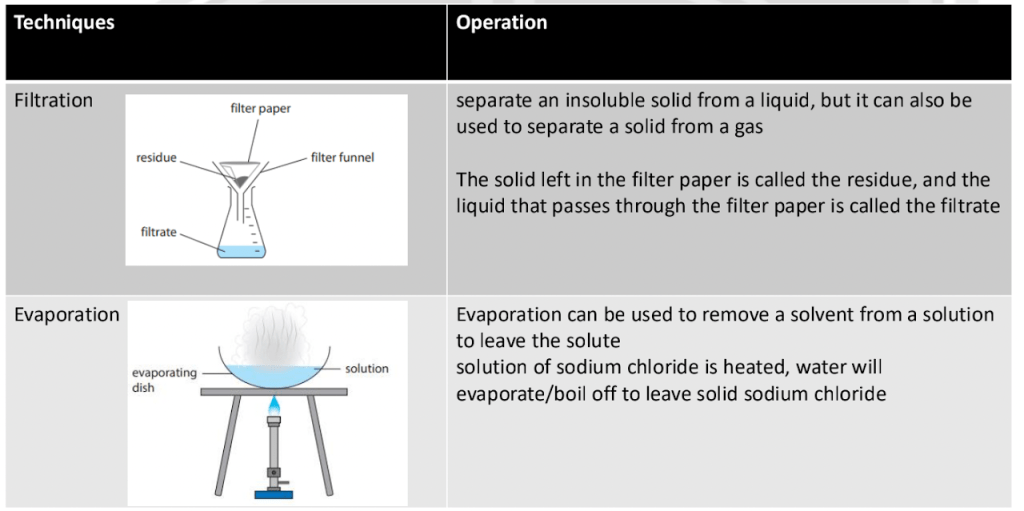
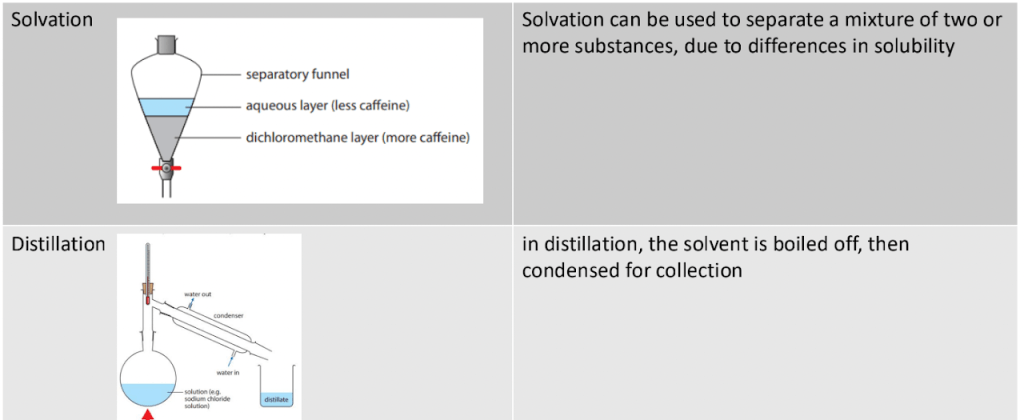
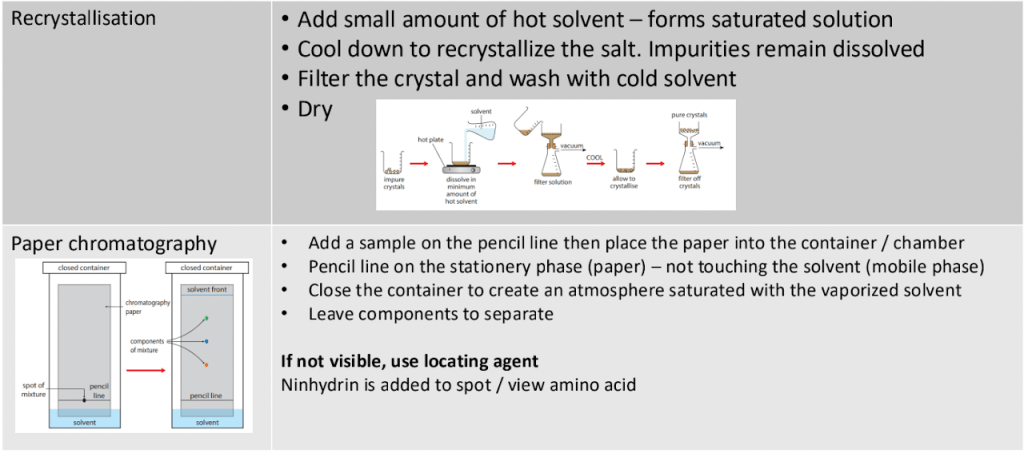
- All mixtures can be separated using separation techniques.
Part 2: Separation Techniques
Part 3: States of Matter
Kinetic Molecular Theory
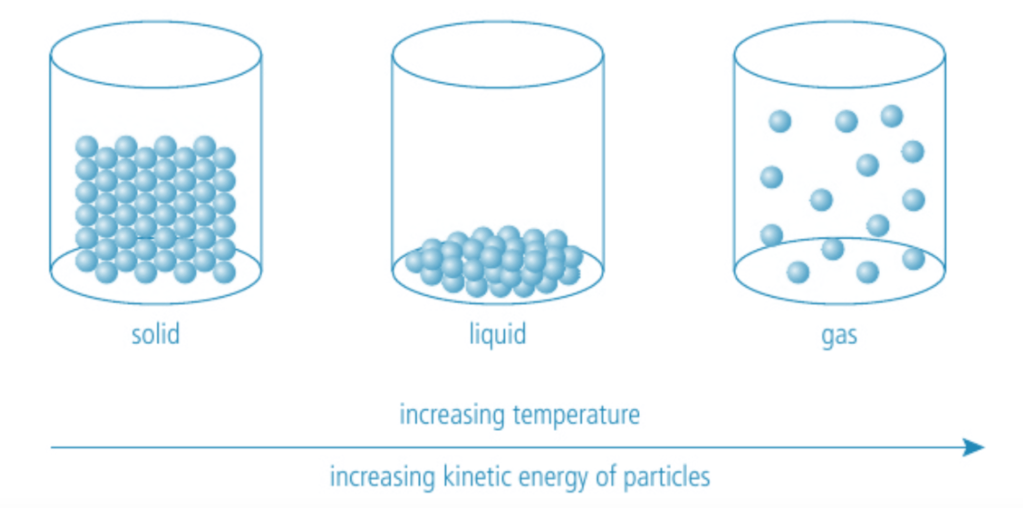
| Property | Solids | Liquids | Gases |
|---|---|---|---|
| Distance between particles | Close together | Close but further apart than in solids | Far apart |
| Arrangement | Regular | Random | Random |
| Shape | Fixed shape | No fixed shape; takes the shape of the container | No fixed shape; fills the container |
| Volume | Fixed | Fixed | Not fixed |
| Movement | Vibrate | Move around each other | Move around in all directions |
| Speed of movement | Slowest | Faster | Fastest |
| Energy | Lowest | Higher | Highest |
| Forces of attraction | Strongest | Weaker | Weakest |
Heating Curve
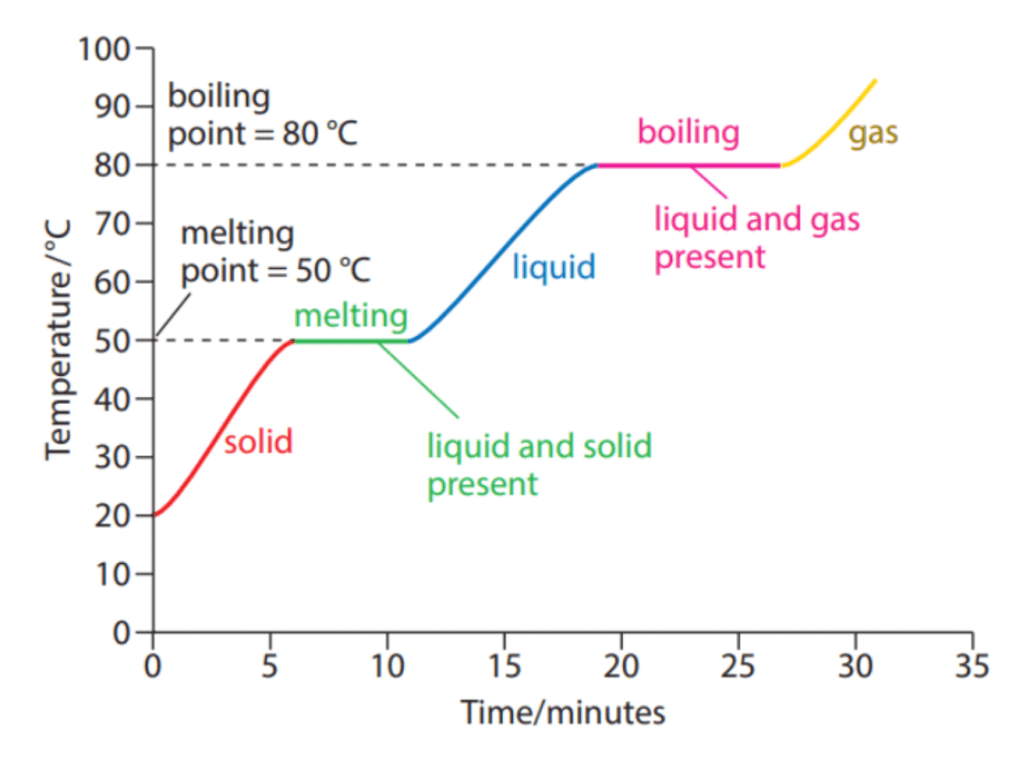
This graph is a heating curve. It shows the states of a substance when progressively heated from low to high temperature.
- At the start, the substance reached 20oC in solid state. The heating started and the particles of the solid started to absorb the energy. The solid increased its temperature while maintaining its state – solid. The energy was not sufficient to break the bonding in the solid state until it reaches 50oC.
- 50oC is when the solid started to melt. This is the melting point of the substance. Some of the particles may still exist in solid form but soon will melt as the heating is continued.
- When all the solid has melted, the liquid form can now start absorbing even higher energy (increasing the temperature) until it reaches the boiling point of the substance. In this case, it was 80oC
- At 80oC, the substance exists as liquid and gas. When all liquid particles have evaporated, the gas particles will then start to absorb even more energy. This will increase the temperature even further, higher than 80oC.
Additional key ideas:
- Temperature is a measure of kinetic energy as in heat is proportionate to kinetic energy.
- The experiment involving heat is usually done using Kelvin unit instead of degree of celcius. The conversion is a scale basis instead of a multiplier factor. 0oC is equal to 273.15K
![ESS 8.1.3 [AHL] Biocapacity and Environmental Migration](https://mypytrclass.com/wp-content/uploads/2025/12/image-4.png?w=1024)



![ESS 8.3.4 [AHL] Photochemical Smogs and Tropospheric Ozone](https://mypytrclass.com/wp-content/uploads/2025/12/image-1.png?w=1024)
 PYTR Class