
Learning Objectives
- Outline Absorption and emission spectra
- Deduce electron configuration
Part 1: Absorption and Emission Spectra
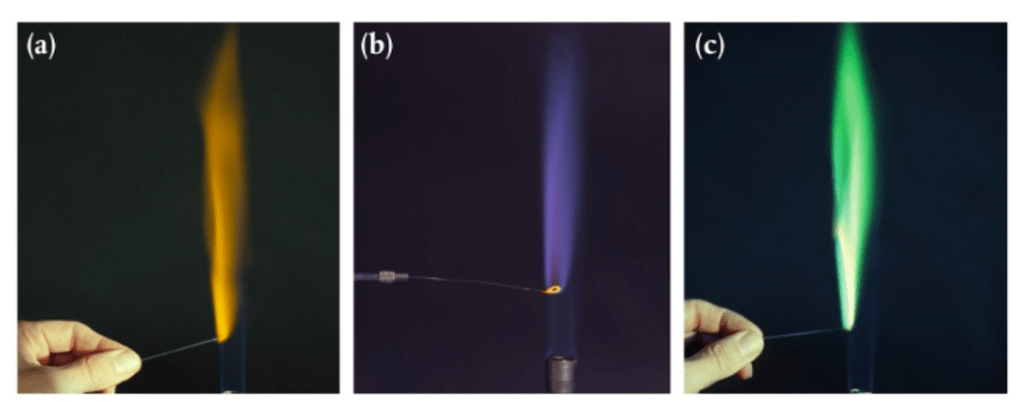
Did you know that the colour of flame correspond to a certain electromagnetic radiation? When burned, electrons are excited and when returned to the original energy level, photon is released. This photon may be visible light, infra-red or UV etc. The above are flame test of Na, K and Cu. These metals produce the same colour when used in fireworks
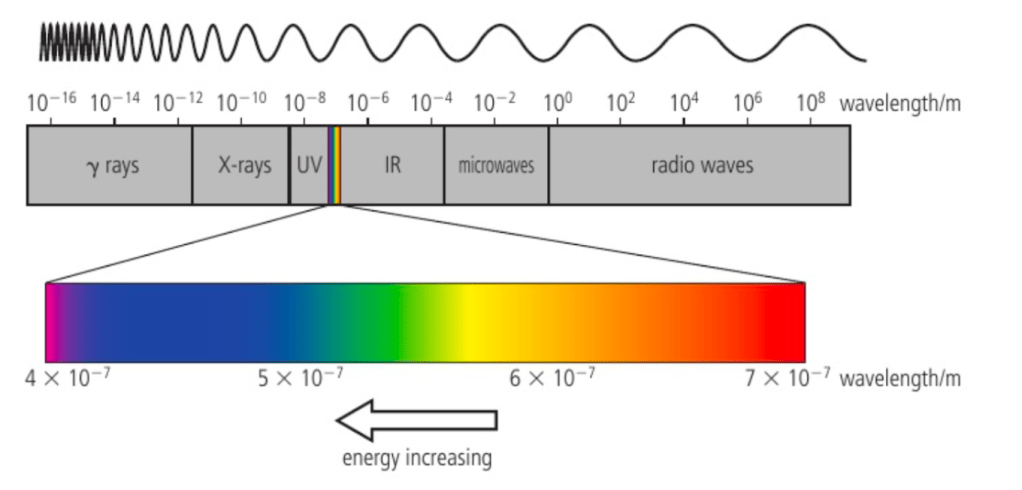
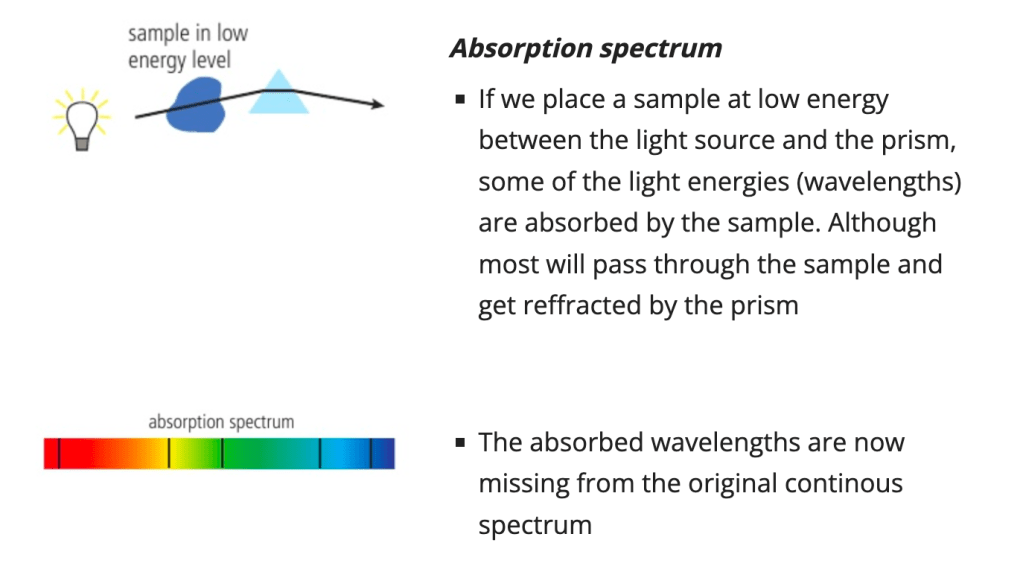
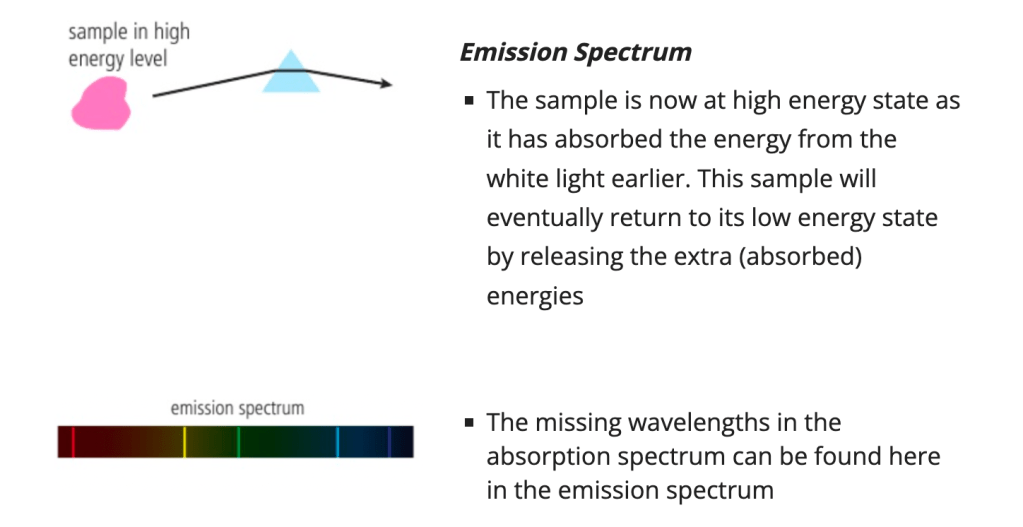
When a white light passes through a prism, different wavelengths are refracted at different angles. This can be observed as the formation of continuous colour (visible) light spectrum as follow;
Part 2: Energy Level
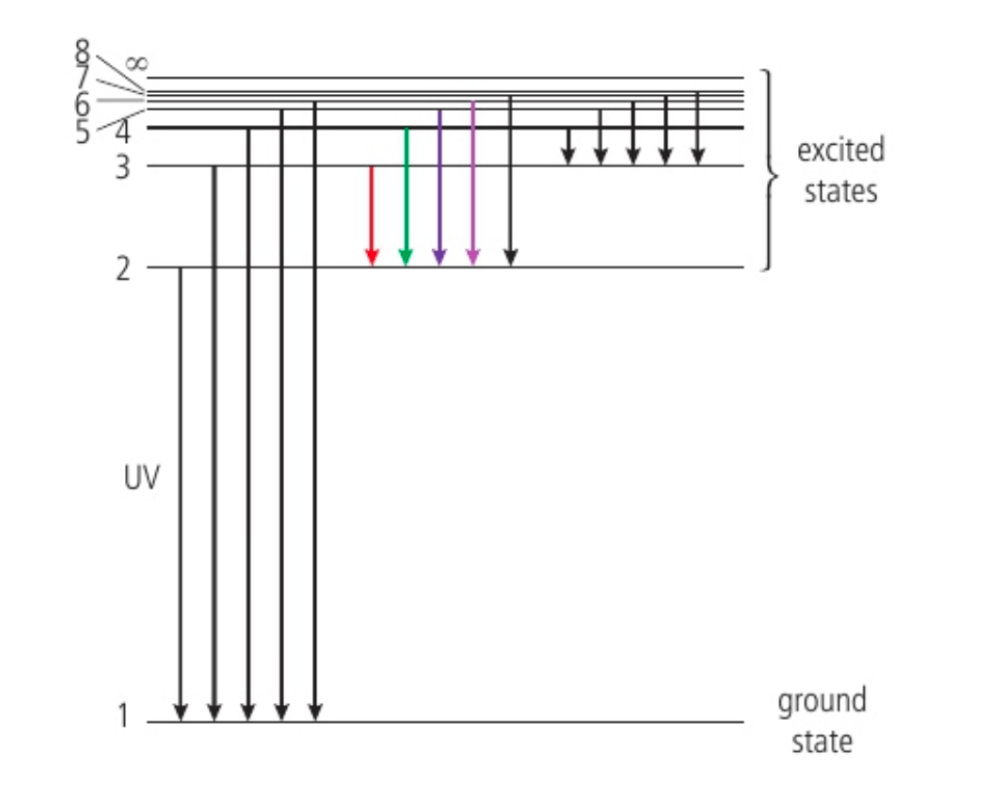
The emission spectrum of hydrogen shows that the lines converge at high energy level
- The lines give us the idea of the energy level.
- The red line is the lowest energy level, hence could be the first shell. However, the emission spectrum does not (cannot) show infrared which is also produced as part of the photon.
- Since red is the lowest energy level in visible light, it is more appropriate to say that the electron travelled for 1 energy level higher, then went back to the original level
- At higher energy level, the purple region, the there are many lines that are converged.
- When an electron reaches the highest level i.e n = ∞, electron can escape the nuclear attraction i.e the atom becomes an ion.
Part 3: Electron Configuration
This section focuses on how to write electron configuration using rules in chemistry.
Keywords:
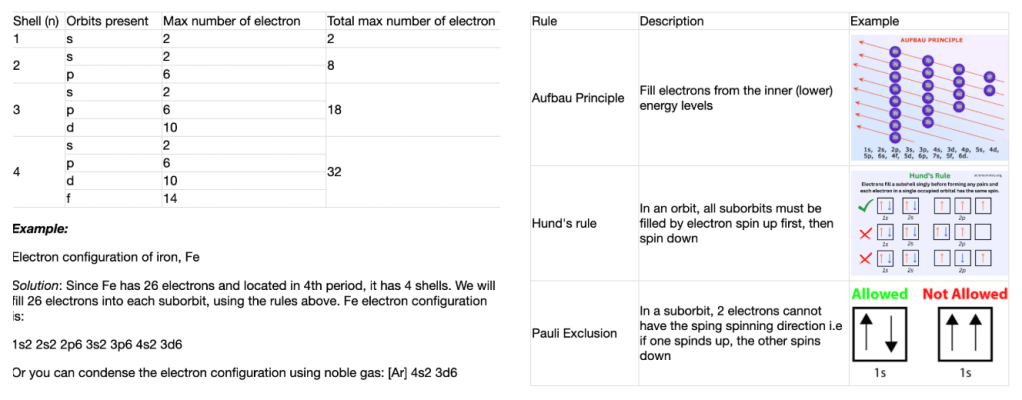
- Shell = energy level (would contain all the orbits)
- Orbit = “shapes” in the shell. These are the s, p, d and f
- Suborbit = specific orbital usually denoted as x, y, z, xy, xz, yz,….and so on. For example, p orbital contains px, py and pz suborbital. Each suborbital can accommodate 2 opposite spin electrons
Futher about Aufbau Principle, the basic rule applies where the maximum number of electrons should be filled in the lower energy level first, before proceeding to the higher energy level.
3 Rules to mind when writing electron configurations:
Special Cases in Electron Configuration
Cu and Cr have the relocate one of their electrons in 4s2 to the 3d orbit in order for them to become stable.
Practice
- Write the electron configuration of Mg and Mg3+
- Challenge yourself: Try this question first before watching the video below
- Write the electron configuration of Cu and Cu+
- Write the electron configuration of Cr
Subscribe to get access: S1.3 Slides with questions and answers
Read more of this content when you subscribe today.
![ESS 8.1.3 [AHL] Biocapacity and Environmental Migration](https://mypytrclass.com/wp-content/uploads/2025/12/image-4.png?w=1024)




![ESS 8.3.4 [AHL] Photochemical Smogs and Tropospheric Ozone](https://mypytrclass.com/wp-content/uploads/2025/12/image-1.png?w=1024)

 PYTR Class