
Learning Objectives
- The use of mole concept to solve stoichiometric problems
- Determination of limiting reactant
Part 1: Limiting Reactant
In every reaction involving two reactants, one may become limiting and the other will be in excess. This means that…
- Limiting reactant has lower number of moles
- Limiting reactant limits the amount of product(s) produced
- Excess reactant will not have completely being used at the end of the reaction
- Some excess reactant will remain unreacted
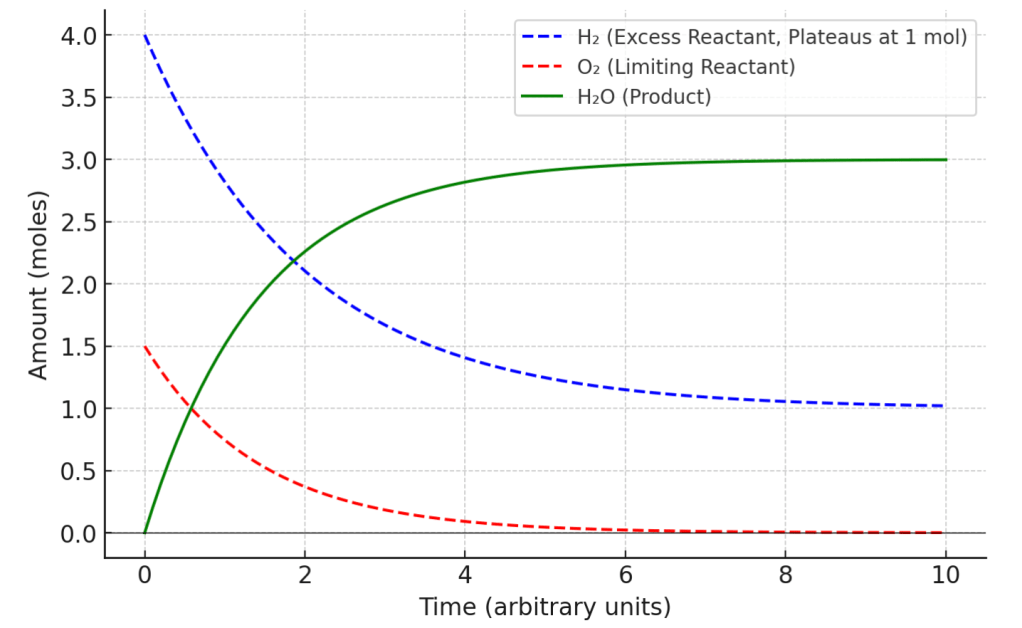
Based on this graph, oxygen is the limiting reactant as it is completely used to form water. There are some amount of hydrogen gas remained unreacted at the end of this reaction.
Part 2: Calculating Limiting Reactant
Consider this reaction:
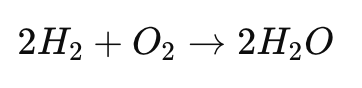
10 g of H₂ and 20 g of O₂
Which is the limiting reactant?
Step 1: Find n of each reactant based on the starting amount
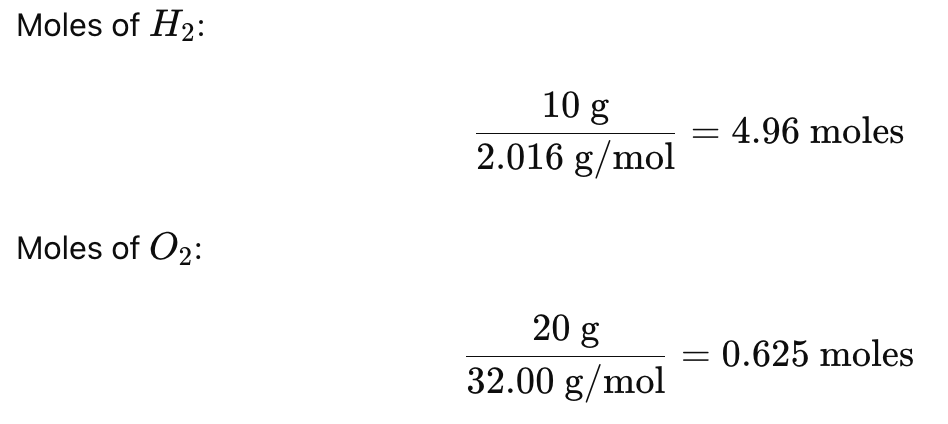
Step 2: Use mole ratio
| Reactant | O2 | H2 |
| Moles, n | 0.625 moles | 4.96 moles |
| Mole ratio (balanced equation) | 1 | 2 |
| Reaction ratio | 0.625 / 1 = 0.625 | 4.96/2 =2.48 |
Based on this ratio, 0.626 (O2) : 2.48 (H2)
Oxygen will be the limiting reactant (having lower ratio)
You could also look at it using mole ratio as follow:
2 moles of H2 react with 1 mole of O2
For 0.625 moles of O2, we need:

Since we have 4.96 moles of H2, which is more than 1.25 moles, O2 is the limiting reactant.
Part 3: Exercises
Question:
Find the amount of products formed when 5g of Mg and 50ml of 0.25 mol/dm3 of HCl reacted. The find the amount of excess or unreacted reactant.
Step 1: Write the Balanced Chemical Equation

Step 2: Calculate Moles of Reactants
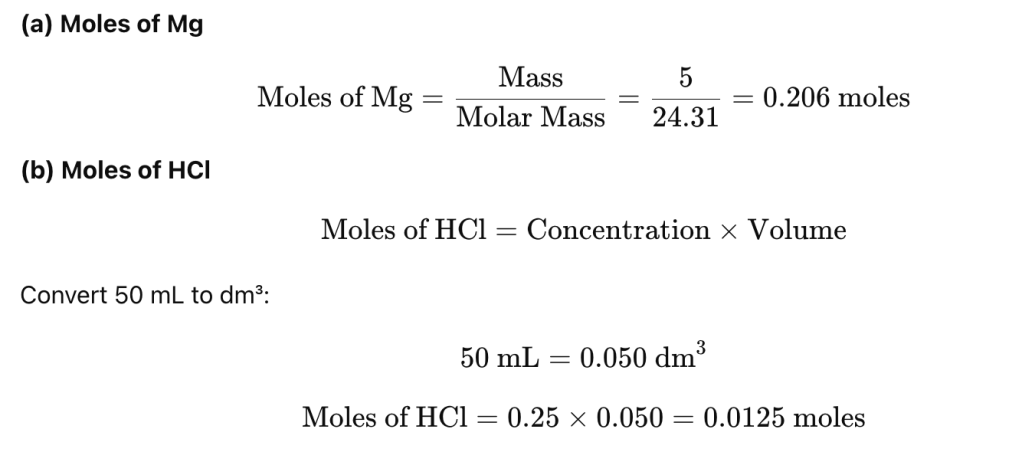
Step 3: Identify the Limiting Reactant
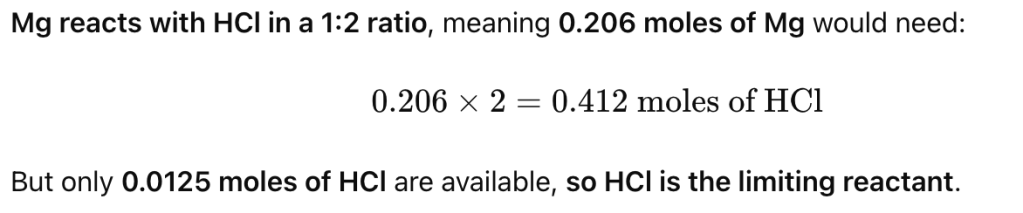
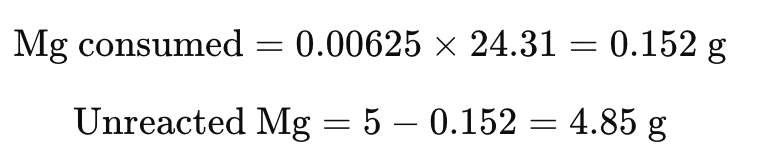
Step 4: Determine the Amount of Products Formed and Unreacted Reactant
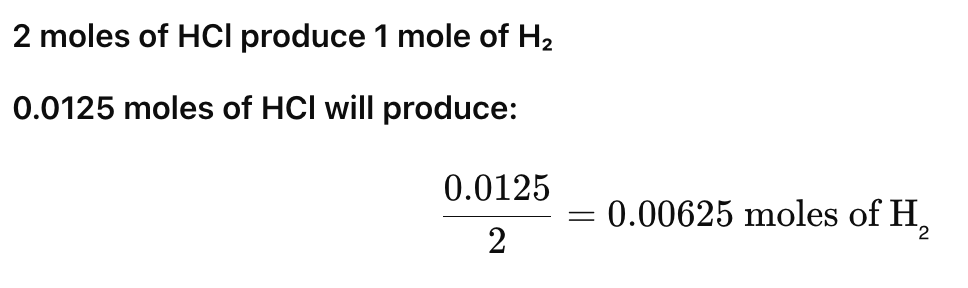
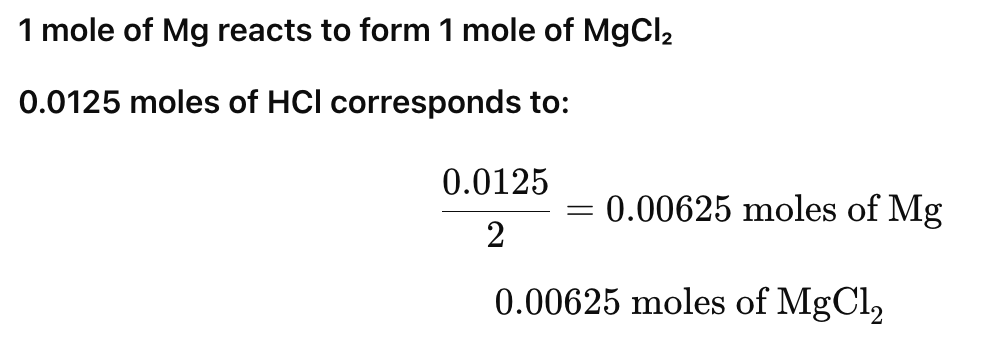
Since HCl is limiting, we base our calculations on 0.0125 moles of HCl.
(a) Moles of H₂ gas produced:
(b) Moles of MgCl₂ produced:
Since HCl is the limiting reactant, there will be some excess Mg left unreacted:
![ESS 8.1.3 [AHL] Biocapacity and Environmental Migration](https://mypytrclass.com/wp-content/uploads/2025/12/image-4.png?w=1024)


![ESS 8.3.4 [AHL] Photochemical Smogs and Tropospheric Ozone](https://mypytrclass.com/wp-content/uploads/2025/12/image-1.png?w=1024)
 PYTR Class