
Learning Objectives
- Outline the meaning of homolytic fission
- Outline the free radical substitution reaction
- Outline how free radical substitution is applied in hydrocarbon testing
- Outline how CFCs affect the ozone layer
Part 1: Heterolytic and Homolytic Fission
Homolytic Fissions
Homolytic fission is the breaking of a covalent bond in which each atom takes one electron from the bond, forming two free radicals.
- Both sides get 1 electron each from the shared electron
- This generally occurs in non-polar and slightly polar bonds
- Requires energy such as UV, light or heat
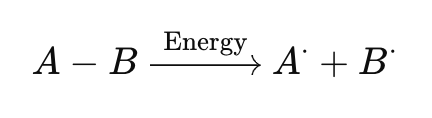
- Since only one electron is transferred to one side, the arrow drawn must be a half arrow. This half arrow is also called a fish hook:
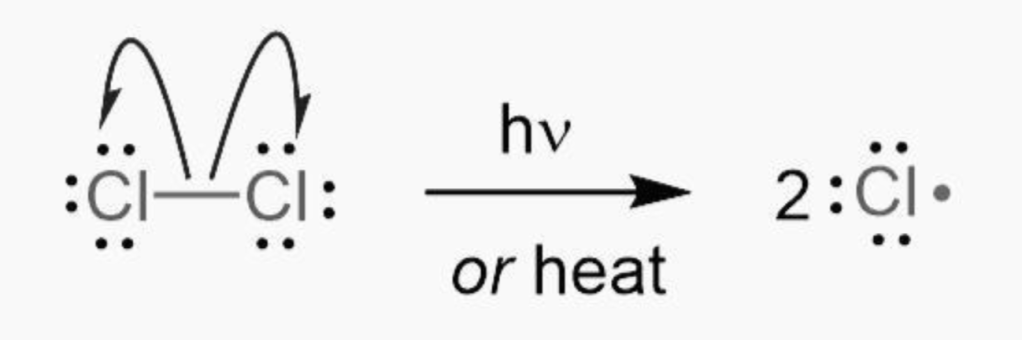
- If the homolytic is done by UV, it is called photolytic fission
- If the homolytic is done by heat, it is called thermolytic fission
Heterolytic Fissions
Heterolytic fission is the process where a covalent bond breaks unevenly, resulting in one atom receiving both electrons from the bond while the other gets none. This leads to the formation of ions—a cation (+ve ion) and an anion (-ve ion)
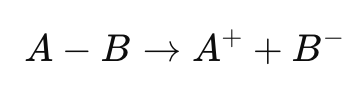
Example:

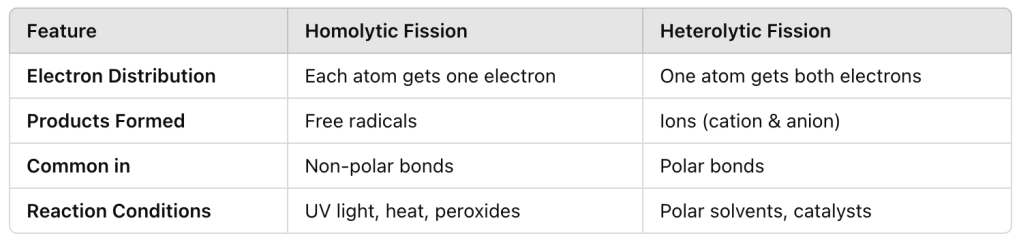
Heterolytic Vs Homolytic Fissions
Part 2: Free Radical Substitution
The reaction follows a radical chain mechanism, which consists of three steps: Initiation, Propagation, and Termination. The following reaction shows the steps in free radical substitution reaction between Cl2 and CH4
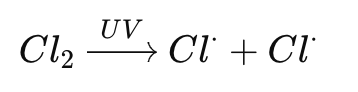
Step 1: Initiation (Formation of Radicals)
- Homolytic fission of chlorine molecule (Cl₂) occurs due to UV light or heat.
- This produces two chlorine radicals (Cl•) with unpaired electrons.
Step 2: Propagation

- The newly formed CH3• can attack any other molecule present. If it attacks Cl2, the reaction is as follow:

- In this step, radicals are regenerated, causing the propagation this step
- Generally, as a radical attacks a neutral molecule, the product is often going to be a neutral molecule and another radical
Step 3: Termination
- Reaction can only be terminated when a radical attacks another radical. Some examples are as follow:
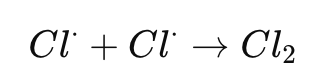


- As both radicals attack each other, the fish hooks will drawn into the middle between the two radicals. It is shown bellow:

- In this step, no further radicals are formed. This means neutral molecules are formed and reaction be terminated
Part 3: Free Radicals in Life
Testing an Unknown Hydrocarbon
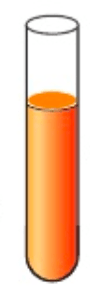
- If you have an unknown hydrocarbon as in you are not sure if it is an alkane or an alkene, you can test it with a coloured halogen.
- The most popular reagent is Br2.
- The mixed the mixture will show the colour of Br2 as shown in Fig.1
- Next step is prepare two sets of this. One will be left in the dark and the other will be left in the light (with UV)
Result
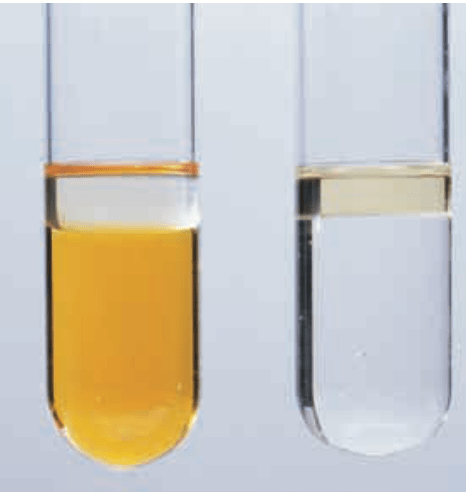
- Bromine is discoloured in the test tube on the right because it was left in the light. The presence of UV enabled the free radical substitution mechanism
- The test tube on the left did not discolour Br2
- This confirms that the hydrocarbon was an alkane as the absence of UV does not enable a free radical substitution reaction. The unknown hydrocarbon and the Br2 remained unreacted
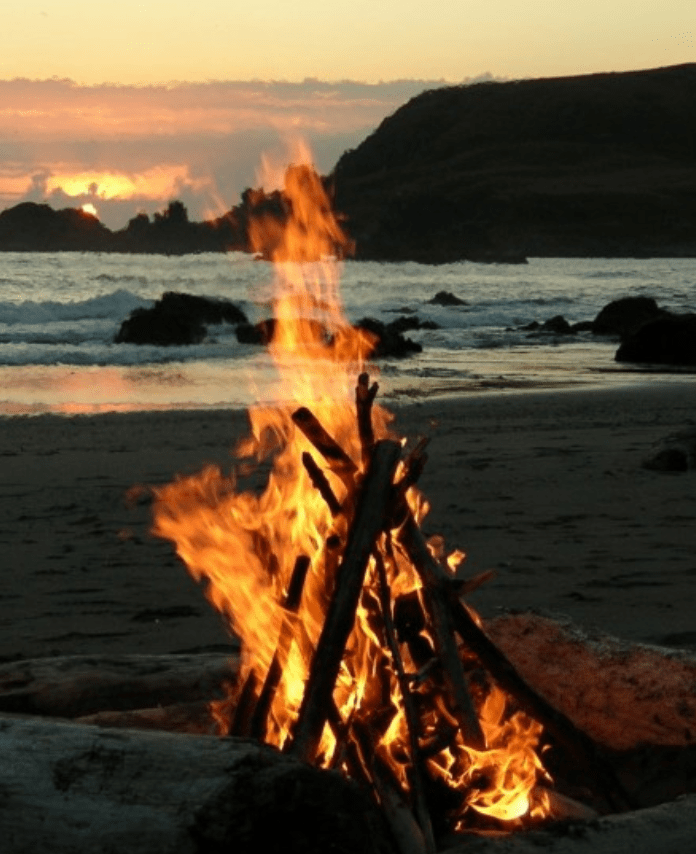
A beach bonfire at sunset.
Combustion reactions, like the burning of wood, proceed through a multi-step chain reaction in which radical species continuously break down the fuel into smaller molecules, ultimately producing carbon dioxide, water, and other simple oxides.
Depletion of Ozone Caused by CFCs
[Note that the IB does not prescribe the ozone cycle anymore. However the free radical substitution reaction between CFCs and ozone could still be tested as it is under the same concept]
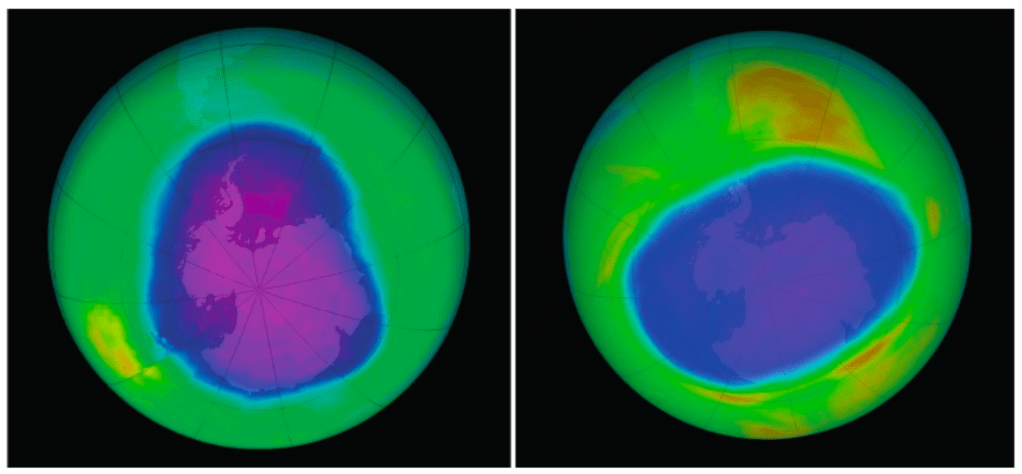
The free radical substitution reaction between chlorofluorocarbons (CFCs) and ozone occurs in the stratosphere, leading to ozone depletion.
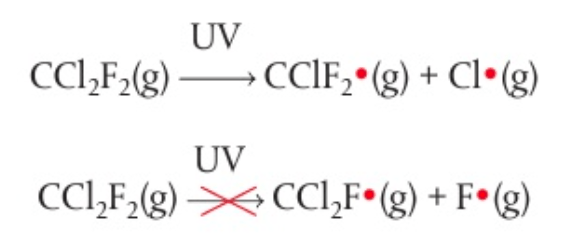
1. Initiation
- Although C-Cl bond has lower bond enthalpy than C-F, when UV is absorbed, the C-Cl bond is preferentially broken and no F radical is produced
2. Propagation
- The chlorine radical reacts with ozone (O₃), breaking it down into oxygen molecules

- The reaction propagate as:
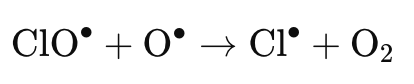
- The chlorine radical acts as a catalyst to the depletion of ozone layer. The next reaction is as follow:
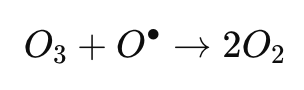
3. Termination (Less Common)
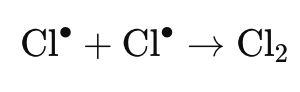
Since chlorine radicals are continuously regenerated in the propagation steps, a single chlorine atom can destroy thousands of ozone molecules before termination occurs.
Overall Impact
The depletion of ozone increases UV radiation reaching Earth’s surface, leading to environmental and health issues like increased skin cancer risks and ecosystem disruptions.
Exercises
Subscribe to get access
Question 1: C3H8, reacts with Cl2, in the presence of UV light. Outline the equations to explain how this reaction occurs through a stepwise mechanism. Draw and name two possible monosubstituted products of the reaction.
Question 2: State and explain what would be observed during the following experiments carried out at room temperature.
(a) Bromine water is added to butane in a test tube exposed to UV light.
(b) Bromine water is added to butane in a test tube that is covered in foil.
![ESS 8.1.3 [AHL] Biocapacity and Environmental Migration](https://mypytrclass.com/wp-content/uploads/2025/12/image-4.png?w=1024)


![ESS 8.3.4 [AHL] Photochemical Smogs and Tropospheric Ozone](https://mypytrclass.com/wp-content/uploads/2025/12/image-1.png?w=1024)
 PYTR Class