

Learning Objectives
- Outline how Lewis acids and bases are interacting in terms of electron sharing [AHL]
- Outline the formation of complex ions [AHL]
- What is “coordination number”?
- What are ligands?
- How to find the charge of the central ion in a complex ion?
Part 1: Interactions Between Lewis Acids and Lewis Bases
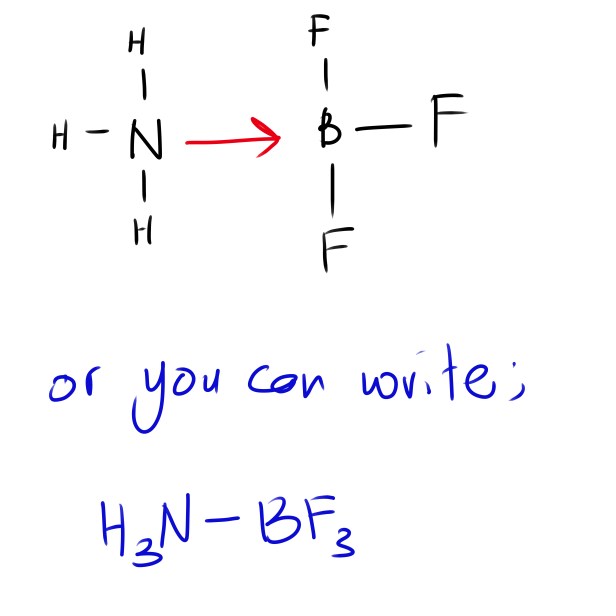
The Lewis acid-base theory describes the interaction between electron pair donors (Lewis bases) and electron pair acceptors (Lewis acids). This theory is broader than the Bronsted-Lowry definition and applies to a wider range of reactions, including coordination complexes and organic reactions.
Terminologies
- Lewis acids
- Lone pair accepters
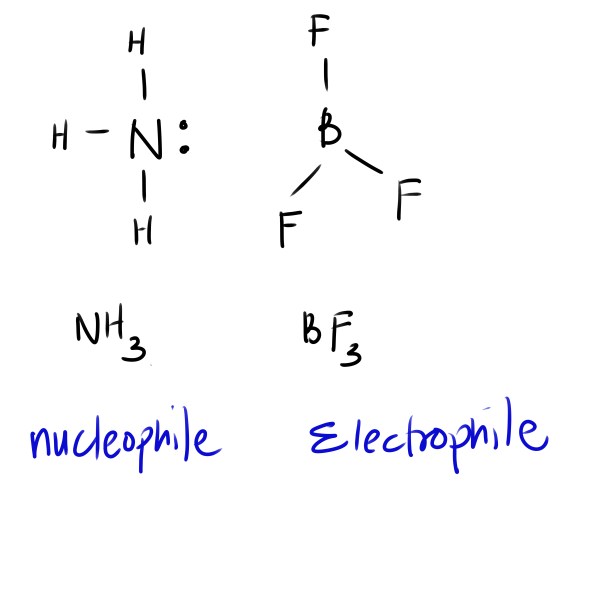
- They have the ability to accept electrons – which means that they are electrophiles
- They could be:
- Neutral – such as BF3 where B is in the state of incomplete octet,
- Cations – especially the transition metal ions with vacant d orbitals
- Lewis bases
- Lone pair donors
- They have extra at least one lone pair electrons to share and hence to form coordination bond
- They could be:
- Neutral – such as H2O, NH3
- Anions – such as OH–, Cl–, CN–
Lewis Acid-Base Interactions
Use the slide show below to see how a Lewis acid and a Lewis base interact

Part 2: Formation Complex Ions

The example above shows another interaction of lone pari sharing. In this case, it is also appropriate to refer to the species based on the terminologies:
- Lewis acid / electrophile: Al3+
- Lewis base / nucleophile: H2O
This complex ion is formed when a cation accepts lone pair(s) from ligand(s).
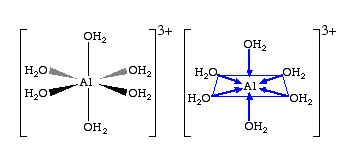
Based on the above complex ion, 6 water molecules (the ligand) form 6 coordination bonds with a single Al3+ ion. This means that the coordination number is 6
What are ligands?
- Lone pair donors
- Lewis bases
- They can be:
- Neutral: H2O, NH3, CO
- Anions: F–, Br–, Cl–, F–, OH–, SCN–, CN–
As you can see, a ligand is just another term used to refer a Lewis base or a nucleophile that can form a coordination bond
Part 3: Calculating Charges of Complex Ions
The overall charge of a complex ion is affected by:
- the charge on the central transition metal ion
- the charge on the ligands
- the coordination number
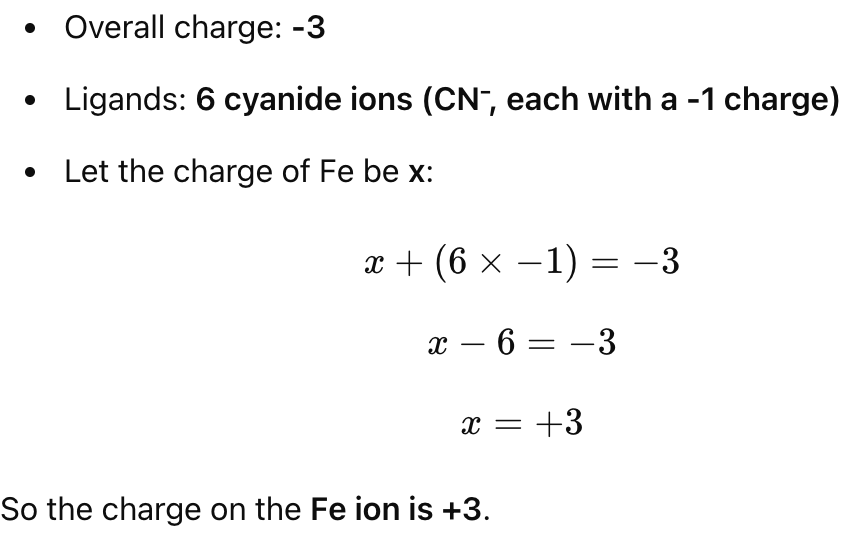
Using algebra, the charge of the central ion or the overall charge can be calculated.
Example: Calculate the charge of central ion in [Fe(CN)6]3−
Solution:
Download this ppsx file to watch the tutorial
Exercises
Subscribe to get access to the answers
Q1: Outline the meaning of “coordination number”
Q2: Determine the charge and give the formula for the complex ion formed when Fe2+ coordinates with two water and four chloride ligands
Q3: Determine the charge on the central chromium ion in the complex ion [Cr(NH3)2(SCN)4]–
![ESS 8.1.3 [AHL] Biocapacity and Environmental Migration](https://mypytrclass.com/wp-content/uploads/2025/12/image-4.png?w=1024)




![ESS 8.3.4 [AHL] Photochemical Smogs and Tropospheric Ozone](https://mypytrclass.com/wp-content/uploads/2025/12/image-1.png?w=1024)

 PYTR Class