
Learning Objectives
- Understand the role of water as a medium for life and its importance in biological processes.
- Explain how hydrogen bonds form due to the polar covalent nature of water molecules.
- Describe the cohesion of water molecules caused by hydrogen bonding and its biological significance.
- Understand adhesion of water to polar or charged materials and its impact on living organisms.
- Explain water’s solvent properties and how they facilitate metabolism and transport in plants and animals.
- Analyse the physical properties of water and their effects on aquatic organisms and habitats.
Part 1 Theory of Water
- Life is believed to have begun in water, likely in the oceans.
- The first cells formed with a small volume of water enclosed in a membrane.
- Dissolved substances in water enabled chemical reactions necessary for life.
- Even today, most biological molecules remain dissolved in water.
- Liquid water allows molecules to move and interact, supporting life processes.
Hydrogen Bonding in Water
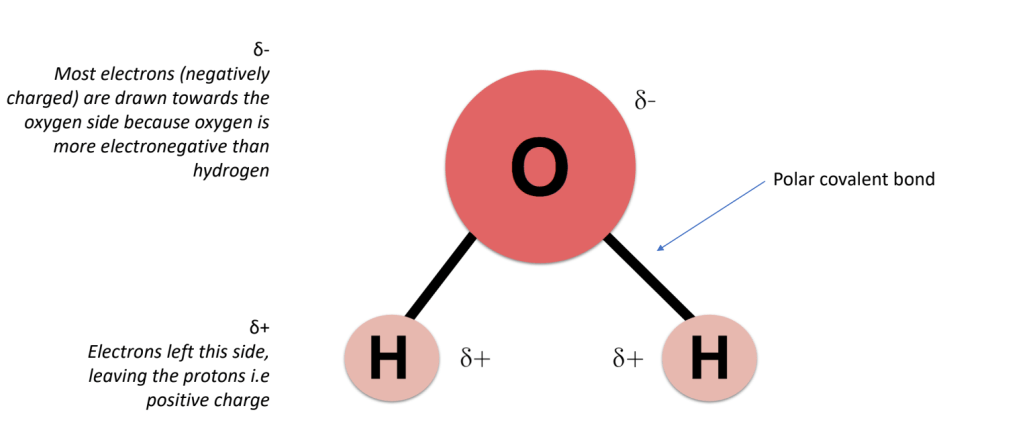
The O-H bond is…
- A covalent bond
- a polar bond due to the difference in electronegativity between O and H
Due to the high electronegativity of O, it pulls the shared electrons towards it making H atoms to be an area of electron deficit (δ+). The O side as the result is now δ– as it is an electron rich region
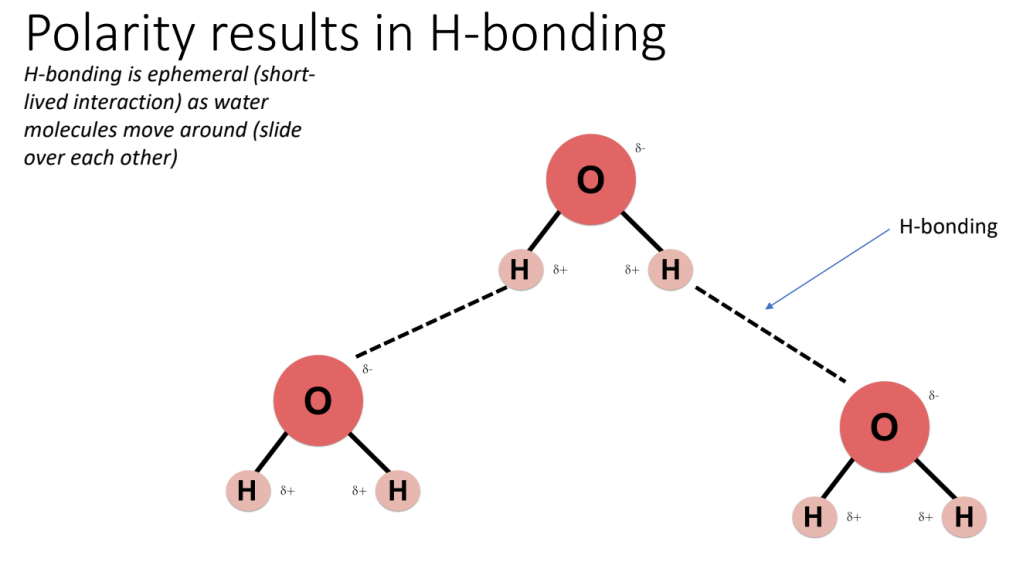
When two water molecules are close by, the δ+ side and the δ– side can interact.
- This interaction is NOT a covalent bond but rather, an intermolecular force called hydrogen bond
- As water molecules are small, a small amount of water (the liquid form) would contain a large amount of H-bonding. This results in many of water properties such as high surface tension, high boiling point (100oC), cohesion and adhesion, etc
Cohesion
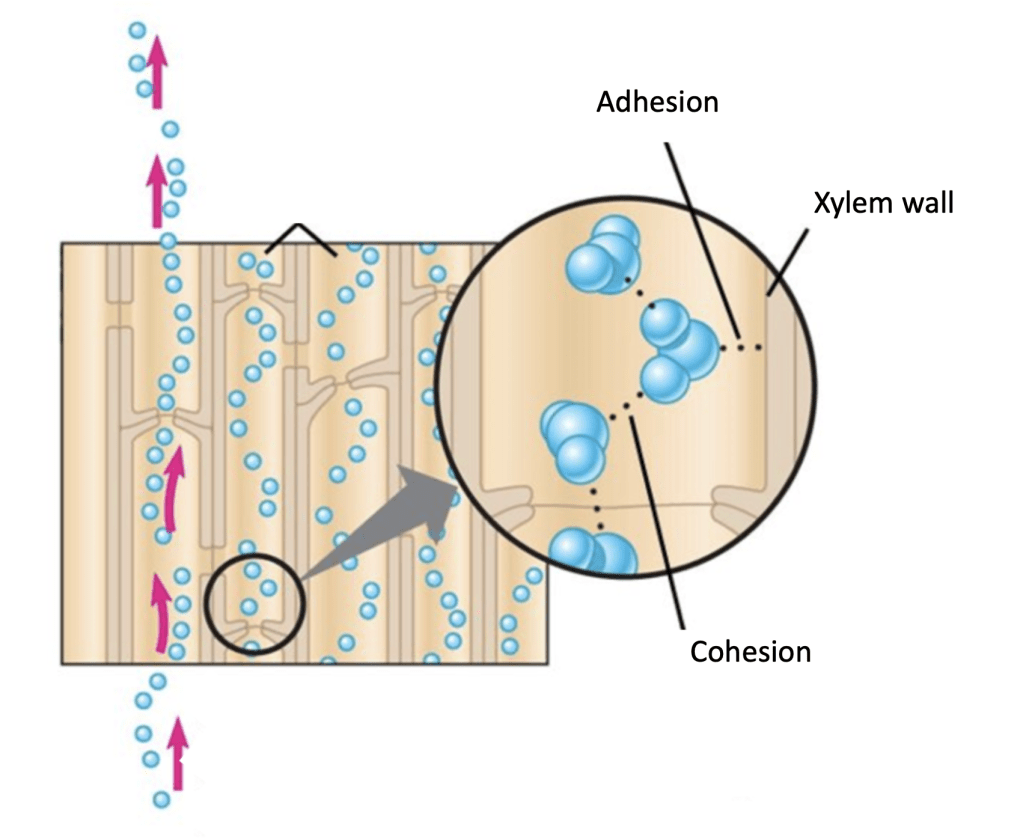
Water molecules are attracted to each other, forming hydrogen bonds. Energy is needed to break these hydrogen bonds, a property known as cohesion.
Living organisms rely on cohesion for various processes.
- Example 1: Water transport in plants (xylem).
- Example 2: Water surfaces as a habitat for organisms.
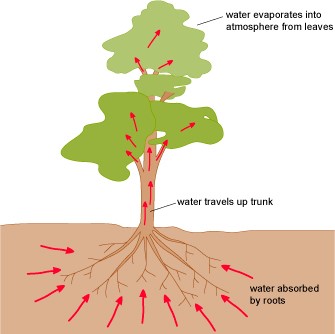
Water Transport in Xylem:
Cohesion enables water transport under tension in plants. Water moves from roots to leaves through tubular vessels in xylem tissue. Continuous columns of water are under tension, similar to a rope pulled from both ends. Tension in roots arises from attraction between soil particles and water. Tension in leaves occurs due to evaporation and attraction to cell walls.
Water moves upward because the pulling forces in the leaves exceed those in the roots. Water in xylem can withstand tension due to hydrogen bonds.
For a water column in xylem to break, many hydrogen bonds must break simultaneously, requiring more energy than is usually available. Strong hydrogen bonds allow water to withstand large tensions, which supports tall trees.
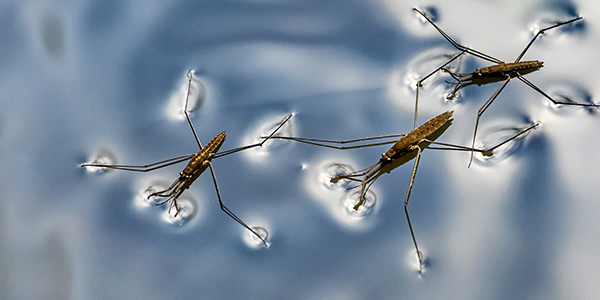
Water Surfaces as Habitats:
Mosquito larvae hang from the surface using their siphon. Water’s surface acts like an elastic membrane due to strong cohesion between water molecules. This property is called surface tension, which is stronger in water than in most other liquids.
Surface tension allows objects like steel pins to float on water, despite being denser than water. For an object to break the surface, many hydrogen bonds must break simultaneously, which requires more energy than is often available.
Some organisms use water surfaces as habitats: Water striders walk on the surface with their legs.
Adhesion
- Hydrogen bonds can form between water and the surface of solids made of polar molecules.
- This causes water to stick to the surface, a process called adhesion.
- Adhesion can also lead to movement, such as water being drawn through narrow glass tubes (capillary action).
- When air is replaced by water in a tube, many hydrogen bonds form, releasing energy.
- As water replaces air, energy is released due to hydrogen bonds between the glass and water.
- Porous solids like paper have large surface areas that attract water, exerting strong suction forces through adhesion.
- This is observed when water moves through the narrow spaces between cellulose molecules in paper towels.
- Water in soil is attracted to various chemical substances, and if the soil is porous, capillary action can draw water through dry soil, wetting it.
- Capillary action allows water to rise from underground sources despite gravity, which pulls it down.
- In plants, adhesion helps water move:
- Water adheres to cellulose molecules in cell walls, rewetting drying walls as long as a water source is available.
- If water evaporates from cell walls in leaves, adhesive forces draw water from nearby xylem vessels, keeping walls moist for carbon dioxide absorption needed for photosynthesis.
- This also creates the low pressure that helps draw water up in xylem vessels.
- If a xylem vessel becomes air-filled, adhesion helps refill the vessel with water.
- For example, in deciduous trees, xylem vessels are air-filled in winter, and in spring, capillary action due to adhesion helps sap rise, refilling the vessels.
To sum about cohesion and adhesion
Part 2: Solvent Properties of Water
Metabolism:
- Cytoplasm is a complex mixture of dissolved substances in water.
- The solvent in cytoplasm is water, and solutes can move and interact.
- Enzymes, dissolved in the cytoplasm, catalyze specific chemical reactions.
- The many reactions catalyzed in cytoplasm are collectively known as metabolism.
- Water is essential for metabolism as it allows components to move and interact on enzyme active sites.
Transport:
- Substances can be transported as aqueous solutions in both plants and animals.
Plant Transport Systems:
- Mineral ions are transported in xylem sap.
- Sucrose and products of photosynthesis are transported in phloem sap.
Blood Transport:
- Blood transports a variety of substances, including:
- Sodium chloride: Dissolves in water, forming sodium (Na+) and chloride (Cl-) ions, carried in blood plasma.
- Amino acids: Soluble in water, though solubility varies based on their hydrophilic or hydrophobic parts.
- Glucose: A polar molecule, freely soluble in water and carried in plasma.
- Oxygen: A non-polar molecule that dissolves sparingly in water. Its solubility decreases as water temperature rises, which limits the amount dissolved in plasma. Red blood cells contain hemoglobin to greatly increase oxygen transport capacity.
- Fat molecules: Non-polar and insoluble in water. They form large droplets in blood, but are coated with phospholipids to keep them suspended and prevent contact with water, aiding in transport.
Part 3: Physical Properties of Water
Buoyancy:
- When an object is immersed in a fluid, the fluid exerts an upward force on the object called buoyancy.
- Buoyancy equals the weight of the fluid displaced by the object.
- If the object’s density is lower than the fluid’s, buoyancy is greater than gravity, and the object will float.
- If the object’s density is higher, buoyancy is less than gravity, and the object will sink.
- Living organisms have an overall density close to water, making it easier to float without much energy.
- Bone fish control their density with an air-filled swim bladder; cyanobacteria use gas vesicles for buoyancy.
- Air provides negligible buoyancy, so organisms must generate lift to stay airborne.
Viscosity:
- Viscosity is the stickiness of a fluid, determining how easily it flows.
- Organic solvents (e.g., propanone) have low viscosity; treacle has high viscosity.
- Viscosity is caused by internal friction when fluid parts move relative to each other.
- Water has higher viscosity than organic solvents due to hydrogen bonds.
- Solutes increase viscosity; e.g., blood has higher viscosity than water.
- Seawater has higher viscosity than freshwater due to dissolved salts.
- Air’s viscosity is about 50 times smaller than water’s at the same temperature.
Thermal Conductivity:
- Thermal conductivity is the rate at which heat passes through a material.
- Water has relatively high thermal conductivity.
- Fats and oils conduct heat at about 25% the rate of water; air at 5%.
- Aquatic warm-blooded animals lose body heat faster than land-based warm-blooded animals.
- Water’s high thermal conductivity helps transport heat, e.g., blood carries heat from muscles to other parts of the body.
Specific Heat:
- Specific heat capacity is the heat required to raise the temperature of 1g of a material by 1°C (or K).
- Water’s specific heat capacity is 4.18 J/g°C, much higher than air (1.01 J/g°C).
- Water’s high specific heat is due to hydrogen bonds restricting molecular motion.
- A large amount of heat is needed to raise water’s temperature, and a similar amount is required to cool it down.
- Water’s stable temperature makes aquatic habitats thermally stable and helps organisms maintain constant body temperatures.
Physical Properties of Air vs. Water:
- Differences in physical properties of air and water affect organisms living in these environments.
- Water provides greater buoyancy than air, so the Arctic loon requires more energy to stay aloft compared to a ringed seal floating in water.
- Water is more viscous, so the seal uses more energy to move through it than the loon flying through air.
- Water has higher thermal conductivity than air, drawing heat away from submerged animals.
- Air insulates better, allowing birds like the loon to maintain a body temperature above the environment, while water provides a more stable thermal environment for aquatic animals like the ringed seal.
![ESS 8.1.3 [AHL] Biocapacity and Environmental Migration](https://mypytrclass.com/wp-content/uploads/2025/12/image-4.png?w=1024)




![ESS 8.3.4 [AHL] Photochemical Smogs and Tropospheric Ozone](https://mypytrclass.com/wp-content/uploads/2025/12/image-1.png?w=1024)

 PYTR Class