
Learning Objectives
- Understand that DNA is the genetic material of all living organisms.
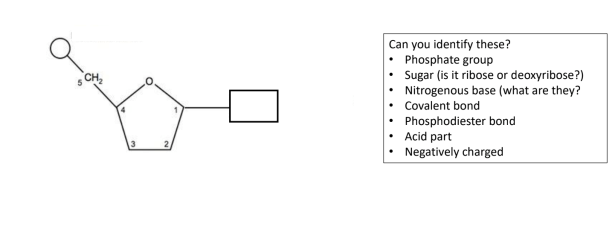
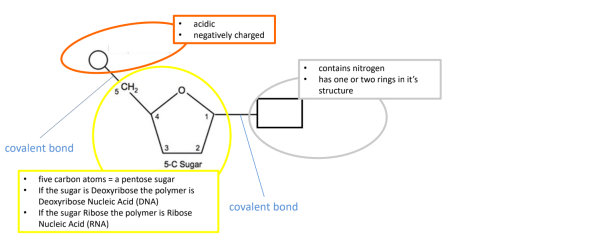
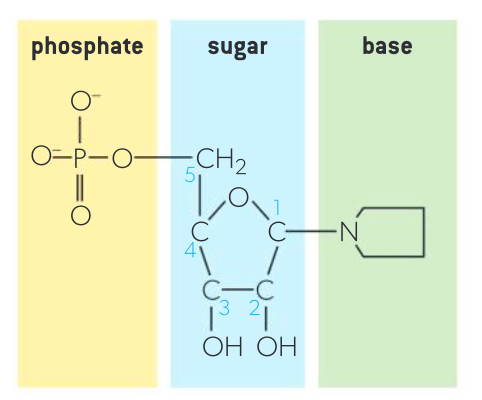
- Identify the components of a nucleotide.
- Describe the sugar-phosphate bonding and the sugar-phosphate “backbone” of DNA and RNA.
- Explain the bases in each nucleic acid and their role in forming a genetic code.
Part 1: Roles and Features of Nucleic Acids
DNA as genetic materials for all living organisms
- Genetic material stores information and can be copied and passed from cell to cell and from parent to offspring.
- Since genetic material is inherited, it is also called hereditary information.
- All living organisms use DNA to store hereditary information.
- Some viruses (e.g., coronaviruses and HIV) use RNA as their genetic material.
- Viruses cannot reproduce on their own and rely on a host cell, so they are not considered true living organisms.
- This means the claim that all living organisms use DNA as genetic material remains valid.
Types of nucleic acids
- Nucleic acids were first discovered in the cell nucleus
- Nucleic acids are large molecules made of nucleotide subunits forming a polymer.
- Two types of nucleic acids are:
- DNA (deoxyribonucleic acid)
- Stores genetic information in all living organisms.
- Double-stranded helix structure.
- Contains deoxyribose sugar.
- Bases: adenine (A), thymine (T), cytosine (C), and guanine (G).
- Found in:
- the nucleus, mitochondria, and chloroplasts of eukaryotic cells.
- in cytoplasm as naked DNA in prokaryotic cells
- RNA (ribonucleic acid)
- Involved in protein synthesis and gene regulation.
- Single-stranded structure.
- Contains ribose sugar.
- Bases: adenine (A), uracil (U), cytosine (C), and guanine (G).
- Found in the nucleus and cytoplasm – depending on the types of RNA:
- tRNA
- rRNA
- mRNA
- DNA (deoxyribonucleic acid)
What are nucleotides?
- Nucleotides are the monomer (single unit) of nucleic acids.
- There are many types of nucleotides such as:
- DNA nucleotides – make DNA
- RNA nucleotides – make RNA
- dNTPs – same as DNA nucleotides but with 3 phosphate groups
- NTPs – same as RNA nucleotides but with 3 phosphate groups
- ATP – the chemical energy formed by cellular respiration
- and many more….
- In general, a nucleotide would have three major components:
- Pentose sugar
- Phosphate group
- Nitrogenous base
Part 2: DNA Backbone and Genetic Bases

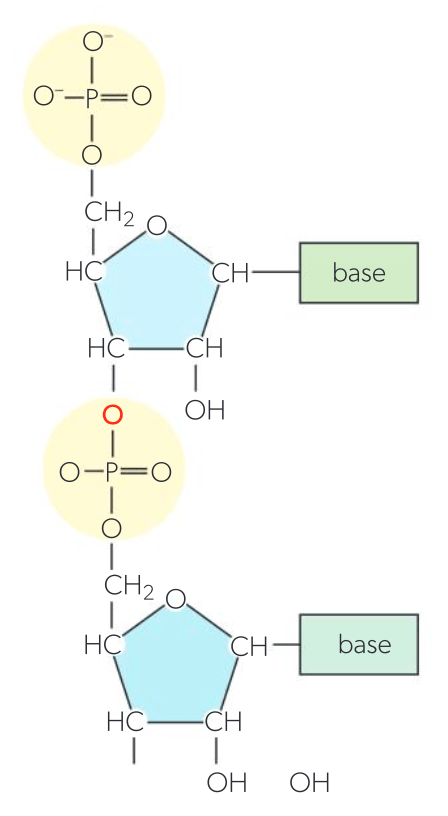
When there are many nucleotides linked together, they will look like a long strand of thread with the nitrogenous bases sticking out.
This makes the sugar – phosphate – sugar – phosphate …. the “backbone”
Note that:
The first nucleotide is linked to carbon-3 of the second nucleotide from its phosphate group. Its phosphate group is located at its carbon-5
- DNA and RNA each contain four different nitrogenous bases.
- Three bases are the same in both, but the fourth differs.
- Bases contain nitrogen, so they are called nitrogenous bases.
- Each nucleotide has one base, meaning there are four types of nucleotides in both DNA and RNA.
- Nucleotides can link together because their phosphate and sugar components are the same.
- Any base sequence is possible, leading to an almost infinite number of sequences in DNA and RNA.
- The sequence of bases stores genetic information in a coded form.
- This forms the universal genetic code, shared by all living organisms.
![ESS 8.1.3 [AHL] Biocapacity and Environmental Migration](https://mypytrclass.com/wp-content/uploads/2025/12/image-4.png?w=1024)




![ESS 8.3.4 [AHL] Photochemical Smogs and Tropospheric Ozone](https://mypytrclass.com/wp-content/uploads/2025/12/image-1.png?w=1024)

 PYTR Class