
Learning Objectives
- Explain the role of complementary base pairing in genetic replication and expression.
- Recognise the diversity of DNA base sequences and its limitless capacity for storing information.
- Understand the conservation of the genetic code across all life forms as evidence of universal common ancestry.
Part 1: Importance of Base Complimentary
Role of Complementary Base Pairing in DNA Replication and Gene Expression
DNA Replication
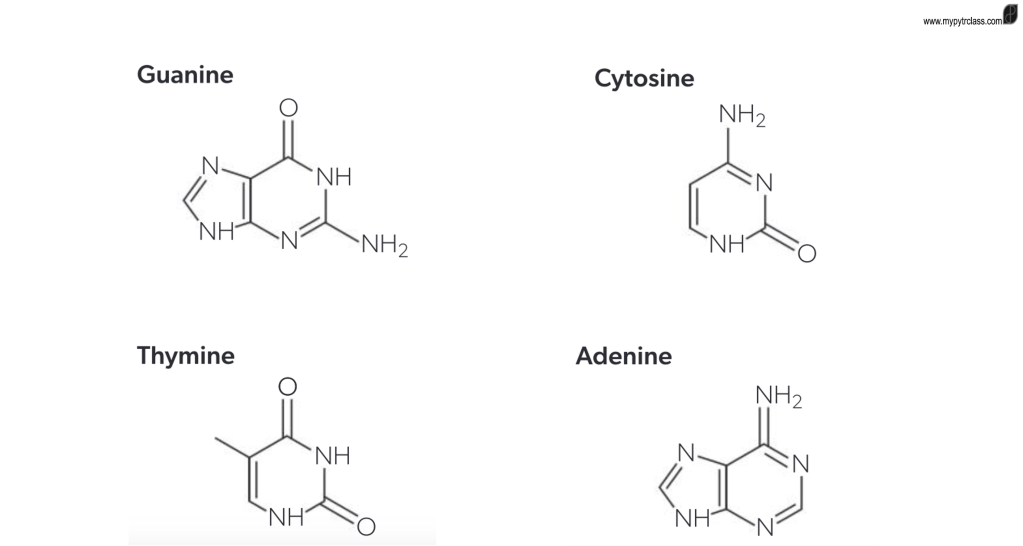
- Complementary base pairing ensures that adenine (A) pairs with thymine (T) and cytosine (C) pairs with guanine (G).
- During DNA replication, the two strands of the double helix separate.
- Each original strand serves as a template for the formation of a new complementary strand.
- New nucleotides are added one by one, ensuring the correct base sequence is maintained.
- The result is two identical DNA molecules, each containing one original strand and one new strand (semi-conservative replication).
Gene Expression
- Genes are sections of DNA that contain genetic information.
- When a gene is expressed, its base sequence is copied into RNA (transcription).
- Only one DNA strand is used as a template for transcription.
- Complementary base pairing applies, but adenine (A) pairs with uracil (U) instead of thymine (T) in RNA.
- The RNA molecule produced can serve regulatory, structural, or protein synthesis roles.
- In protein synthesis, the RNA sequence is translated into an amino acid sequence, again involving complementary base pairing.
Part 2: DNA as Universal Genetic Materials
Diversity of DNA Base Sequences and Limitless Information Storage
- Genetic information is stored in the base sequence of DNA.
- Any sequence of four bases (A, C, G, T) is possible.
- The number of possible sequences increases exponentially:
- 4² = 16 possible two-base sequences
- 4³ = 64 possible three-base sequences
- 4ⁿ possible sequences for n bases, making the potential combinations immense.
- DNA molecules vary in length, further increasing sequence diversity.
- DNA is extremely compact (2 nm in diameter), allowing vast amounts of information to be stored efficiently.
- Compared to human-made storage systems, DNA is highly space-efficient and uses minimal material.
Conservation of the Genetic Code and Universal Common Ancestry
- DNA and RNA store genetic information in a coded form.
- Information is decoded during protein synthesis, where:
- Three-base units (codons) encode amino acids.
- There are 64 possible codons.
- Most codons specify an amino acid.
- One codon signals start of protein synthesis.
- Three codons signal stop.
- The genetic code is nearly universal, used by all living organisms and viruses.
- Despite billions of years of evolution, the code has remained almost unchanged, supporting the idea of a universal common ancestor.
- Minor exceptions exist, where stop codons have been repurposed, but the core structure remains the same.
![ESS 8.1.3 [AHL] Biocapacity and Environmental Migration](https://mypytrclass.com/wp-content/uploads/2025/12/image-4.png?w=1024)




![ESS 8.3.4 [AHL] Photochemical Smogs and Tropospheric Ozone](https://mypytrclass.com/wp-content/uploads/2025/12/image-1.png?w=1024)

 PYTR Class