
Learning Objectives
- Understand the chemical properties of carbon that enable the formation of diverse biological compounds.
- Outline condensation and hydrolysis
- Outline the condensation to form maltose (in carbohydrates), dipeptide (for protein) and triglyceride (in lipids)
- Outline the formation phospholipids
Part 1: Roles of Carbon in Biological Systems
- Carbon is the 15th most abundant element on Earth
- Essential for life due to its ability to form diverse molecules.
- Carbon atoms form covalent bonds
- Involve the sharing of electron pairs between adjacent atoms.
- Each carbon atom can form 4 covalent bonds, allowing complex molecular structures as these can be:
- Four single covalent bonds
- Single covalent bonds allow rotation, but atoms cannot move closer or further apart.
- Carbon bonds form a tetrahedral shape, leading to zig-zag chains rather than straight ones.
- Methane (CH₄): Carbon bonded to four hydrogen atoms
- Ethanol (C₂H₅OH): Carbon bonded with oxygen and hydrogen.
- Two single and one double covalent bond
- In unsaturated fatty acids
- Two double bonds
- Carbon dioxide
- Four single covalent bonds
- Carbon can bond with other carbon atoms or elements like hydrogen, oxygen, nitrogen, and phosphorus.
- Carbon atoms can form chains of any length, leading to different molecular structures:
- Unbranched chains (e.g., fatty acids with up to 20 carbon atoms).
- Such as amylose
- Branched chains, often involving oxygen atoms.
- Such as glycogen
- Cyclic (ring) structures, where carbon atoms form rings.
- Consist entirely of carbon (e.g., menthol).
- Include other elements like oxygen or nitrogen (e.g., thymine and adenine).
- Cholesterol contains four interconnected carbon rings.
- Unbranched chains (e.g., fatty acids with up to 20 carbon atoms).
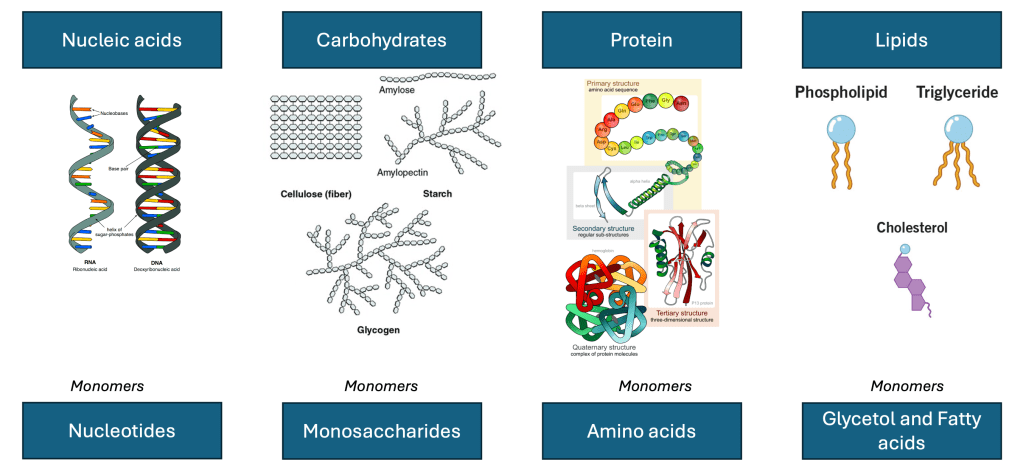
Part 2: Summary of macromolecules
Part 3: Condensation and Hydrolysis
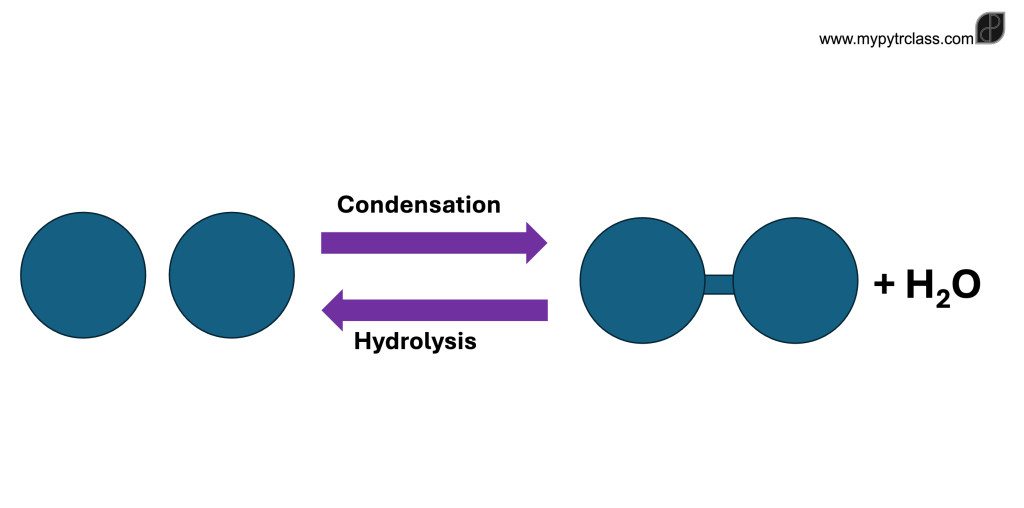
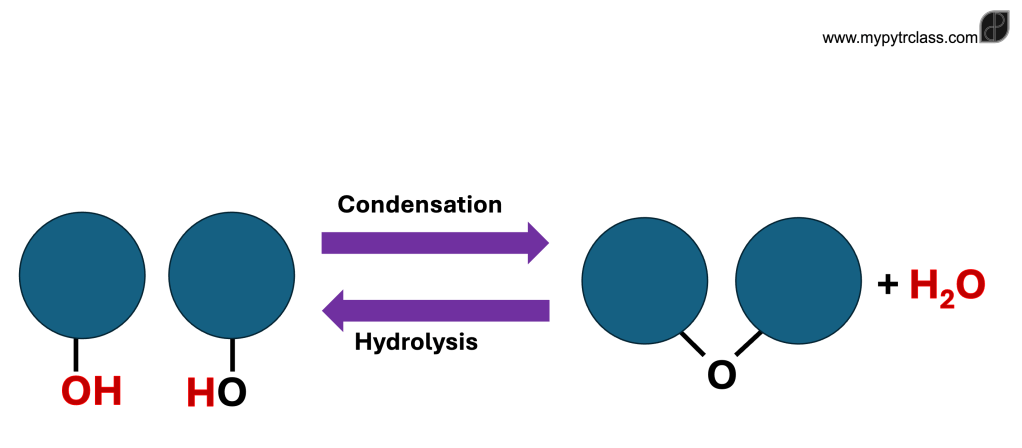
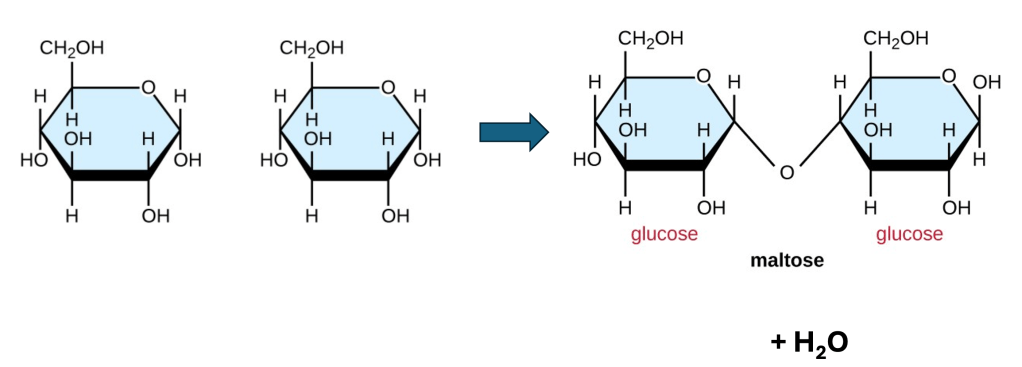
The making of large polymers often requires condensation reaction. The breaking down of the large polymers would be the reverse of condensation reaction and this is called hydrolysis. Both ways usually require enzymes or other non-biological substances such as acids.
Since the condensation produces water, H2O, the two monomers must has -OH and -H to donate.
Digestion of polymers
- Involves breaking them down into monomers for reuse in building new polymers or as an energy source.
- Hydrolysis reactions facilitate the breakdown of polysaccharides, polypeptides, and nucleic acids into monosaccharides, amino acids, and nucleotides.
- Animals carry out digestion both inside cells and externally in the gut.
- Decomposers release digestive enzymes into their environment to break down polymers by hydrolysis for absorption and use of monomers.
Formation of a Disaccharide
Download the following ppsx to watch the tutorial
Formation of a dipeptide
Formation of Triglycerides and Phospholipids
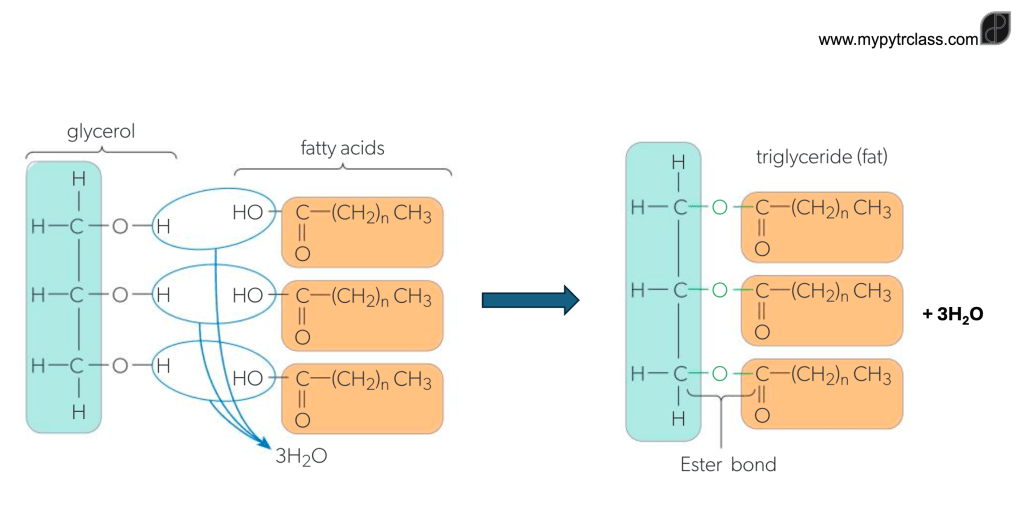
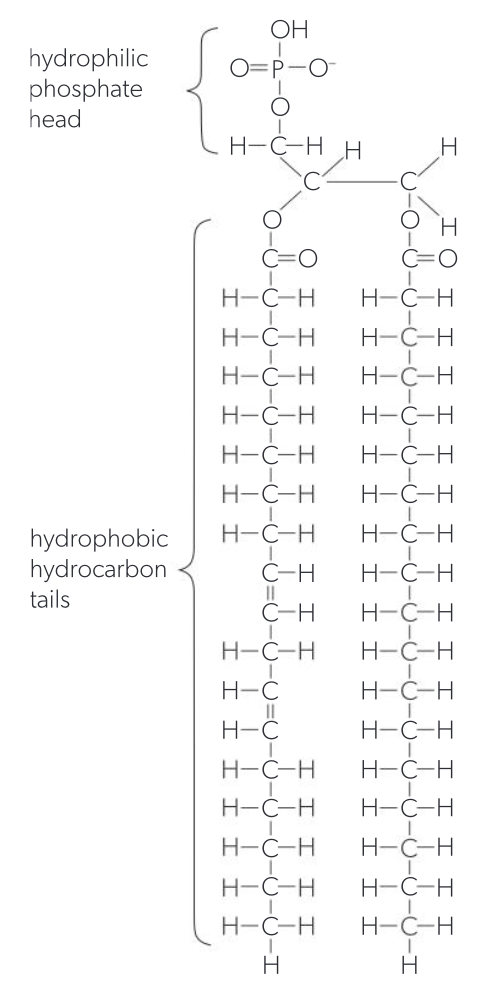
- Phospholipids have a structure similar to triglycerides, but with key differences.
- They contain two fatty acids attached to glycerol, instead of three.
- The third fatty acid is replaced by a phosphate group.
- The phosphate group is hydrophilic, making phospholipid molecules both hydrophilic and hydrophobic.
![ESS 8.1.3 [AHL] Biocapacity and Environmental Migration](https://mypytrclass.com/wp-content/uploads/2025/12/image-4.png?w=1024)



![ESS 8.3.4 [AHL] Photochemical Smogs and Tropospheric Ozone](https://mypytrclass.com/wp-content/uploads/2025/12/image-1.png?w=1024)
 PYTR Class