

Learning Objectives
- Identify the structure and function of monosaccharides in biological systems.
- Explain the role of polysaccharides in energy storage.
- Relate the structure of cellulose to its function as a structural polysaccharide in plants.
- Understand the function of glycoproteins in cell–cell recognition.
Part 1: Structures Roles of Monosaccharides
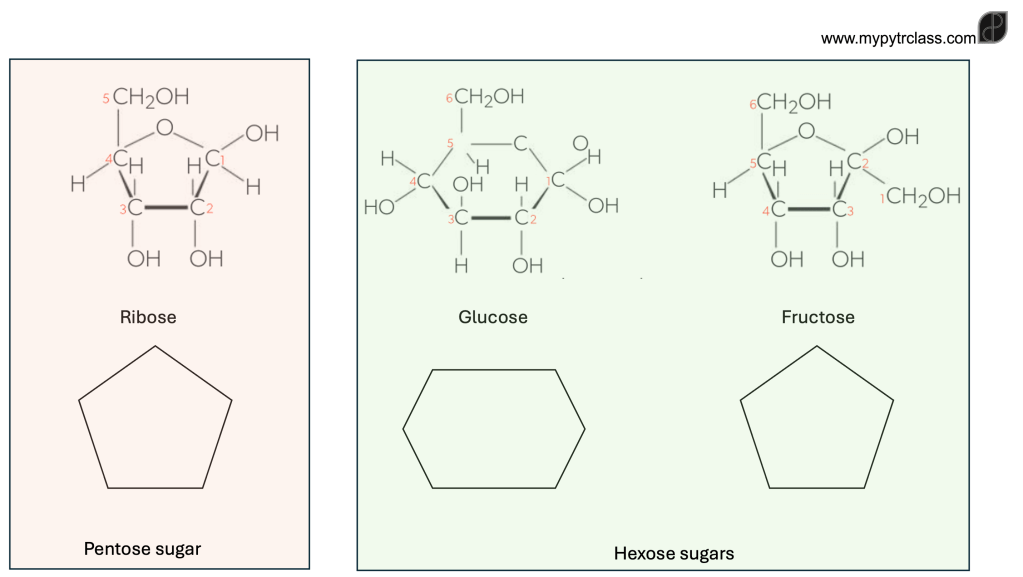
- Monosaccharides contain three to seven carbon atoms.
- Pentoses have five carbon atoms
- Hexoses have six carbon atoms
- Both pentoses and hexoses usually form ring structures.
- The ring consists of one oxygen atom and four or five carbon atoms.
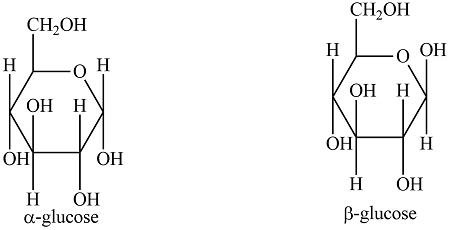
There are two type of glucose: alpha and beta. When becomes polymer, they form different structures
Part 2: Polysaccharides
1. Polysaccharides as Energy Storage:
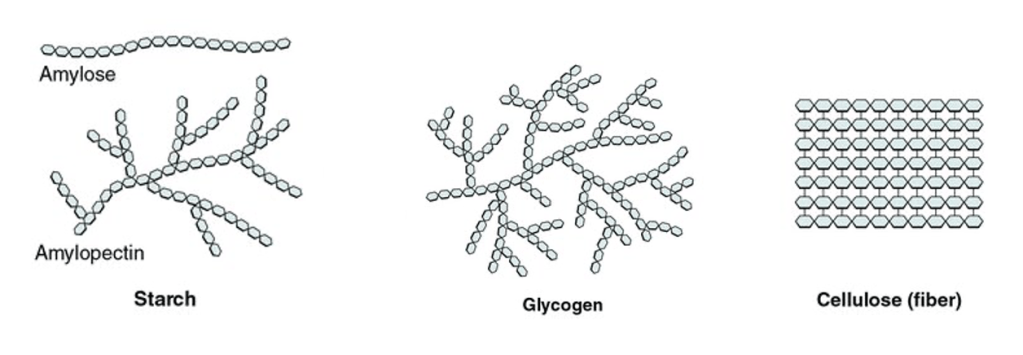
- Starch (plants) and glycogen (animals) serve as energy storage molecules.
- Both are composed of α-glucose molecules, which can be used in aerobic and anaerobic respiration.

- 2 types of Starch:
- Amylose:
- Unbranched chain of α-glucose linked by α-1→4 glycosidic bonds.
- Forms a helical structure due to bond angles.
- Amylopectin:
- Similar to amylose but with some α-1→6 glycosidic bonds, creating branches.
- Branched structure allows faster glucose removal when needed.
- Amylose:
- Glycogen Structure:
- Similar to amylopectin, with α-glucose linked by α-1→4 bonds and branches via α-1→6 bonds.
- More branched than amylopectin (1 in 10 glucose molecules vs. 1 in 20).
- Can contain tens of thousands of glucose subunits.
Advantages of Starch & Glycogen:
- Lower solubility than glucose, preventing osmotic swelling.
- Compact branched structure, allowing efficient storage.
2. Cellulose
- Cellulose Structure & Composition:
- Composed of β-glucose instead of α-glucose, giving it different properties from starch and glycogen.
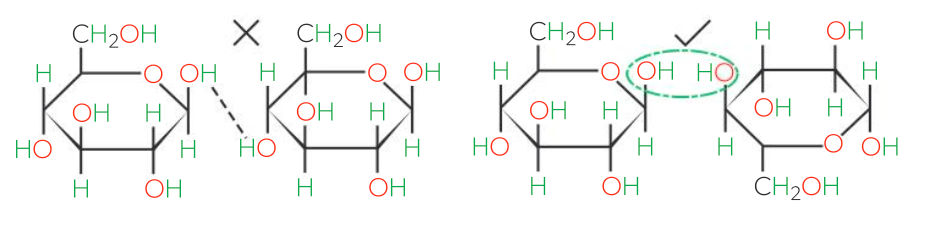
- Condensation reactions link C1 of one β-glucose to C4 of another, forming β-1→4 glycosidic bonds.
- Forms unbranched chains that can exceed 10,000 β-glucose molecules and 10 µm in length.
- Molecular Orientation & Bonding:
- β-glucose structure requires alternating orientation of glucose units, resulting in straight chains instead of helices.
- Hydrogen bonds between chains form bundles called microfibrils.
- Regularly spaced hydroxyl groups enable extensive hydrogen bonding.
- Function & Strength:
- Microfibrils are the structural basis of plant cell walls.
- High tensile strength due to:
- Strong covalent bonds within cellulose molecules.
- Numerous cross-links between molecules.
- Large number of molecules in parallel arrangement.
- Prevents plant cells from bursting, even under high internal pressure from osmosis.
Part 3: Glycoproteins
Role of Glycoproteins in Cell–Cell Recognition
- Structure:
- = protein + carbohydrates (usually oligosaccharides)
- Found in plasma membranes of animal cells, with carbohydrates facing outward.
- Function:
- Enable cell recognition by displaying distinct glycoproteins.
- Recognised by receptors on other cells, facilitating tissue organisation.
- Help identify and destroy foreign or infected cells.
- Example: ABO antigens in red blood cells function as glycoproteins for cell recognition.
ABO Glycoproteins & Blood Transfusion
- Red Blood Cell Glycoproteins:
- Membranes contain glycoproteins with three possible oligosaccharides: O, A, and B.
- Each person has one or two types but never all three.
- Blood Transfusion & Immune Response:
- A-type blood is rejected if transfused into a person without A glycoproteins.
- B-type blood is rejected if transfused into a person without B glycoproteins.
- O-type blood causes no rejection, as it has the same structure as A and B but with one monosaccharide less.
![ESS 8.1.3 [AHL] Biocapacity and Environmental Migration](https://mypytrclass.com/wp-content/uploads/2025/12/image-4.png?w=1024)




![ESS 8.3.4 [AHL] Photochemical Smogs and Tropospheric Ozone](https://mypytrclass.com/wp-content/uploads/2025/12/image-1.png?w=1024)

 PYTR Class