
Learning Objectives
- Explain the physical properties of transition metals
- high melting points
- magnetic properties (different types of magnetism is not assessed)
- Analyse the characteristics of Zn and Sc that may exclude them from being transition metals
Part 1: The First Row of d-Block
The electron configurations of the elements in the first row of the d-block are summarised in the table below. Notably, chromium (half d for Cr) and copper (full d for Cu) exhibit unusual electron configurations.

Atomic Radii
As the inner d-sublevel fills across the series, these elements display similar physical and chemical properties, as evidenced by the relatively small range in atomic radii. The minimal decrease in atomic radius across the d-block results from a relatively small increase in the effective nuclear charge experienced by the outer 4s electrons. The added proton’s nuclear charge is largely offset by the simultaneous addition of an electron to an inner d-sublevel.
This similarity in atomic radii explains why d-block metals readily form alloys—atoms of one d-block metal can substitute for another with minimal disruption to the solid structure. The small increase in effective nuclear charge also accounts for the narrow range of first ionisation energies across the first-row d-block elements.
Zinc: Not a Transition Metal
Although zinc (Zn) belongs to the d-block, it is not considered a transition metal because it lacks the characteristic properties of transition elements. For example, zinc does not form colored compounds and only exhibits the +2 oxidation state in its compounds. The reason for this classification lies in its electronic configuration—both Zn atoms and Zn²⁺ ions have a completely filled d-sublevel. The electron configurations of various ions, including Sc²⁺ and Zn²⁺, are provided for comparison.
Scandium: A Transition Element?
There is debate over whether scandium (Sc) should be classified as a transition metal. The most stable ion, Sc³⁺, has no d-electrons, which challenges its inclusion. However, Sc²⁺(aq)—though uncommon—contains a single d-electron, supporting arguments for its classification as a transition element.
Part 2: Physical Properties of Transition Metals
As mentioned earlier, the atomic radii of the transition metals are small. The other physical properties special for transition metals are as follow:
- high melting points
- magnetic properties (different types of magnetism is not assessed)
Physical and Magnetic Properties of Transition Metals
General Physical Properties of Transition Metals
Transition metals exhibit several distinctive physical characteristics:
- High electrical and thermal conductivity
- High melting points
- Malleability – can be easily shaped
- High tensile strength – capable of bearing heavy loads without breaking
- Ductility – can be drawn into wires
- Iron, cobalt, and nickel exhibit ferromagnetism
These properties arise from the strong metallic bonding present in transition metals. Since 3d and 4s electrons are similar in energy levels, both participate in bonding and contribute to the delocalized sea of electrons, which strengthens the metal lattice. The abundance of delocalized electrons enhances metallic bonding strength and electrical conductivity. Additionally, the smaller atomic radii of transition metals, compared to s-block elements, contribute to their higher densities.
Part 3: Magnetism
Magnetic Properties of Transition Metals and Their Compounds
Iron, nickel, and cobalt possess strong magnetic properties. These arise due to the presence of unpaired electrons in their d orbitals.
- Each spinning electron acts as a tiny magnet.
- When electrons are paired, they spin in opposite directions, canceling out their magnetic effects.
- Most substances have paired electrons and are non-magnetic.
- However, some transition metals and their compounds retain unpaired electrons, and when these align, they exhibit magnetic properties.
Since Cr has the highest number unpaired electrons in the first d-block, it will experience the strongest magnetic attraction to a magnetic field. In contrast, Zn has all its d sub-orbit filled with paired electrons. Therefore, Zn does not experience any attraction towards a magnetic field.
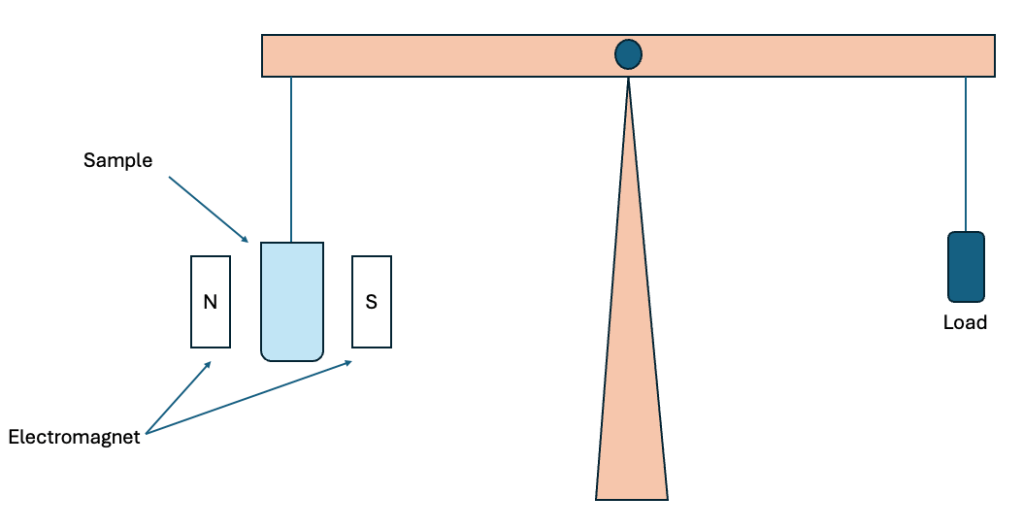
The above setup is called the Gouy balance. When the sample is exposed to a magnetic field, it show reveal its magnetism. Strong magnetic substance will produce magnetic field proportionate to, or stronger than, the applied magnetic field. This will cause the sample to increase its mass. In contrast, weak magnetic substance will decrease its mass.
Exercises
Subscribe to get see the answers
Q1. Which of the following atoms would be expected to be attracted by a magnetic field?
A) Zn
B) Mg
C) Mn
D) Ca
Q2. Explain why zinc is not classed as a transition metal.
Q3. Predict the observation of this experiment and explain your answer

![ESS 8.1.3 [AHL] Biocapacity and Environmental Migration](https://mypytrclass.com/wp-content/uploads/2025/12/image-4.png?w=1024)




![ESS 8.3.4 [AHL] Photochemical Smogs and Tropospheric Ozone](https://mypytrclass.com/wp-content/uploads/2025/12/image-1.png?w=1024)

 PYTR Class