
Learning Objectives
- Outline influences on the type of community that develops in a succession
- Summarise the changes in net productivity and gross productivity in a community undergoing succession
- Outline r- and K-strategist species
- Outline challenges to the concept of a climax community
- Outline the term plagioclimax
Part 1: Influences on the type of community that develops in a succession
Influenced by bottom-up and top-down factors
- Bottom-Up Factors:
- Pressures restricting resource availability for lower trophic levels (e.g., producers) reduce resource supply, limiting the abundance of organisms at higher trophic levels.
- Effect of soil and producers, shaping ecosystem development. Factors are:
- Steep Slopes: Limit soil formation.
- Poor Drainage: Leads to waterlogging.
- Parent Rock: Can create extreme soil conditions (e.g., ultra-basic soils).
- Soil’s Role: Varies in mineral content and structure, influencing plant communities.
- Top-Down Factors:
- A higher trophic level shapes the community structure of a lower trophic level through predation.
- Effect of higher trophic levels and cascade down the food chain.
- Primary Consumers: Influence plant populations.
- Higher Trophic Levels: Regulate lower levels, impacting succession.
- Impact on Succession: Living organisms shape the structure of the final community.
Part 2: Changes in net productivity and gross productivity in a community undergoing succession
- In the early stages of succession:
- Gross Primary Productivity (GPP) is low, but Net Primary Productivity (NPP) is high due to low overall cellular respiration rates.
- This relationship is represented by the production-to-respiration ratio (P : R).
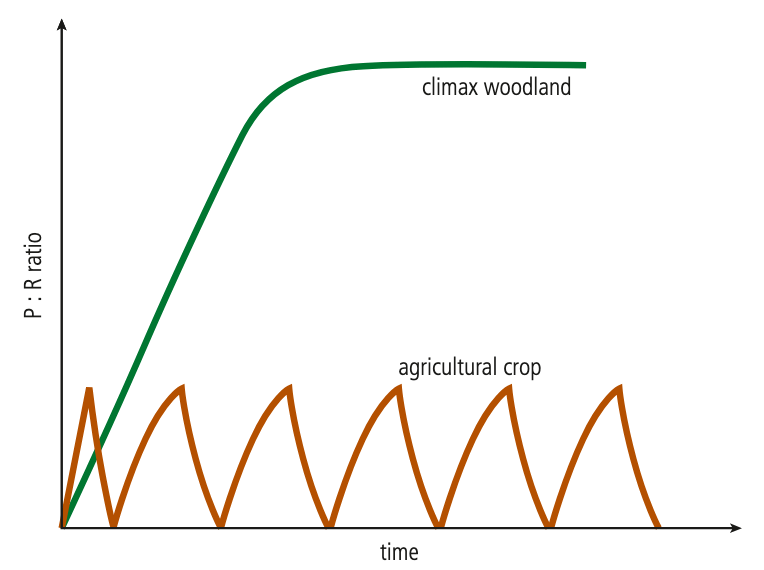
- P : R ratio dynamics:
- P : R = 1 → Production equals cellular respiration, resulting in a steady-state community.
- P : R > 1 → Biomass accumulates.
- P : R < 1 → Biomass is depleted.
- In later succession stages:
- Increased consumer populations lead to higher community respiration rates.
- Gross productivity remains high in a climax community, but net productivity approaches zero (NPP = GPP − R).
- The P : R ratio approaches 1 as respiration balances productivity.
- Comparing food production systems to natural ecosystems:
- Intensive crop production differs from a natural climax community.
- Both fields and woodlands start with low productivity, increasing as biomass accumulates.
- Farmers prevent P : R from reaching 1, as high respiration would negate productivity gains.
- Crops like wheat are harvested before P : R = 1 to maximize yield.
- In food production, herbivore populations are controlled to increase net productivity.
- In natural woodlands, consumer populations rise, balancing productivity with respiration, leading to a climax community where P : R = 1.
Part 3: K-strategist and r-strategist Species [Recall]
- Natural selection may favour individuals with high reproductive rates and rapid development (r-species) over those with lower reproductive rates but better competitive ability (K-species).
- In predictable environments (e.g., climax communities where resources do not fluctuate), there is little advantage to rapid growth.
- Natural selection favours species that maximize use of natural resources.
- These species produce fewer young with a higher probability of survival.
- K-species tend to have long life spans, large body sizes, and develop slowly.
- In disturbed habitats with rapidly changing conditions (e.g., pioneer communities), r-species are favoured.
- R-species can respond quickly, develop rapidly, and reproduce early.
- This leads to a high rate of productivity.
- Colonizer species often have high dispersal abilities to reach disturbed areas.
r-Strategist Species
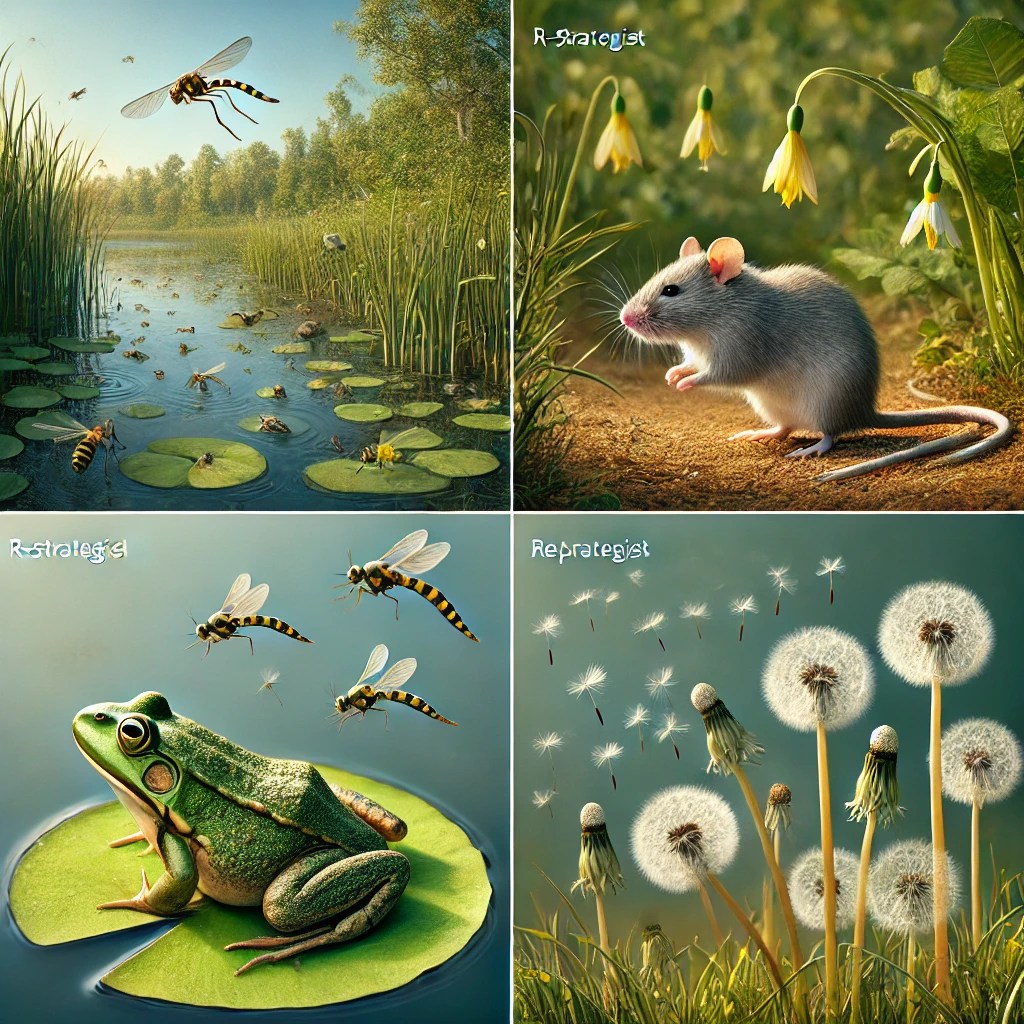
r-strategists are species that focus on high reproductive rates and rapid population growth in unpredictable environments.
Characteristics:
- Short lifespan
- High reproductive rate (many offspring per reproductive cycle)
- Minimal parental care (offspring are left to survive on their own)
- Small body size
- Rapid maturation (short time to reach reproductive age)
- High mortality rate (many offspring die before reaching adulthood)
- Boom-and-bust population cycles (population size fluctuates dramatically)
- Efficient colonisers of new or disturbed environments
K-Strategist Species
K-strategists focus on long-term survival, stable populations, and competition in environments with limited resources.
Characteristics:
- Long lifespan
- Low reproductive rate (few offspring per reproductive cycle)
- High parental care (offspring receive protection and nurturing)
- Larger body size
- Slow maturation (longer time to reach reproductive age)
- Low mortality rate (higher survival of offspring)
- Stable population size (close to carrying capacity, K)
- Strong competitors in stable environments

Part 4: Climax Community and Plagioclimax
Challenges to the Climax Community Concept
- The idea of a single, definitive climax community is debated.
- Uncertainty exists about which ecosystems would naturally develop without human influence.
- Traditionally, it was believed that closed-canopy forests would dominate Central and Western Europe wherever trees could grow.
- The Vera wood–pasture hypothesis, proposed by Frans W.M. Vera, suggests that large herbivores (e.g., cattle, horses) would have created a dynamic landscape of alternating forests and open areas.
- In this hypothesis, herbivore activity leads to alternative stable states rather than a single climax community.
- Herbivore Influence: Large herbivores play a key role in shaping plant communities.
- No Fixed Endpoint: Ecosystem development is not destined for a single, stable state.
- Dynamic Mosaic: Grazing maintains a mix of open grasslands and scattered trees, preventing full forest cover.
Plagioclimax
- Climatic and soil (edaphic) factors determine the nature of a climax community.
- Human disturbances can interrupt succession, leading to a different stable state rather than the natural climax community. This process is known as plagioclimax.
- Examples of causes leading to plagioclimax:
- Footpath erosion from continuous trampling.
- Sand dune degradation caused by walkers destroying vegetation.
- Human activities such as agriculture, hunting, forest clearance, burning, and grazing alter succession and prevent the original climax community from forming.
- An ecosystem’s ability to survive change depends on its diversity and resilience.
Exercises
Exercise 1 – Multiple Choice Questions
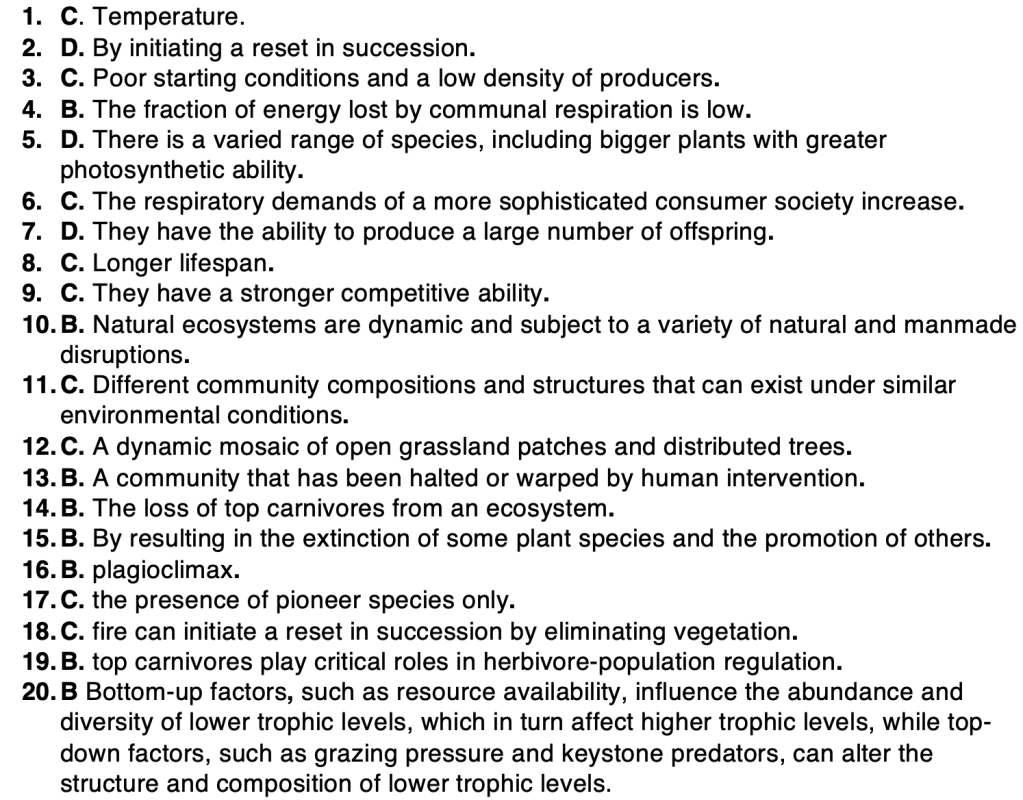
Answer for the MCQs
Exercise 2 – Written Answer Questions
Subscribe to get access to the worksheet with answers
Read more of this content when you subscribe today.
![ESS 8.1.3 [AHL] Biocapacity and Environmental Migration](https://mypytrclass.com/wp-content/uploads/2025/12/image-4.png?w=1024)



![ESS 8.3.4 [AHL] Photochemical Smogs and Tropospheric Ozone](https://mypytrclass.com/wp-content/uploads/2025/12/image-1.png?w=1024)
 PYTR Class