
Learning Objectives
- Outline properties of transition metals
- variable oxidation state
- catalytic properties
- formation of coloured compounds
- formation of complex ions with ligands.
- Deduce the electron configurations of ions of the first-row transition elements.
Chemical Properties of Transition Metals
Transition metals exhibit distinct chemical behaviors that set them apart from s-block metals. They:
- Form compounds with multiple oxidation states
- Create a variety of complex ions
- Produce colored compounds
- Function as catalysts in elemental and compound form
Part 1: Variable Oxidation State
A key characteristic of transition metals is their ability to exist in multiple oxidation states, unlike s-block metals, which typically display a single oxidation state corresponding to their group number. Key observations include:
- All transition metals exhibit both +2 and +3 oxidation states.
- From scandium to chromium, the +3 oxidation state (M³⁺) is more stable,
- In later elements, the +2 state (M²⁺) becomes more common due to increasing nuclear charge, which makes the removal of a third electron more difficult.
- The maximum oxidation state increases in steps of +1, peaking at manganese, where both 4s and 3d electrons participate in bonding.
- After manganese, the maximum oxidation state decreases incrementally.
- Oxidation states above +3 tend to exhibit covalent character
- Highly charged ions polarise negative ions, increasing covalent interactions.
- Compounds with higher oxidation states often act as oxidising agents.
- For example, potassium dichromate(VI), K2Cr2O7, is used in alcohol oxidation reactions.
Charges of first row of transition metals
| Element | Sc | Ti | V | Cr | Mn | Fe | Co | Ni | Cu | Zn |
|---|---|---|---|---|---|---|---|---|---|---|
| Oxidation States | +2, +3 | +2, +3, +4 | +2, +3, +4, +5 | +2, +3, +4, +5, +6 | +2, +3, +4, +5, +6, +7 | +2, +3, +4, +5, +6 | +2, +3, +4, +5 | +2, +3, +4 | +1, +2, +3 | +2 |
Part 2: Catalysis
Transition Metals as Catalysts
Transition metals and their ions serve as crucial catalysts by providing alternative reaction pathways with lower activation energy, enabling industrial chemical processes to proceed efficiently.
Examples of transition metals in catalysis:
- Iron (Fe) in the Haber process

- Nickel (Ni) in hydrogenation reactions:
- Nickel catalyses the conversion of alkenes to alkanes by adding hydrogen across a carbon-carbon double bond.
- This process is used to convert unsaturated vegetable oils into margarine.
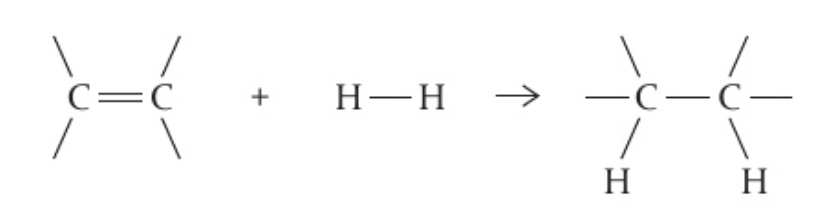
- Palladium (Pd), rhodium (Rh), and platinum (Pt) in catalytic converters:
- This reaction helps eliminate harmful pollutants from vehicle exhaust emissions.

Part 3: Formation of Complexes & Coloured Compounds
Formation of Complexes with Ligands
Transition metal ions in solution have high charge density, attracting water molecules that form coordination bonds, creating complex ions. For example, [Fe(H2O)6]3+ forms when Fe3+ binds with six water molecules.
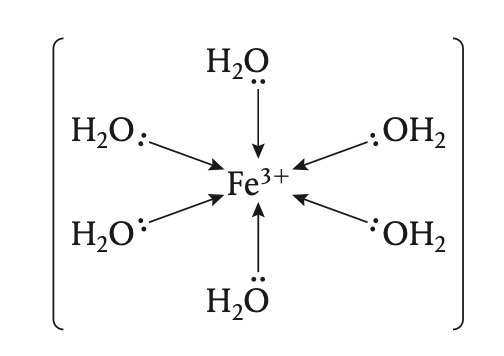
The square brackets indicate that the ion and ligands form a single unit, with charge distributed between them. Complexes form when a central metal ion is surrounded by molecules or ions (ligands) possessing lone electron pairs, which are used to create coordination bonds. The number of these bonds defines the coordination number.
Colouration of Transition Metal Complexes
Transition metal complex ions are coloured due to the splitting of the 3d sublevel into two energy levels in the presence of ligands. The ion Sc3+ appears colourless because it lacks d-electrons.
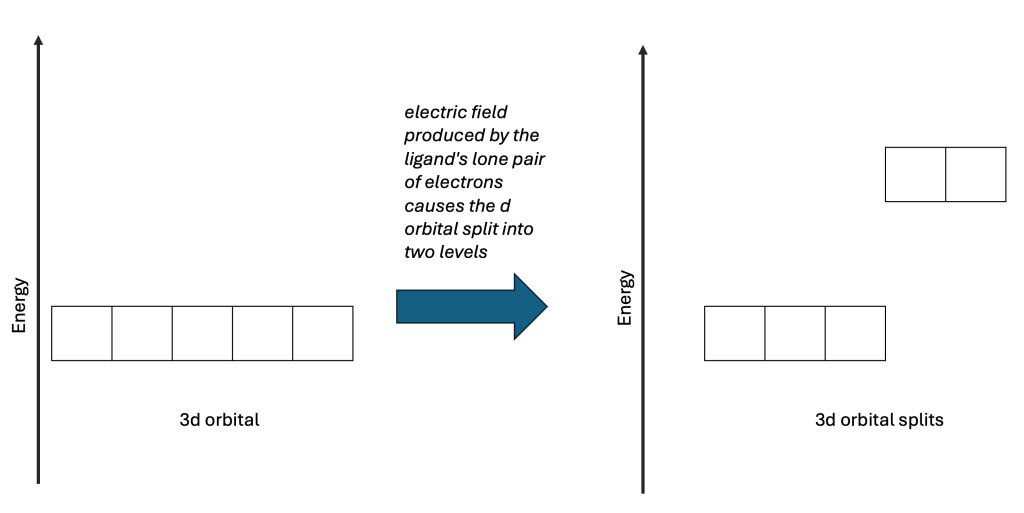
When light passes through a transition metal solution, electrons absorb energy and move between d-orbital levels, resulting in characteristic colours.
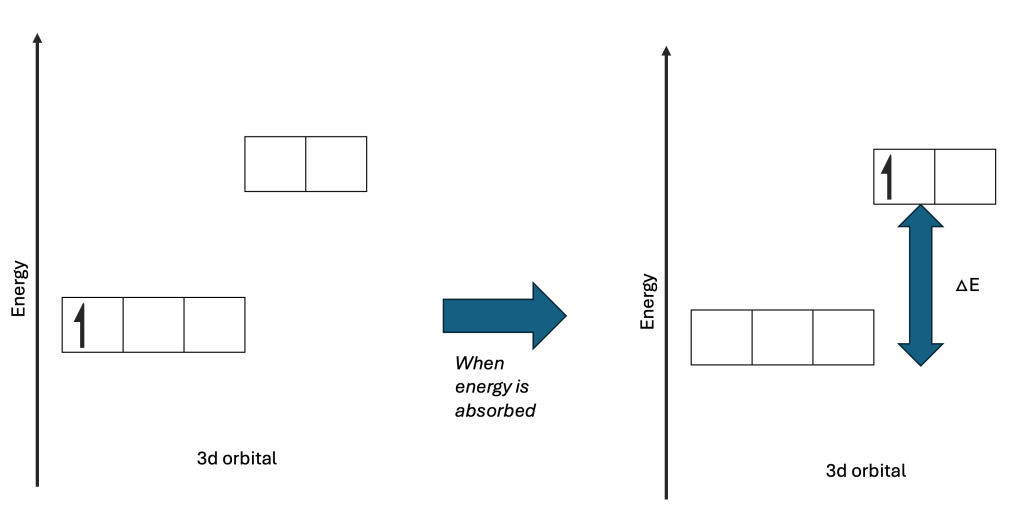
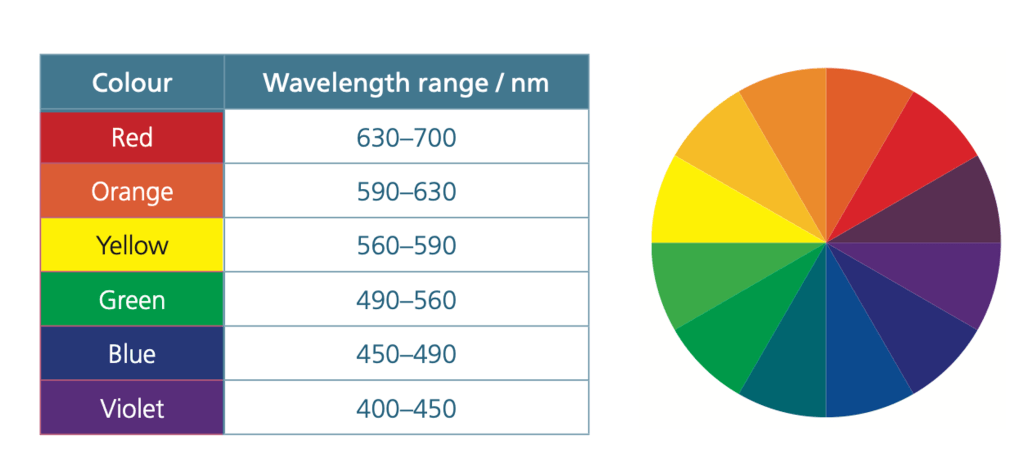
The colour observed is complementary to the absorbed wavelength. For example, [Fe(H₂O)₆]³⁺ appears yellow because it absorbs blue light. The difference in energy levels between the two splits defines the frequency. This can be measured with the wavelength as shown below.
Influence of Ligands on Colour
Different ligands cause varying degrees of d-orbital splitting, affecting the wavelength of absorbed light and, therefore, the observed color. For example, replacing four water molecules in [Cu(H₂O)₆]²⁺ with ammonia in [Cu(NH₃)₄(H₂O)₂]²⁺ results in a deeper blue color due to greater d-orbital splitting by ammonia.
Relationship Between Absorbance and Concentration
Colored substances absorb specific light wavelengths, and the intensity of absorption is proportional to concentration. This relationship allows the use of calibration curves to determine unknown concentrations by comparing absorbance values from known standards.
Exercises
Subscribe to see the answer
Q1. Predict whether the splitting of the d orbitals in [Fe(CN)6]4− would be less than or greater than the splitting in [Fe(H2O)6]2+.
Q2. Explain why [Fe(H2O)6]3+ and [Cr(H2O)6]3+ have different colours.
![ESS 8.1.3 [AHL] Biocapacity and Environmental Migration](https://mypytrclass.com/wp-content/uploads/2025/12/image-4.png?w=1024)




![ESS 8.3.4 [AHL] Photochemical Smogs and Tropospheric Ozone](https://mypytrclass.com/wp-content/uploads/2025/12/image-1.png?w=1024)

 PYTR Class