
Learning Objectives
- Explain how solar radiation and gravity drive the movement of water in the hydrosphere.
- Describe the global hydrological cycle as a system with stores and flows.
- Identify and quantify the main water stores in the hydrological cycle, including oceans, glaciers, groundwater, surface freshwater, atmosphere, and organisms.
- Explain the key flows in the hydrological cycle, such as transpiration, sublimation, evaporation, condensation, advection, precipitation, melting, freezing, surface runoff, infiltration, percolation, streamflow, and groundwater flow.
Part 1: Hydrological Cycle
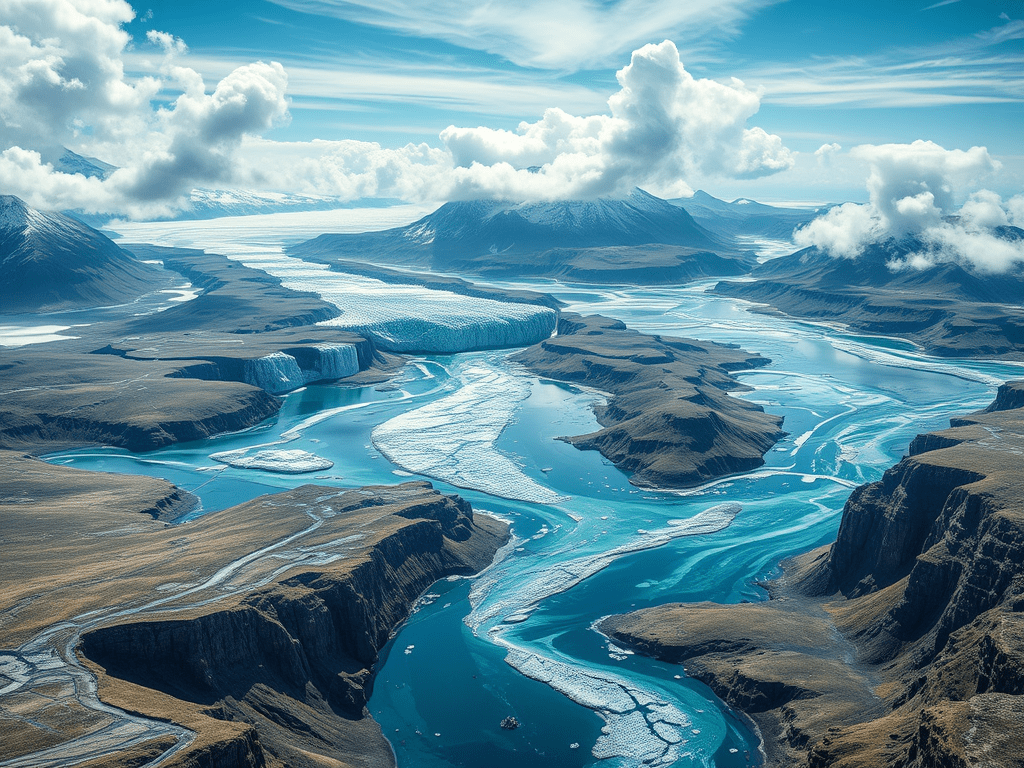
- About 70% of Earth’s surface is covered by water, collectively known as the hydrosphere.
- The hydrosphere includes oceans, rivers, lakes, glaciers, ice caps, and atmospheric water vapor.
- Water moves between different parts of the hydrosphere through processes like melting, evaporation, and precipitation.
- The movement of water is driven by two main forces: the sun and gravity.
- Solar radiation provides heat energy, causing water to evaporate from oceans, rivers, lakes, and wetlands.
- Water vapor rises, is transported by wind, and condenses to form precipitation, returning water to the surface.
- Gravity moves water from high elevations, such as mountains, to lower areas, eventually reaching the sea.
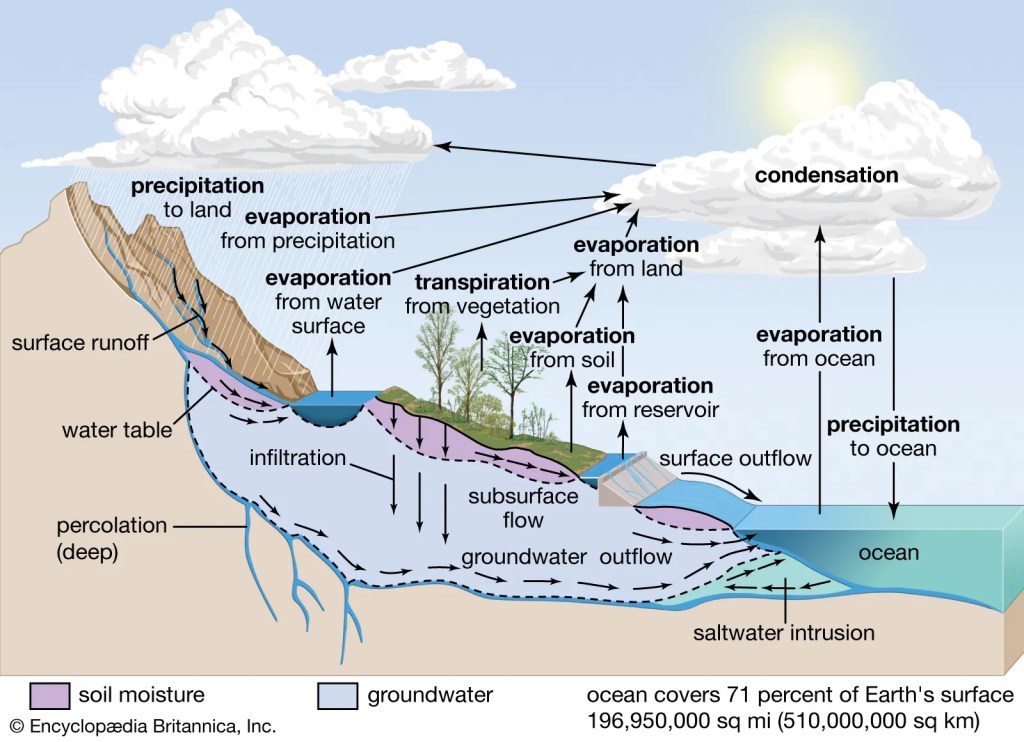
- This continuous movement of water in different phases is known as the water cycle or hydrological cycle.
Part 2: Hydrological Cycle as a System
Recall that a system would have an input, process and storage, and an output.
- The hydrological cycle is a biogeochemical cycle, functioning as a system with stores and flows.
- Stores and flows can be examined individually or collectively.
Inflows and Outflows of a Lake
Inflows:
- Rainfall or other forms of precipitation
- Overland flow of water from surrounding areas
- Sewage inputs from domestic, industrial, or agricultural sources
Outflows:
- Evaporation
- Infiltration of water into groundwater
- Abstraction of water for domestic, industrial, or agricultural use
- Precipitation: The conversion and transfer of moisture in the atmosphere to the land, including all forms of rainfall, snow, frost, hail, and dew.
- Interception: Water that is caught and stored by vegetation.
- Water not stored by plants may be lost through:
- Interception loss: Water retained by plant surfaces and later evaporated away.
- Throughfall: Water that falls through gaps in the vegetation or drips from leaves, twigs, or stems.
- Stemflow: Water that trickles along twigs and branches before flowing down the main trunk.
Part 3: Transfer & Transformation
Water Cycle Transfers
- Surface runoff:
- Water from rainfall flows downhill over the land surface.
- Eventually enters lakes, rivers, or other surface waterways.
- Usually in small quantities but can be significant during floods.
- Streamflow:
- Water moves through rivers and streams following their channels.
- Eventually flows into lakes, wetlands, or the sea.
- Infiltration:
- Water soaks into the soil if it stays on the surface long enough.
- More likely on flat or gently sloping land with vegetation slowing runoff.
- Land surfaces like pavement or tarmac reduce infiltration.
- Percolation:
- Water moves through soil and rock particles after infiltration.
- Eventually reaches the water table, where the ground is fully saturated.
- Groundwater flow:
- Groundwater moves slowly through porous rocks, usually downhill.
- Movement stops when it reaches impermeable rocks that prevent further flow.
- Can emerge at the surface as a spring, which may develop into a stream or river.
- Advection:
- Wind moves water vapor and clouds across long distances.
Water Cycle Transformations
- Evaporation:
- Heat energy breaks bonds between water molecules, converting liquid water into vapor.
- Happens faster at higher temperatures and in windy conditions.
- High humidity slows evaporation.
- Transpiration:
- Plants absorb liquid water from soil and release it as vapor through their leaves.
- Water moves from roots to leaves to replace lost moisture.
- Evapotranspiration is the combined process of transpiration and evaporation.
- Condensation:
- Water vapor cools and turns back into liquid water droplets.
- Happens at low temperatures, especially at high altitudes.
- Contributes to cloud formation.
- Sublimation:
- Ice converts directly into water vapor, or vice versa, under specific conditions.
- Precipitation:
- Water returns to the Earth’s surface as rain, snow, hail, sleet, dew, frost, or fog.
- Melting and Freezing:
- Melting: Ice turns into water if the temperature rises.
- Freezing: Water turns into ice if the temperature drops.
- Glacial meltwater flows into rivers and eventually reaches the sea.
Part 4: Stores in the Hydrological Cycle
Major Stores in the Hydrological Cycle
| Store | Best estimate (km³) | Residence time |
|---|---|---|
| Oceans | 1,350,000,000 | 2500 years |
| Atmosphere | 13,000 | 8 days |
| Rivers | 1,700 | 16 days |
| Lakes | 100,000 | 17 days |
| Inland seas | 105,000 | Data not available |
| Soil moisture | 50,000 | 1 year |
| Groundwater | 8,200,000 | 1400 years |
| Glaciers & ice caps | 27,500,000 | Montane glaciers: 1600 yearsPolar ice caps: 9700 years |
| Organisms | 1,100 | Hours |
Oceans (96.5% of all water)
- Composed of saltwater with an average salinity of 35 parts per thousand (%)
- High salinity makes seawater unsuitable for farming, industry, or drinking
- Desalination can convert seawater into freshwater but is energy-intensive and expensive
Glacial and Polar Ice (1.7%)
- Frozen freshwater found in high mountains (e.g., Rockies, Himalayas) and polar regions (Greenland, Antarctica, Arctic, Southern Oceans)
- Ice fluctuates seasonally but is declining due to global warming
Groundwater (1.7%)
- Water percolates into porous rocks or aquifers
- Groundwater is generally fresh but may contain dissolved minerals
- Extracted using wells
Surface Freshwater (0.02%)
- Includes rivers, lakes, and freshwater wetlands
- Naturally low salinity but prone to pollution from farming, industry, and households
- Despite being a small store, it is highly accessible
Relatively Minor Stores
Atmosphere (0.001%)
- Water evaporates from oceans and surface waters and enters the air as water vapor
- Varies over time and location
- Water vapor is an important greenhouse gas, helping regulate Earth’s temperature
Living Organisms (0.0001%)
- Water is essential for life, present in cells and tissues of all organisms
Exercises
Subscribe to access the MCQ Quiz
Read more of this content when you subscribe today.
![ESS 8.1.3 [AHL] Biocapacity and Environmental Migration](https://mypytrclass.com/wp-content/uploads/2025/12/image-4.png?w=1024)


![ESS 8.3.4 [AHL] Photochemical Smogs and Tropospheric Ozone](https://mypytrclass.com/wp-content/uploads/2025/12/image-1.png?w=1024)
 PYTR Class