
Learning Objectives
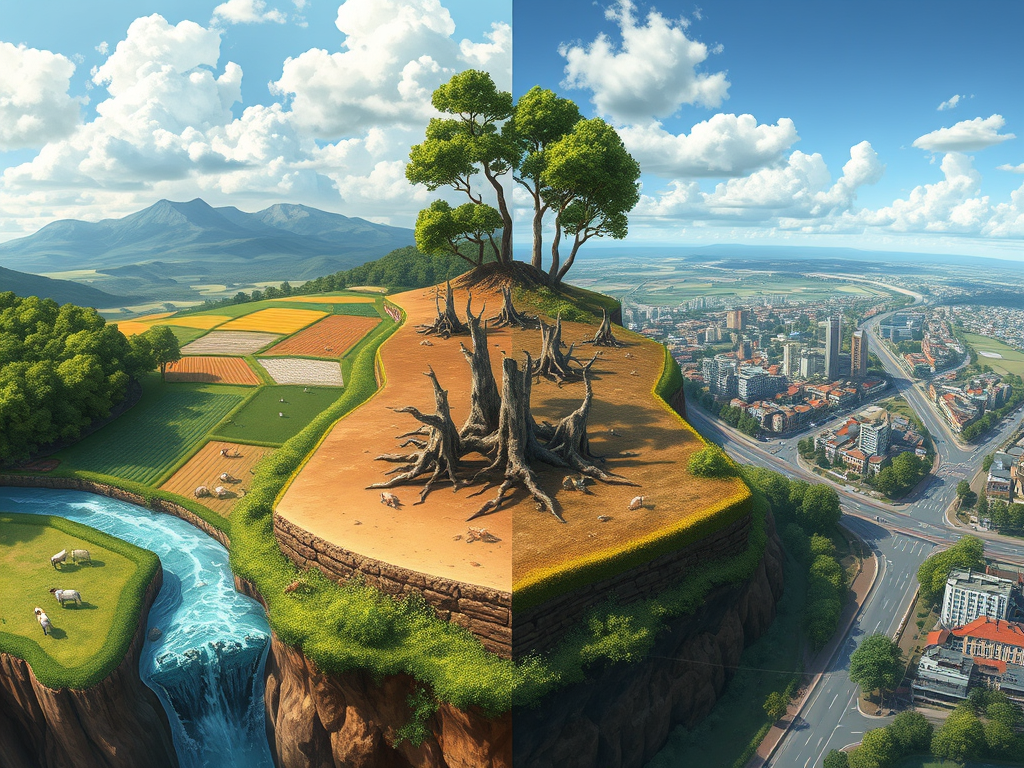
- Analyze how human activities (e.g., agriculture, deforestation, and urbanization) impact the flows and stores of the hydrological cycle.
- Illustrate the steady-state condition of a water body using flow diagrams of inputs and outputs.
Part 1: Human Activities
- Human Activities & Hydrological Impact: Agriculture, deforestation, and urbanization can alter water stores and flows. Changes in land use often lead to reduced evapotranspiration and increased runoff, increasing the risk of flash floods.
Agriculture
- Different types of agriculture impact drainage basin stores and flows differently:
- Arable (crop) farming: Removes vegetation cover during harvest, making the land more vulnerable to erosion.
- Pastoral (livestock) farming: Maintains grass cover year-round but may replace diverse forests with monoculture grass, leading to lower interception, reduced storage, and decreased infiltration.
- Vegetation type and density determine interception:
- Cereals intercept less water than broadleaf crops.
- Row crops leave bare soil exposed.
- Forests allow up to five times more infiltration than grasslands by channeling water into the ground.
- Land-use practices impact infiltration:
- Grazing compacts soil, reducing infiltration.
- Poor drainage can lead to waterlogging and salinisation.
Table 1: Influence of ground cover on infiltration rates
| Ground cover | Infiltration rate (mm h⁻¹) |
|---|---|
| Old permanent pasture | 57 |
| Permanent pasture: moderately grazed | 19 |
| Permanent pasture: heavily grazed | 13 |
| Strip-cropped | 10 |
| Weeds or grain | 9 |
| Clean-tilled | 7 |
| Bare, crusted ground | 6 |
Deforestation
- Vegetation helps regulate water movement by increasing interception, reducing overland flow, and boosting evapotranspiration.
- Effects of deforestation:
- Increased flood risk due to reduced interception and increased runoff.
- Increased river sediment transport.
- Increased overland flow leading to more frequent erosion.
- Reduced infiltration and evapotranspiration.
- Deforestation has widespread impacts as it often occurs for:
- Agricultural expansion.
- Industrial and tourist developments.
- Urbanisation.
Urbanization
- Urban areas create impermeable surfaces (roads, roofs, pavements) that reduce infiltration and increase runoff.
- Urbanization increases drainage density with extensive networks of drains, gutters, and underground sewers.
- Greater impact in lower drainage basins, where more urban areas are located.
- Conflicting impacts on hydrological processes:
- Increased erosion due to higher water volumes in rivers.
- Faster flow and transport of materials due to enlarged channels.
- Reduced erosion in some areas due to riverbank protection schemes.
Part 2: Steady State of Water Bodies
- Steady State of Water Bodies: The balance of inputs and outputs in a water body can be represented using flow diagrams.
- Uses of Flow Diagrams:
- Help calculate sustainable rates of water harvesting from lakes, aquifers, and other water bodies.
- Inputs into a Drainage Basin:
- Mainly from precipitation.
- Can also come from transfer from other drainage basins and groundwater flow.
- Outputs from a Drainage Basin:
- Evaporation and transpiration.
- Discharge out of the basin.
- Groundwater flow into other drainage basins.
- Examples:
- Water balance. in the Amazon rainforest.
Exercises
Subscribe to access the file with answer keys
Questions:
- Describe how deforestation affects the infiltration rate of soil?
- Outline how urbanisation alter the natural flow of water in the hydrological cycle?
- Explain that heavily grazed permanent pasture has a lower infiltration rate compared to old permanent pasture?
- Outline the potential consequences of increased surface runoff due to agricultural practices?
- Outline how the construction of impermeable surfaces in urban areas impact groundwater recharge?
![ESS 8.1.3 [AHL] Biocapacity and Environmental Migration](https://mypytrclass.com/wp-content/uploads/2025/12/image-4.png?w=1024)




![ESS 8.3.4 [AHL] Photochemical Smogs and Tropospheric Ozone](https://mypytrclass.com/wp-content/uploads/2025/12/image-1.png?w=1024)
 PYTR Class