
Learning Objectives
- Describe the properties of water
- Describe the roles of water as C sink
- Describe water stratification
- Outline process of upwelling
- Describe the thermohaline circulation system
Part 1: Properties of Water
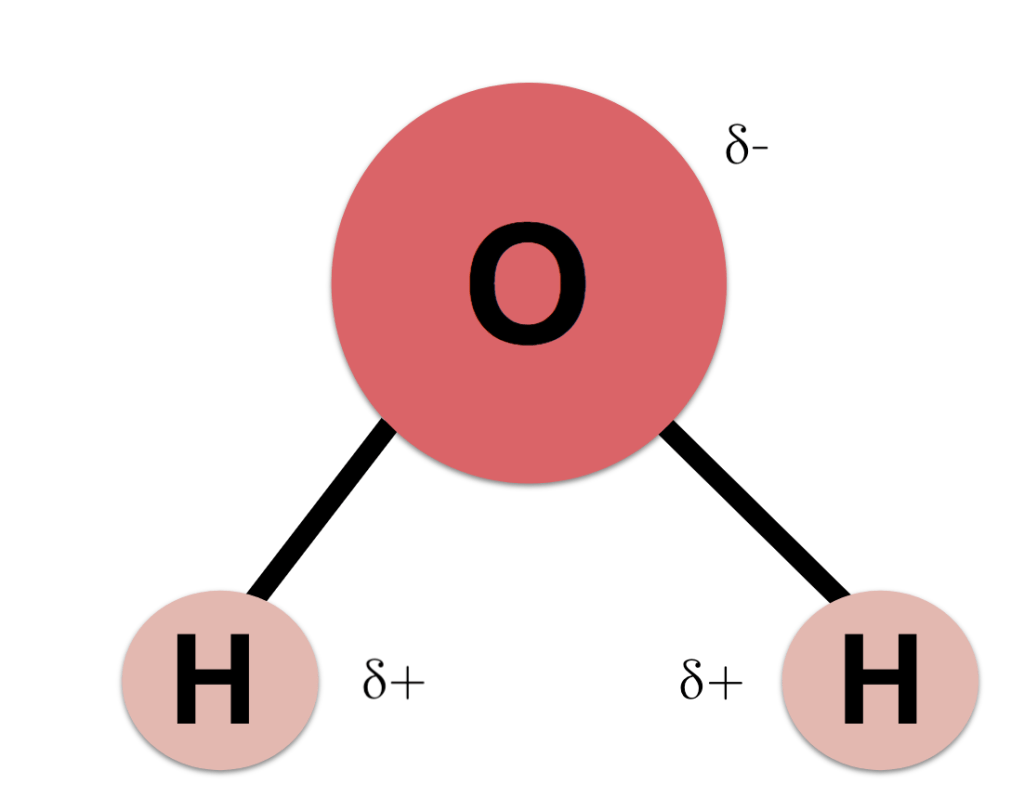
- Water (H₂O) is an inorganic compound made of hydrogen (H) and oxygen (O).
- It exists as a solid, liquid, or gas and covers over 70% of Earth’s surface.
Structure & Properties
- Polarity:
- Oxygen draws electrons away from hydrogen, creating a partial negative charge on oxygen and partial positive charges on hydrogen.
- This makes water a polar molecule.
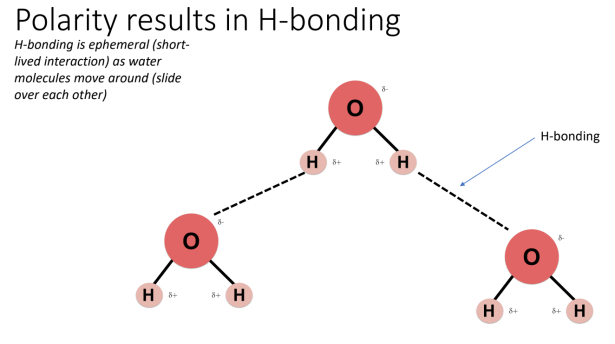
- Hydrogen Bonding & Cohesion:
- The attraction between partially charged hydrogen and oxygen atoms of different water molecules forms hydrogen bonds.
- These bonds keep water molecules close together (cohesion).
- Specific Heat Capacity:
- Water has a high specific heat capacity, meaning it takes longer to heat up and cool down.
- This leads to moderate maritime climates near water bodies and extreme continental climates inland.
- Surface Tension:
- Due to strong hydrogen bonds, water has high surface tension, allowing some insects to walk on its surface.
- Adhesion:
- Water molecules stick to other surfaces due to their polarity.
- On clean glass, adhesion > cohesion, forming a thin film.
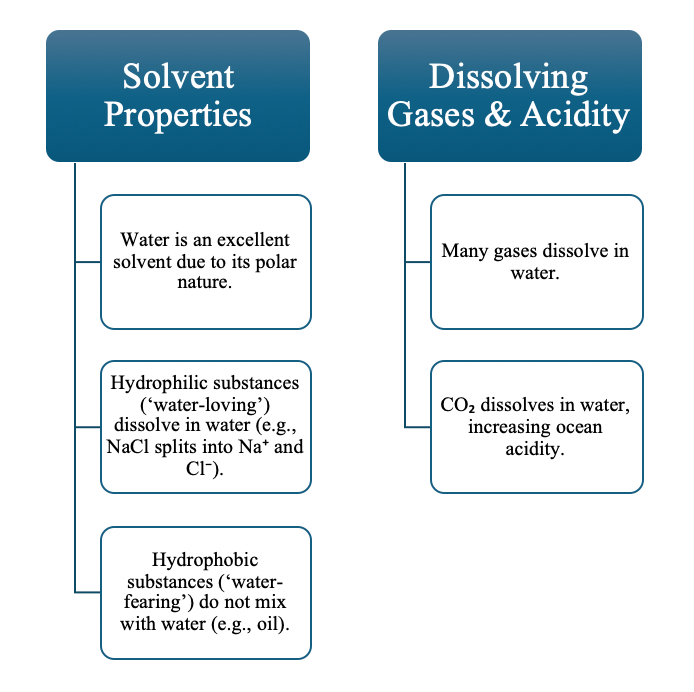
Part 2: Water as C Sink
Carbon in Oceans & Seabed Sediments
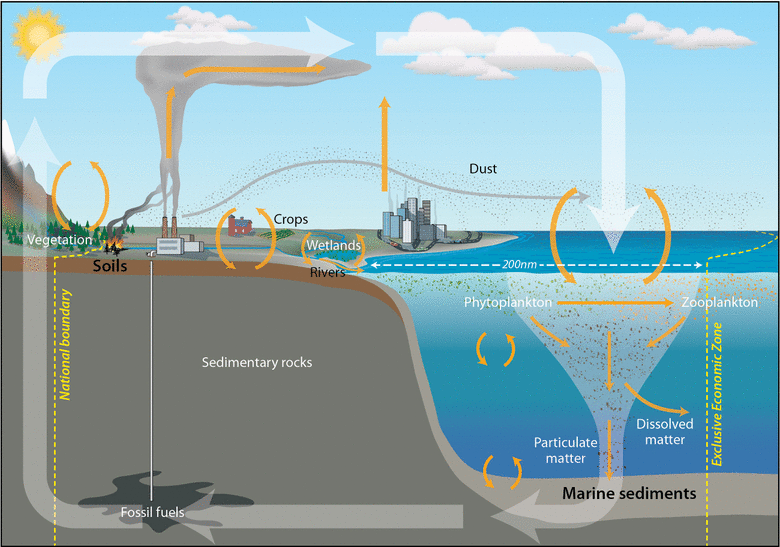
- Over the long term, carbon is taken up by living organisms as biomass, which accumulates on the seabed.
- Seabed sediments contain inorganic carbonates and organic carbon compounds that are not fully decomposed.
- Over millions of years, these sediments can become fossil fuels.
Oceans as a Carbon Sink
- Oceans are the largest CO₂ sink on Earth.
- More than 90% of the world’s carbon has settled in the ocean over geological time.
- Photosynthesis converts CO₂ into organic material, which eventually settles in the deep ocean.
- The deep ocean has a higher concentration of carbon than the upper ocean.
- Oceans reduce atmospheric CO₂ by storing large amounts in seawater and deep-sea sediments.
- If carbon stored on the ocean floor were released, oceans could become a source of CO₂ instead of a sink.
Ocean Acidification
- Short-term carbon sequestration in oceans as dissolved CO₂ leads to ocean acidification.
- Cause of ocean acidification: Anthropogenic sources, such as carbon emissions from industries, power plants, cars, and planes.
Effects of CO₂ Absorption in Oceans
- Up to half of the CO₂ released from fossil fuel burning in the last 200 years has been absorbed by the ocean.
- Absorbed CO₂ in seawater forms carbonic acid (H₂CO₃), lowering the pH and making the ocean more acidic.
- Increased H⁺ concentration in water:
- Makes the ocean more acidic.
- Reduces marine organisms’ access to carbonate ions, which are essential for forming shells and hard parts.
Part 3: Water Stratification
Water Stratification
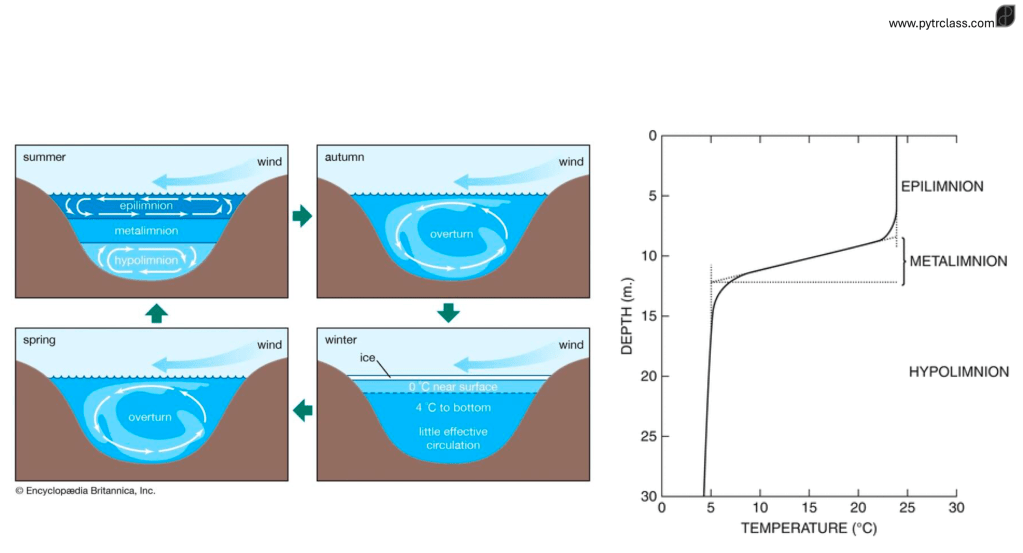
- Lakes and reservoirs can develop layers of warmer, less dense water and colder, denser water due to thermal stratification.
- Water is most dense at 4°C and becomes less dense at temperatures above and below this point.
Seasonal Stratification Changes
- Autumn cooling:
- Surface water cools, becomes denser, and sinks to the bottom.
- When the whole lake reaches 4°C, it reaches its maximum density.
- Further cooling makes the surface water colder but less dense, causing it to float on top of the denser 4°C water.
- If the temperature reaches 0°C, ice forms on the surface, insulating the water below.
- Water below the ice stays around 4°C, supporting freshwater ecosystems.
- Spring warming:
- Ice melts as temperatures rise.
- The surface water warms, increases in density, and sinks, mixing with deeper water.
Stratification Zones in Lakes
- Epilimnion: The warm, well-mixed upper layer.
- Hypolimnion: The colder, denser bottom layer.
- Metalimnion: The transitional layer between them, where temperature changes rapidly.
Factors Affecting Stratification Stability
- Lake depth, size, and shape influence stratification.
- Wind speed and water movements can disrupt or maintain stratification.
- Lakes with high water flow do not develop persistent stratification due to shorter water residence time.
Permanent Stratification (Meromictic Lakes)
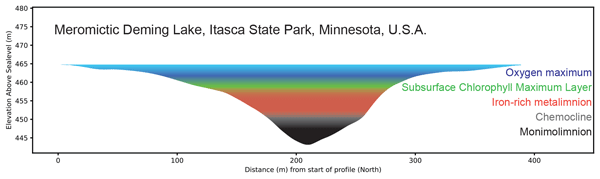
- Some lakes, like Lac Pavin (France), experience permanent stratification.
- Layers in meromictic lakes:
- Mixolimnion (top layer)
- Chemocline (middle layer)
- Monimolimnion (bottom layer) – hypoxic (low O₂), saltier, and denser
Stratification in Freshwater Lakes & Marine Areas
- Stratification occurs in deep freshwater lakes and oceans, forming distinct temperature layers.
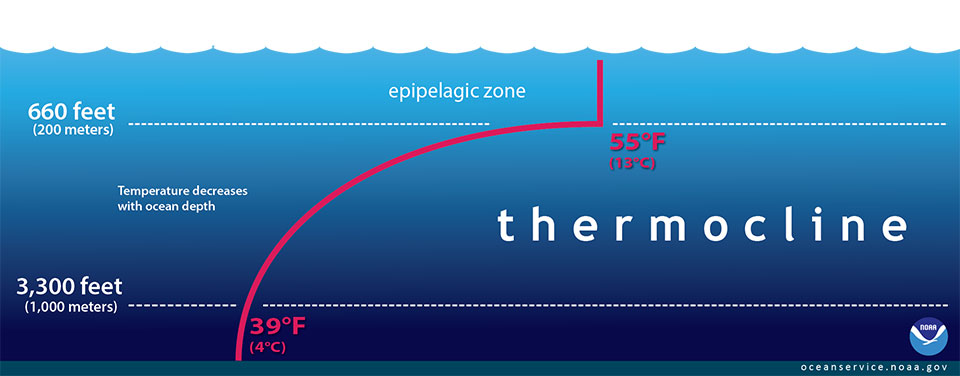
- A thermocline is the transition layer between the warmer mixed surface layer and the cooler water below.
- Warm and cold water differ in:
- Dissolved oxygen (O₂) concentration
- Nutrient availability
Thermoclines
Thermoclines in Oceans
- Sunlight energy is mostly absorbed in the top few centimetres of the ocean.
- Waves mix the surface water, distributing heat down to about 100 m depth.
- Below the mixed layer, temperature remains relatively stable between day and night.
- Ocean temperature declines with depth.
- Thermoclines vary by latitude:
- Steepest in the tropics
- Variable in temperate regions
- Lowest in polar areas (where sea ice insulates the water below)
Thermoclines in Lakes & Seasonal Stratification
- Summer stratification:
- Warm, less dense surface water sits above cold, dense deep water.
- The thermocline separates the layers, preventing mixing.
- Oxygen levels are low below the thermocline, as organisms deplete it.
- Autumn & Winter mixing:
- Surface temperature drops, making water denser.
- Dense surface water sinks, mixing the layers and bringing nutrients to the surface.
- This may trigger an algal/phytoplankton bloom.
- Freezing conditions:
- As temperatures fall, the surface may freeze.
- The densest water sinks to the bottom.
- Less dense water near 0°C rises to the surface, remaining until spring melts the ice.
Ocean Stratification & Climate Change
- Global warming and salinity changes have intensified ocean stratification.
- The greatest changes occur in the upper 200 m of the ocean.
- Over the past 50 years, increasing global temperatures have increased the temperature difference between warm and cold water, reducing mixing.
- Reduced ocean mixing affects:
- Heat transport from the surface to deeper layers.
- Oxygen (O₂) and carbon dioxide (CO₂) exchange between layers.
- Global warming, as warmer surface temperatures lead to further heating.
- Oceans have absorbed excess heat since the 1880s due to human-induced climate change.
- Stratification increase (1960–2018):
- 7% in the upper 200 m.
- 5.8% from the surface down to 2000 m.
- Largest increases:
- Southern Ocean (9.6%)
- Pacific Ocean (5.9%)
- Stratification reduces ocean mixing:
- Wind, currents, and tides usually mix surface and deeper waters.
- Increased density differences between warm and cold water slow down mixing.
- Oceans become more stable, reducing nutrient and gas exchange.
- A warming climate further increases stratification:
- Warmer water expands (steric effect).
- Melting ice adds freshwater, decreasing surface salinity.
- Consequences of stronger stratification:
- Less CO₂ absorption by surface waters, increasing atmospheric CO₂ and global warming.
- Reduced oxygen levels in deeper waters due to limited mixing.
Part 4: Upwelling
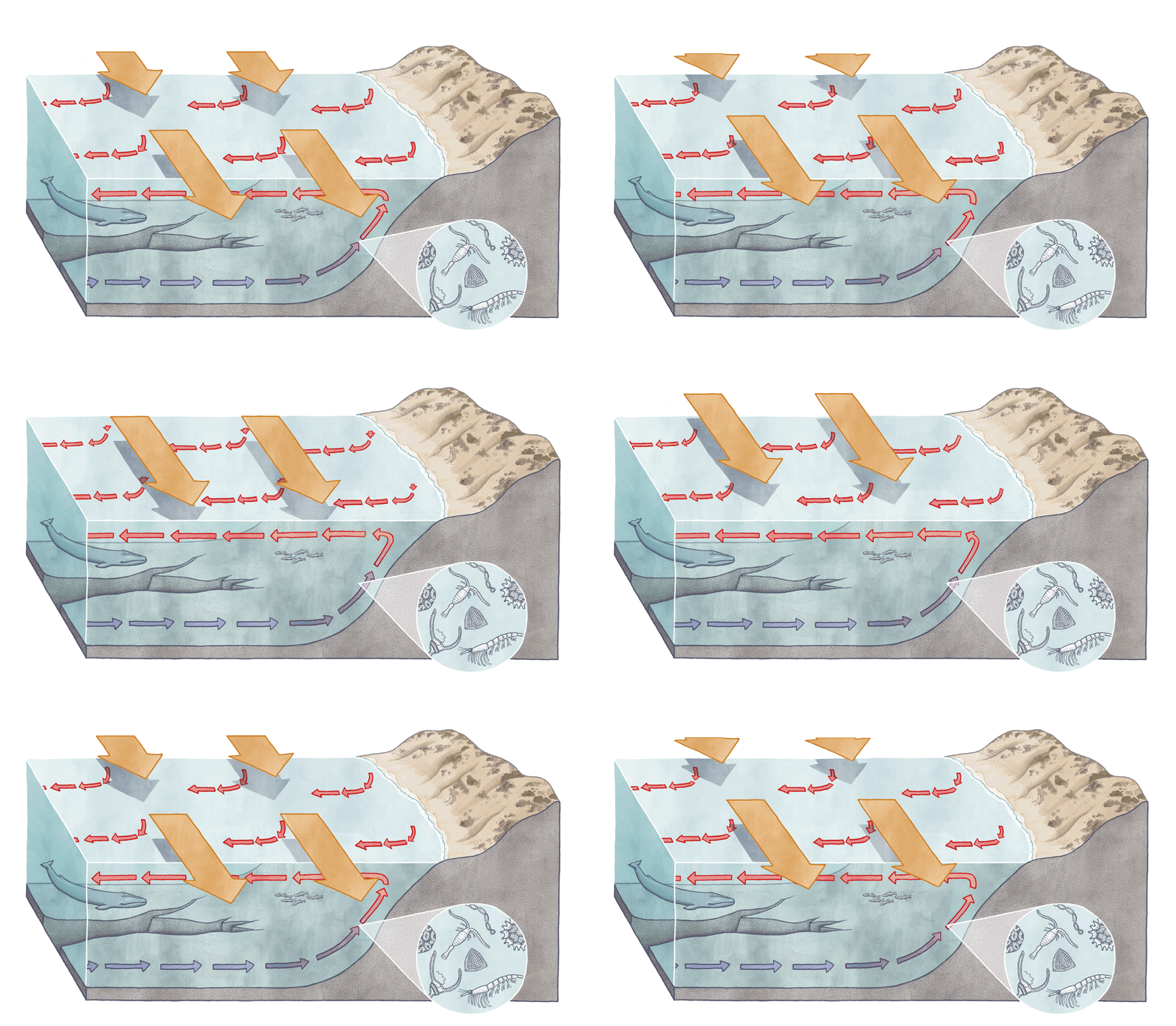
- Upwelling brings cold, nutrient-rich water to the surface.
- Upwelling occurs due to:
- Wind displacement of surface water.
- Coriolis effect (Earth’s rotational deflection).
- Ekman transport (spiraling water movement due to wind and Earth’s rotation).
- Coastal upwelling happens when winds blow parallel to the coastline, replacing warm surface water with colder, nutrient-rich water.
- Main coastal upwelling areas:
- Benguela Current
- California Current
- Canary Current
- Humboldt Current
- Somali Current
- Upwelling varies with ENSO (El Niño-Southern Oscillation) events:
- Weaker trade winds reduce upwelling in equatorial regions.
- Less upwelling = lower productivity due to reduced nutrient supply.
Part 5: Thermohaline Circulation System
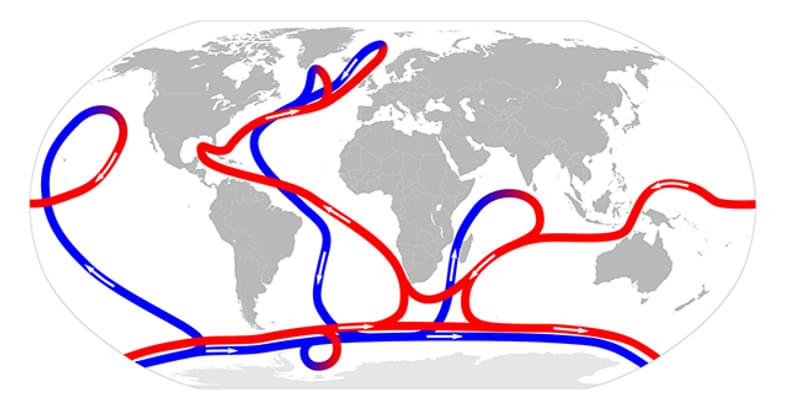
- Driven by temperature and salinity differences in seawater.
- Temperature differences:
- Heating and cooling at the sea surface.
- Salinity differences:
- Evaporation and sea ice formation → increase salinity.
- Precipitation, runoff, and melting ice → decrease salinity.
- Deep water formation & movement:
- In polar regions, cold salty water sinks and moves toward the equator.
- The densest water is in Antarctica, where seawater freezes at -2°C, leaving behind salty, dense water.
- This water circulates into the deep Atlantic, Pacific, and Indian Oceans.
- Surface currents transport warm water to the North Atlantic from the Indian and Pacific Oceans.
- North Atlantic water loses heat to cold winds from Canada → water cools, becomes denser, and sinks.
- Denser water moves through deep ocean currents, eventually reaching the Pacific where it mixes and becomes less dense.
- Density factors in ocean layering:
- Temperature: Higher temp = lower density.
- Salinity: Higher salinity = higher density.
- Pressure: Higher pressure = higher density.
- Freshwater from land runoff is less dense than seawater and stays at the surface.
Exercises
Subscribe to get access
Read more of this content when you subscribe today.
![ESS 8.1.3 [AHL] Biocapacity and Environmental Migration](https://mypytrclass.com/wp-content/uploads/2025/12/image-4.png?w=1024)


![ESS 8.3.4 [AHL] Photochemical Smogs and Tropospheric Ozone](https://mypytrclass.com/wp-content/uploads/2025/12/image-1.png?w=1024)
 PYTR Class