
Learning Objectives
- Describe the ionisation energy patterns
- [AHL] Explain how these discontinuities provide evidence for the existence of energy sublevels.
- [AHL] Calculate ionisation energies using electron excitation data
Part 1: Patterns of First Ionisation Energy
The first ionisation energy is the energy required to remove one mole of electrons from one mole of gaseous atoms to form one mole of gaseous 1+ ions. It is measured in kilojoules per mole (kJ/mol).
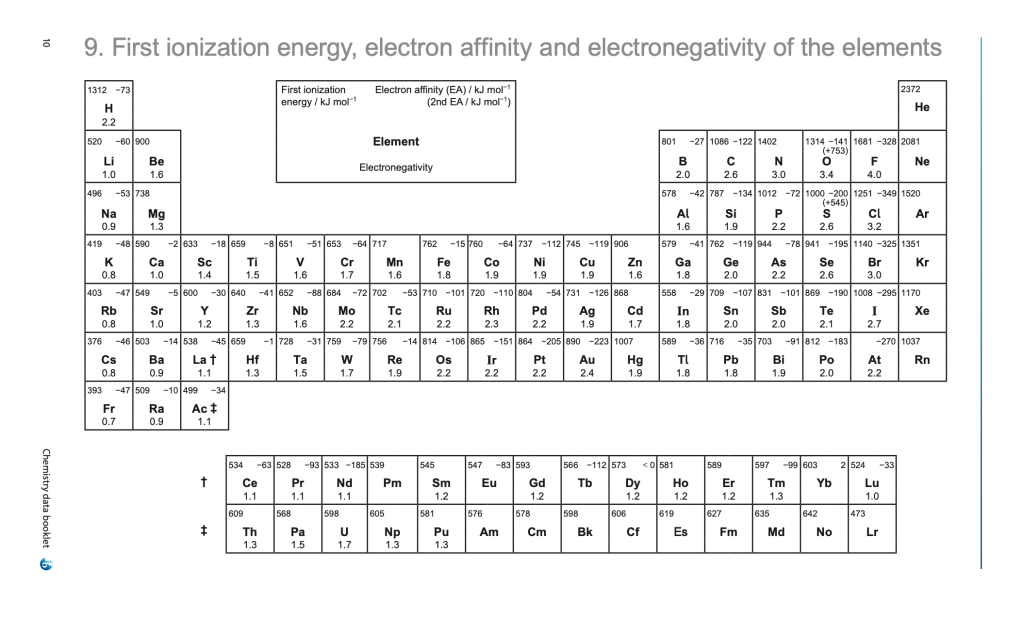
- Group 13 elements (e.g., B) have the electron configuration ns²p¹.
- Group 2 elements (e.g., Be) have the electron configuration ns².
- Group 13 elements have lower first ionisation energies than Group 2 elements because p orbitals have higher energy than s orbitals.
- The ionization energy drops between Group 15 (e.g., N) and Group 16 (e.g., O).
- In Group 16 elements, the removed electron comes from a doubly occupied p orbital, unlike Group 15 elements.
- The Group 16 electron is easier to remove because it experiences repulsion from its paired electron.
It is generally easier to remove an electron from a doubly occupied suborbital than from a singly occupied one. This is because of electron-electron repulsion:
- When two electrons share the same orbital, they have opposite spins, which creates additional repulsion between them.
- This repulsion makes it energetically favorable to remove one of the electrons, lowering the ionization energy.
This explains why Group 16 elements (e.g., O) have lower first ionisation energies than Group 15 elements (e.g., N)—the removed electron in Group 16 comes from a doubly occupied p orbital, where it experiences repulsion from its partner.
Trends in the First 20 Elements (Hydrogen to Calcium)
- General Trend Across a Period (Left to Right)
- The first ionization energy increases across a period (e.g., across Periods 2 and 3).
- This is because the nuclear charge (number of protons) increases, pulling electrons closer to the nucleus.
- The atomic radius decreases, meaning electrons are held more tightly.
- Shielding effect remains relatively constant across a period since electrons are added to the same shell.
- General Trend Down a Group (Top to Bottom)
- The first ionization energy decreases down a group (e.g., from Lithium to Cesium).
- This happens because atomic radius increases due to additional electron shells.
- Outer electrons are further from the nucleus, experiencing less attraction.
- The shielding effect increases, reducing the effective nuclear attraction on the outermost electron.
First Ionization Energies of the First 20 Elements
| Element | Atomic Number | First Ionization Energy (kJ/mol) | Trend Explanation |
|---|---|---|---|
| Hydrogen (H) | 1 | 1312 | Only one electron, strongly attracted to the nucleus. |
| Helium (He) | 2 | 2372 | Highest in Period 1, very strong nuclear attraction. |
| Lithium (Li) | 3 | 520 | Lower than He, as the outer electron is in a new shell (higher energy level). |
| Beryllium (Be) | 4 | 900 | Higher than Li due to greater nuclear charge and small atomic radius. |
| Boron (B) | 5 | 801 | Slight decrease due to the first p-electron, which is slightly easier to remove than s-electrons. |
| Carbon (C) | 6 | 1086 | Higher than B due to increased nuclear charge. |
| Nitrogen (N) | 7 | 1402 | Higher than C due to stable half-filled p-orbitals (extra stability). |
| Oxygen (O) | 8 | 1314 | Lower than N because of electron pairing in the 2p orbital, increasing repulsion. |
| Fluorine (F) | 9 | 1681 | High due to increased nuclear charge and small atomic radius. |
| Neon (Ne) | 10 | 2080 | Highest in Period 2, as it has a full stable outer shell. |
| Sodium (Na) | 11 | 496 | Sharp drop due to the electron being in a new, higher energy 3s orbital. |
| Magnesium (Mg) | 12 | 738 | Higher than Na, as the 3s electron is more tightly bound. |
| Aluminium (Al) | 13 | 578 | Slight decrease as the electron is in the 3p orbital, which is easier to remove than 3s. |
| Silicon (Si) | 14 | 787 | Increasing trend due to higher nuclear charge. |
| Phosphorus (P) | 15 | 1012 | Higher than Si due to stable half-filled 3p orbitals. |
| Sulfur (S) | 16 | 1000 | Slight drop due to electron pairing in 3p, increasing repulsion. |
| Chlorine (Cl) | 17 | 1251 | Higher due to increased nuclear charge and small atomic radius. |
| Argon (Ar) | 18 | 1521 | Highest in Period 3 due to a full stable outer shell. |
| Potassium (K) | 19 | 419 | Large drop as outer electron is now in the 4s orbital, further from the nucleus. |
| Calcium (Ca) | 20 | 590 | Slight increase due to increased nuclear charge and relatively small atomic radius. |
Key Anomalies
- Boron (B) < Beryllium (Be): Due to the first p-electron being easier to remove than a paired s-electron.
- Oxygen (O) < Nitrogen (N): Due to electron pairing in the p-orbital, increasing repulsion.
- Aluminium (Al) < Magnesium (Mg): Due to the 3p electron being easier to remove than the 3s electron.
- Sulfur (S) < Phosphorus (P): Due to electron pairing in the p-orbital increasing repulsion.

Part 2: [AHL] IE of Period 4 Transition Metals
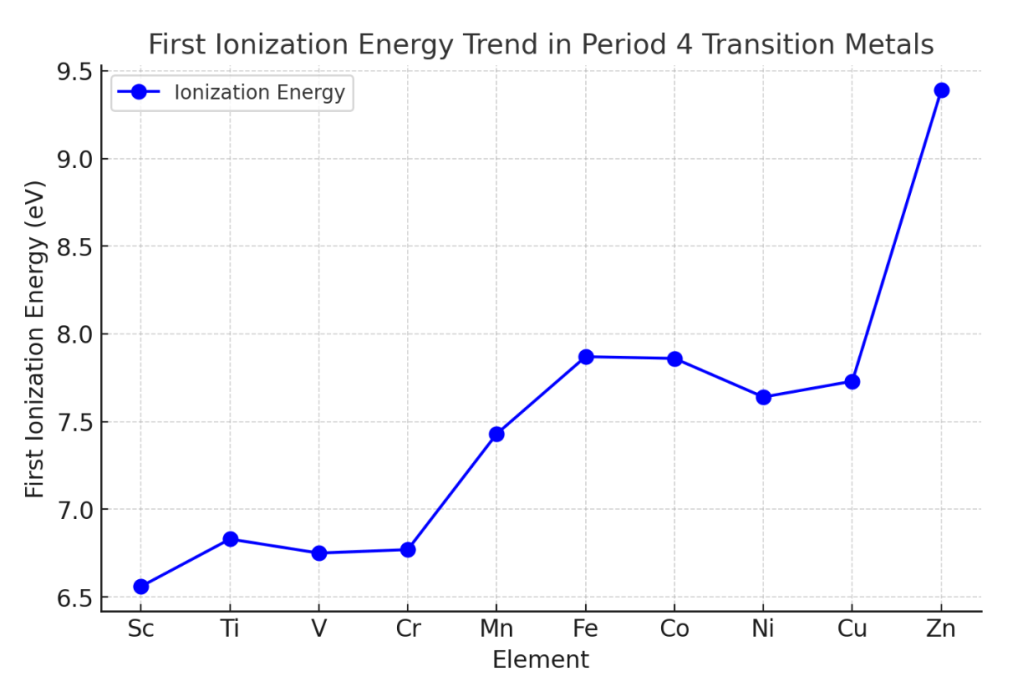
Ionization Energy Trend in Period 4 Transition Metals (Sc → Zn)
The ionization energy (IE) of transition metals in period 4 (3d series) shows a relatively small variation compared to main-group elements. However, some key trends can be observed:
1. General Increase Across the Period (Sc → Zn)
- As we move across the period, nuclear charge (Z) increases, meaning more protons pull the electrons closer to the nucleus.
- This increases the ionization energy overall.
2. Irregularities Due to Electron Configuration
The trend is not smooth due to the incomplete filling of 3d orbitals, which leads to variations in shielding and stability:
- Sc → Cr (small increase):
- The 3d electrons are being added, but they shield the outer 4s electrons from the increasing nuclear charge.
- The ionization energy increases slightly but remains lower than expected.
- Cr & Mn (slightly lower IE than expected):
- Cr ([Ar] 3d⁵ 4s¹) has a half-filled d-subshell, which is extra stable, making its first ionization energy lower than Fe.
- Mn ([Ar] 3d⁵ 4s²) also has a stable half-filled d-subshell, leading to a slight dip in IE.
- Fe → Zn (gradual increase):
- As the d-subshell fills, the electrons experience greater attraction to the nucleus, increasing the ionization energy.
- Zn ([Ar] 3d¹⁰ 4s²) has a completely filled d-subshell, making it relatively stable and resulting in a slightly higher IE.
3. Shielding Effect & 3d vs. 4s Orbital Contributions
- The 3d electrons do not shield effectively because they are closer to the nucleus than 4s electrons.
- As a result, the outermost 4s electron experiences a stronger attraction, leading to a gradual increase in IE.
Overall
- The first ionisation energy generally increases across the period, but with minor irregularities due to electron configurations.
- The trend is less pronounced compared to s- and p-block elements because 3d electrons provide additional shielding.
- The stability of half-filled (Cr, Mn) and fully filled (Zn) d-orbitals creates small deviations in the trend.
Part 3: [AHL] E = hf Calculation
The table below presents the frequencies of spectral lines in the Lyman series. Each transition corresponds to an electron moving from an excited state (n ≥ 2) down to the n = 1 energy level. The third column displays the difference in frequency between successive lines.
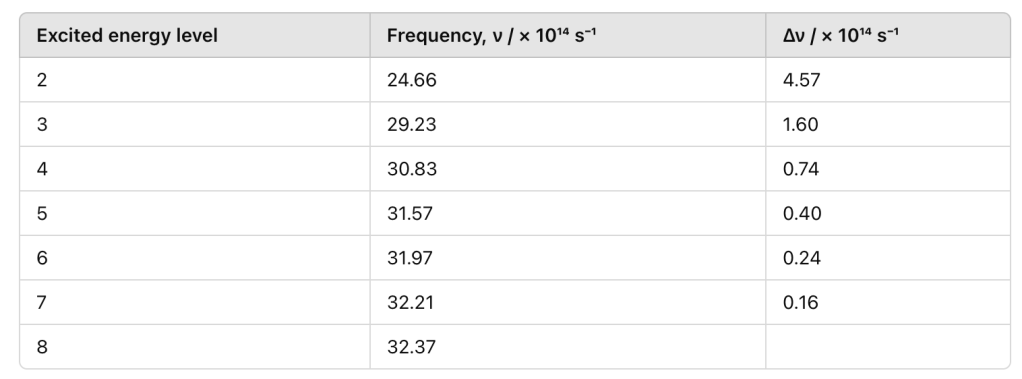
Based on this table, we draw this graph…

The graph illustrates the relationship between the emitted frequency and the difference in frequency between successive lines in the Lyman series of the hydrogen atom. The new symbol of v is f for the IB

Exercises
Subscribe to get access the answers
1. The first four ionisation energies for a particular element are 738, 1450, 7730, and 10,550 kJ/mol. Determine the group number of the element.
2. The successive ionization energies for an unknown element are given below:
| First Ionization (kJ/mol) | Second Ionization (kJ/mol) | Third Ionization (kJ/mol) | Fourth Ionization (kJ/mol) |
|---|---|---|---|
| 590 | 1145 | 4912 | 6491 |
Identify the element.
3. The successive ionization energies (in kJ/mol) for carbon are:
| 1st | 2nd | 3rd | 4th | 5th | 6th |
|---|---|---|---|---|---|
| 1086 | 2352 | 4619 | 6220 | 37820 | 47280 |
(a) Explain why there is a large increase between the fourth and fifth values.
(b) Explain why there is an increase between the second and third values.
![ESS 8.1.3 [AHL] Biocapacity and Environmental Migration](https://mypytrclass.com/wp-content/uploads/2025/12/image-4.png?w=1024)




![ESS 8.3.4 [AHL] Photochemical Smogs and Tropospheric Ozone](https://mypytrclass.com/wp-content/uploads/2025/12/image-1.png?w=1024)

 PYTR Class