
Learning Objectives
- Define water security and explain its importance in ensuring access to safe drinking water.
- Analyse how social, cultural, economic, and political factors influence the availability and equitable distribution of freshwater resources.
- Explain the relationship between population growth, economic development, and the need to increase water supply or improve water-use efficiency.
- Identify and describe methods for increasing water supplies, including dams, reservoirs, rainwater catchment systems, desalination, and wetland enhancement.
Part 1: Water Security
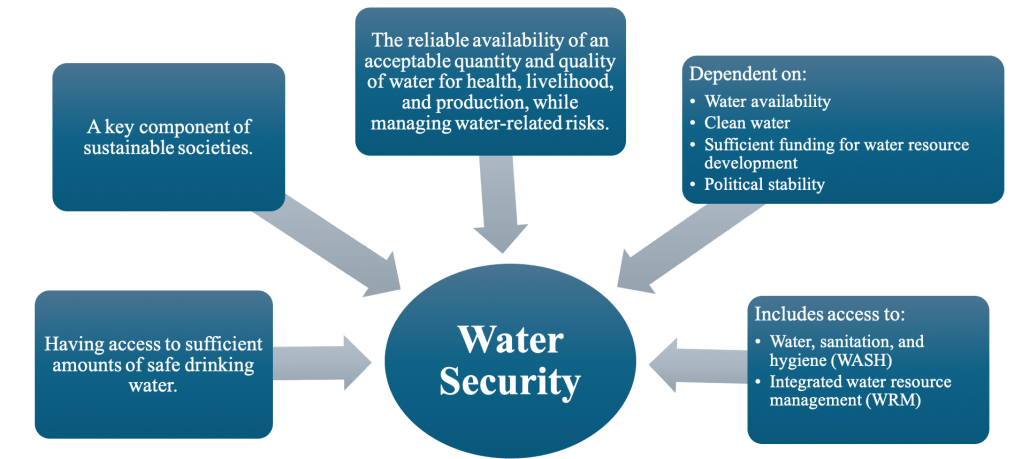
- Global Water Crisis:
- Mid-2010s: Over 25% of the world’s population lived in water-scarce regions.
- Projected to rise to over 40% by 2050.
- Climate change effects on water security:
- More extreme precipitation in some areas, drier conditions in others.
- Changes in frequency and severity of floods, droughts, hurricanes, and wildfires.
- Accelerated melting of glaciers and permafrost, leading to rising sea levels and freshwater contamination.
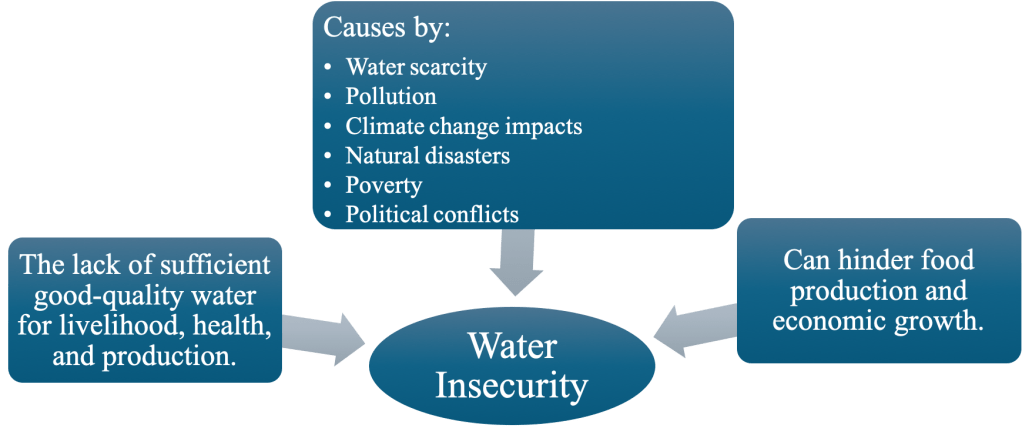
- Other Factors Affecting Water Supply:
- Population growth
- Rising living standards
- Increased demand from farming and industry
- Pollution from agriculture, industry, and transport
Part 2: Factors of Freshwater Availability & Access
Social Factors
- Population growth increases demand for water.
- As income levels rise, water consumption also increases.
- Education influences water use (e.g., awareness of WASH services increases demand for clean water).
Economic Factors
- Water use varies between rich and poor countries:
- Wealthier people use more water for recreation, gardening, washing cars, etc.
- Agriculture consumes most of the world’s water, reducing availability in farming regions.
- Cost affects access:
- Piped water is cheaper than buying from vendors.
Cultural Factors
- Climate change is a major cultural factor affecting water access:
- Greenhouse gas emissions increase global temperatures, leading to droughts and reduced water availability.
- Gender inequality impacts access to freshwater:
- Women and girls without safe WASH services face higher risks of illness, abuse, and attack, affecting education, work, and quality of life.
Political Factors
- Shared water resources between countries can cause disputes (e.g., Middle East, Grand Ethiopian Renaissance Dam).
- Global water insecurity (2020 data):
- 2 billion people lacked safely managed drinking water (over 25% of the world’s population).
- 80% of those without drinking water live in rural areas, many in low-income countries (LICs).
- Women and girls are disproportionately affected by poor water and sanitation.
- Marginalised groups (e.g., Rohingyas in Myanmar) have less access to water than Indigenous residents.
- Examples of water cost disparities:
- Port-au-Prince, Haiti:
- Households with piped water paid ~US$1.00 per m³.
- Unconnected households paid between US$5.50 – US$16.50 per m³.
- Lima, Peru:
- Poor families on the outskirts paid 20 times more than those connected to mains.
- Jakarta, Indonesia:
- Some residents paid 50 times more than those connected to mains.
- Port-au-Prince, Haiti:
- Water overuse in farming:
- Some U.S. farmers overuse water because they don’t pay for it.
- Over-extraction has depleted aquifers, e.g., Ogallala Aquifer (USA), Sahara and Arabian Desert aquifers.
- Overuse benefits short-term economic gains but reduces long-term water availability.
- Negative impacts vary based on income and location.
Part 3: How We Use Water
General Use of Water
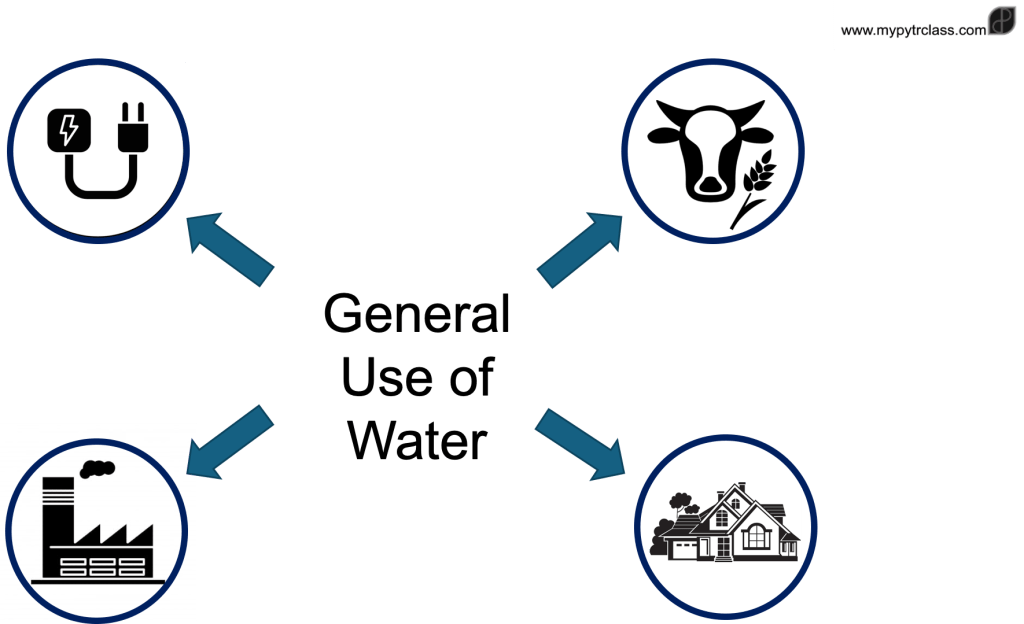
- Human societies experiencing population growth or economic development must:
- Increase water supply
- Improve efficiency of water use
- Freshwater resources are scarce, and demand is increasing.
- Over 2 billion people lack access to clean drinking water at home.
- 2.3 billion people lack adequate sanitation.
Unsustainable Demands
- Water demand has continuously grown since the Industrial Revolution.
- Demand is increasing in HICs (high-income countries), MICs (middle-income countries), and LICs (low-income countries).
- Reasons for increased demand in MICs:
- Population growth
- Rising standards of living
- Changing agricultural practices
- Expanding industries
- HICs consume more water due to:
- Frequent washing (clothes, cars, personal hygiene)
- Gardening and recreation
- Increased per capita water use raises demand on finite resources.
- Some countries are reaching their water availability limits.
- Better management and new water sources are required.
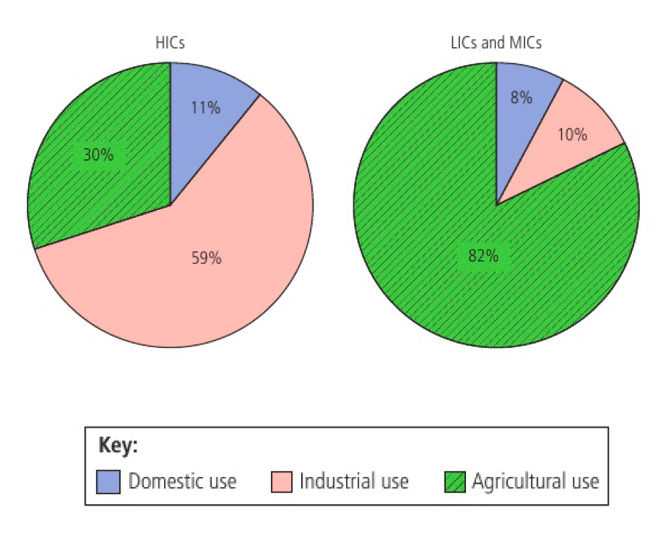
Future Water Scarcity Trends
- By 2025:
- Global freshwater availability may drop to 5,100 m³ per person (25% decrease from 2000 levels).
- Rapid urbanisation is making it harder to provide clean water and sanitation in shanty towns.
- Water scarcity is increasing in many regions:
- Sub-Saharan Africa → 300 million people already live in water-scarce areas.
- Central & Southern Europe → Expected to become drier due to climate change.
Water Consumption by Region
- HICs continue to increase or maintain high water use.
- More water is being consumed indirectly through agricultural and manufactured products.
- Per capita water use:
- North America & Western Europe: ~3 m³ per day
- Asia: ~1.4 m³ per day
- Africa: ~1.1 m³ per day
Key Factors Driving Increased Water Demand
- Population growth
- Rising middle-income populations
- Dietary changes
- Urbanisation
- Climate change
- Growth in tourism & recreation
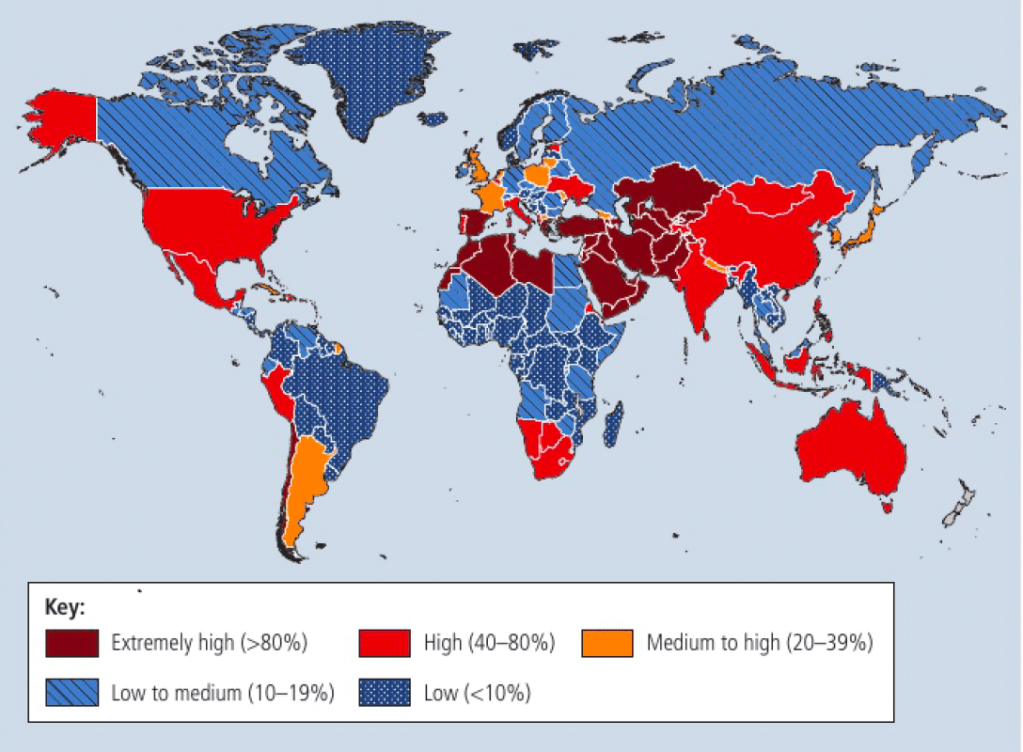
Based on the above projection,
- Uneven Distribution of Freshwater:
- The global freshwater supply is not evenly distributed.
- Seasonal and yearly variations affect water availability.
- Disparity in Rainfall Distribution:
- Three-quarters of annual rainfall occurs in areas with less than one-third of the world’s population.
- Two-thirds of the world’s population live in regions receiving only a quarter of annual rainfall.
- Examples of Water Imbalance:
- Amazon Basin: Holds 20% of global annual run-off, but has fewer than 10 million people.
- Congo Basin: Accounts for 30% of Africa’s run-off, but is home to less than 10% of Africa’s population.
- Future Water Stress & Climate Change:
- Rising temperatures increase evaporation and water loss.
- Freshwater availability is expected to decline in many regions.
- Potential conflicts may arise between water-rich and water-scarce areas.
Part 4: Development of Water Supply
- Water supplies can be increased through:
- Dams and reservoirs
- Rainwater catchment systems
- Desalination plants
- Enhancement of natural wetlands
Dams and Reservoirs

Advantages:
- Flood and drought control
- Irrigation support
- Hydroelectric power generation
- Improved navigation for trade
- Recreational and tourism benefits
Disadvantages:
- Water loss through evaporation
- Salinization of water sources
- Population displacement due to dam construction
- Drowning of settlements in reservoir areas
- Increased earthquake activity (due to reservoir-induced seismicity)
- Channel erosion below the dam
- Silting upstream as sediment accumulates
- Reduced fertility downstream (silt gets trapped behind the dam)
- Higher risk of waterborne diseases (e.g., malaria, schistosomiasis)
Rainwater Catchment System
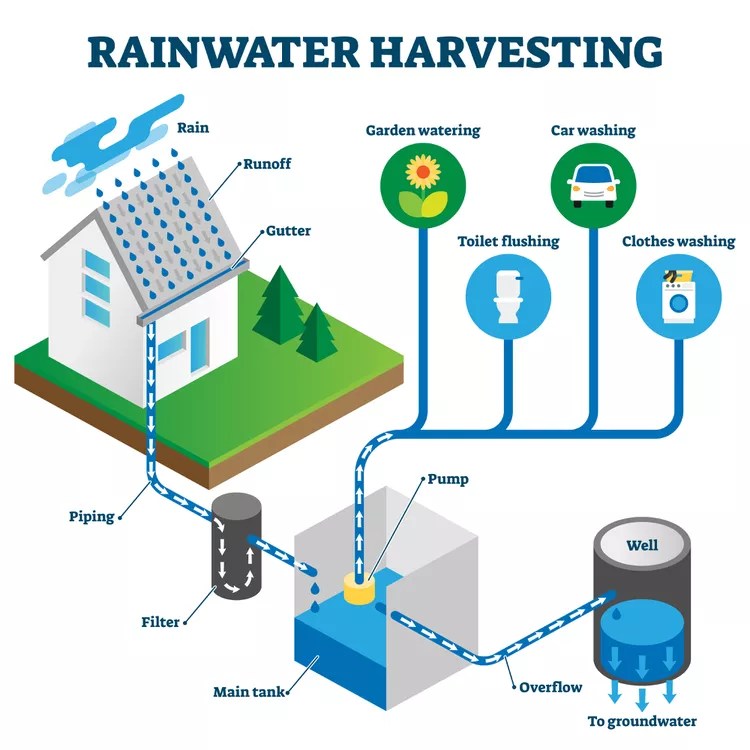
- What is it?
- Collection and storage of rainwater in tanks, wells, boreholes, or to recharge groundwater.
- Uses
- Drinking, cooking, washing, irrigation, cooling (households, schools, hospitals, industries).
- Advantages:
- Supplements main water supply.
- Useful in areas with seasonal water supply.
- Reduces pressure on mains supply and lowers water costs.
- Helps reduce soil erosion.
- Example: Frankfurt Airport collects rainwater for flushing toilets, cleaning air conditioning units, and watering plants.
- Disadvantages:
- Quality concerns: rainwater from roofs may contain dust, pesticides, and pollutants (e.g., animal faeces).
- Some systems, like large dams, are costly and may have ecological impacts.
- Filtering improves quality but can be expensive.
- Stored rainwater can become contaminated, saline, or brackish over time.
- Usage in Different Regions:
- 40% of rural households in Thailand rely on rainwater catchment.
- Compulsory in parts of India (e.g., Tamil Nadu, Rajasthan).
- Encouraged in new buildings in Indian cities like Mumbai and Bengaluru.
Desalination and Reverse Osmosis
- What is it?
- Removal of salt and minerals from seawater/salt marshes to produce potable water and irrigation water.
- Reverse Osmosis:
- Uses a semi-permeable membrane to separate salt from water.
- Requires high energy to force saltwater through tiny membrane pores.
- Expensive due to high energy input.
- Cost of Desalination:
- New technology is reducing costs.
- Example: Sorek plant in Israel produces desalinated water at US$ 0.60 per m³.
- Cost comparisons:
- Japan: US$ 1.21 per m³.
- USA: US$ 0.5–1.0 per m³.
- Environmental Concern:
- Disposal of removed salt (brine) can negatively impact local ecosystems if added to water bodies.

Enhancement of natural wetlands
- Rainwater can be harvested from lakes, rivers, and natural wetlands.
- Water availability and quality vary by location.
- Wetland enhancement involves improving a wetland’s function, such as:
- Dredging or deepening to increase water storage
- Restoring indigenous species
- Removing invasive species


Exercises
Subscribe to get access
Read more of this content when you subscribe today.
![ESS 8.1.3 [AHL] Biocapacity and Environmental Migration](https://mypytrclass.com/wp-content/uploads/2025/12/image-4.png?w=1024)


![ESS 8.3.4 [AHL] Photochemical Smogs and Tropospheric Ozone](https://mypytrclass.com/wp-content/uploads/2025/12/image-1.png?w=1024)
 PYTR Class