

Learning Objectives
- Outline the meaning of water stress in comparison to water scarcity
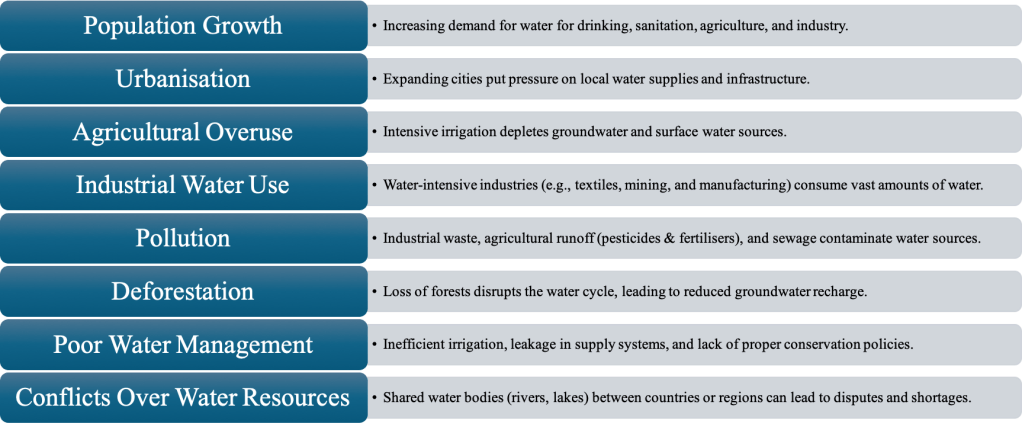
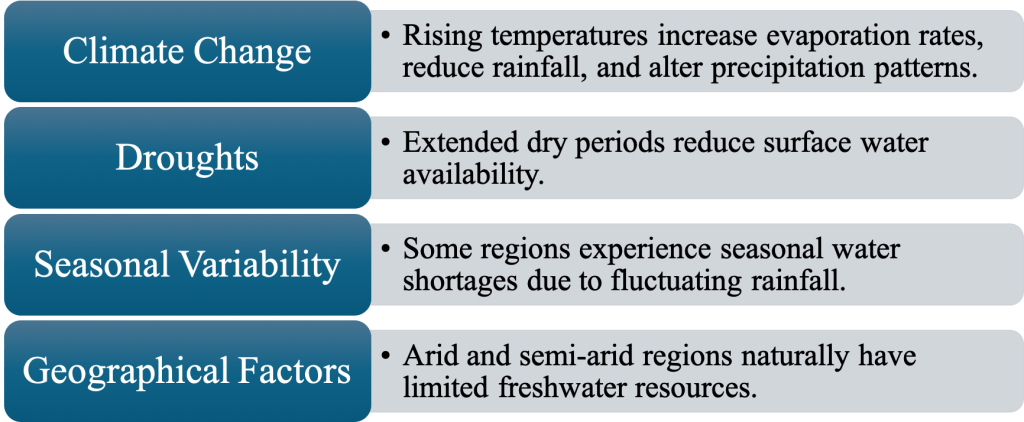
- Outline the factors that increase water stress in a region
- Describe water stress involving transboundary disputes
Part 1: Global Water Stress
- Water stress is a measure of water supply limitations, similar to water scarcity.
- Water stress is defined as a supply of less than 1700 m3 per year per capita of clean, accessible water.
- It considers not just availability but also:
- Water quality
- Environmental flows
- Accessibility
- A region with an ample water supply may still experience water stress due to low water quality.
- Water stress refers to the inability to meet human and ecological demands for water.
- It occurs when the demand for safe, usable water exceeds supply.
- Water scarcity, in contrast, refers specifically to a lack of abundant water supply.
Part 2: Factors Increasing Water Stress
Human Factors
Natural Factors
The causes of increasing water stress vary depending on the socioeconomic context:
- Emerging Economies
- Rapid industrialisation increases water demand for manufacturing and energy production, often leading to over-extraction and pollution of water sources.
- Low-Income Countries (LICs)
- Population growth and urbanisation put pressure on existing water supplies, leading to over-abstraction of groundwater and depletion of surface water resources.
Other contributing factors include:
- climate change,
- inefficient water management, and
- poor infrastructure.
Case Study:
Water Stress and the Indian Textile Industry
- Global Water Stress
- Of the world’s 60 largest economies, 29 are ranked “high to extremely high” for water stress (World Resources Institute – WRI).
- Water-intensive industries are concentrated in these 29 countries, including:
- 88% of global coal mining.
- 80% of global textile production.
- The top four textile producers are China, India, the USA, and Indonesia.
- The textile industry is worsening India’s growing water crisis.
- Water Stress in India
- India is ranked 13th among the world’s most water-stressed countries (WRI).
- Water stress in India is extremely high:
- 50% of the population lacks access to safe water.
- Surface and groundwater supplies are rapidly depleting.
- Fast Fashion’s Impact
- Growth of fast fashion increases demand for cheap, mass-produced textiles.
- Retail brands prioritise low production costs, often at the expense of:
- Environmental protection.
- Workers’ rights.
- Cotton Production and Water Use
- India produces some of the cheapest cotton in the world, leading to high demand.
- Cotton is highly water-intensive:
- 22,500 litres of water are needed to produce 1 kg of cotton (enough for one T-shirt and a pair of jeans).
- Competing Water Demands
- Farmers and industries compete for water resources.
- Population growth further increases water demand.
- As more Indians enter the middle class, their water consumption rises, exacerbating the crisis.
Part 3: Transboundary Dispute
| River or Aquifer | Countries Involved in the Dispute | Subject of Dispute |
|---|---|---|
| Nile | Egypt, Sudan, Ethiopia, Uganda, Kenya, DR Congo, Eritrea | Siltation, flooding, water flow/diversion |
| Euphrates, Tigris | Iraq, Syria, Turkey | Dams, reduced water flow, salinisation, hydroelectricity |
| Brahmaputra, Ganges | Bangladesh, India | Siltation, flooding, water flow/diversion |
| Mekong | Cambodia, Laos, Thailand, Vietnam | Water flow, flooding, irrigation |
| Parana | Argentina, Brazil | Dam, land inundation |
| Lauca | Bolivia, Chile | Dam, salinisation |
| Rio Grande, Colorado | Mexico, USA | Salinisation, water flow, agrochemical pollution |
| Great Lakes | Canada, USA | Water diversion |
| Rhine | France, Netherlands, Switzerland, Germany | Industrial pollution |
| Danube | Austria, Slovakia, Hungary | Water diversion, hydroelectricity |
Exercises
Subscribe to get access
Read more of this content when you subscribe today.
![ESS 8.1.3 [AHL] Biocapacity and Environmental Migration](https://mypytrclass.com/wp-content/uploads/2025/12/image-4.png?w=1024)


![ESS 8.3.4 [AHL] Photochemical Smogs and Tropospheric Ozone](https://mypytrclass.com/wp-content/uploads/2025/12/image-1.png?w=1024)
 PYTR Class