
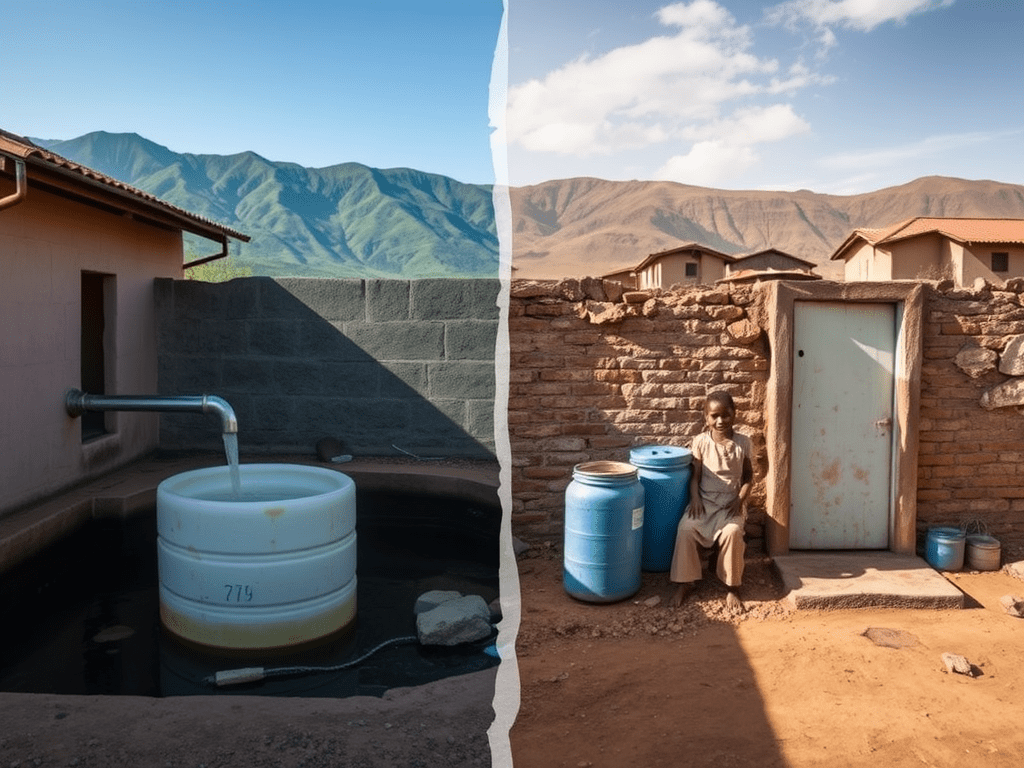
Unequal access to clean water and sanitation poses risks to human health and sustainable development, disproportionately affecting marginalised groups like Indigenous communities and low-income households.
- 74% of the global population (2 billion people) lack safely managed drinking water.
- 1.2 billion people lack even basic water service.
- Between 2015 and 2020, the global population with safely managed sanitation increased from 47% to 54%.
Water and Sanitation Challenges in South Africa
- South Africa is a water-scarce country with significant challenges in water and sanitation services.
- Key issues include:
- Insufficient infrastructure maintenance and investment.
- Recurring drought.
- Unequal access.
- Deteriorating water quality.
Household Access to Water
- According to the 2019 General Household Survey:
- Households with access to improved water sources (piped connections, public standpipes, protected wells/springs) increased from 84.4% to 88.2% between 2002 and 2018.
- In 2019, 44.9% of households had piped water in their dwelling.
- 3.1% of households had to collect water from rivers, springs, and wells.
- South Africa loses 1.5 billion m³ of water annually due to faulty piping infrastructure (Mission 2017).
Household Access to Sanitation
- Over 13.5 million households (80%) had improved sanitation facilities.
- 0.4 million households (2%) had no sanitation facilities.
Inequality in Water and Sanitation Access
- Inequalities arise from:
- Rising unemployment.
- The legacy of segregated services from the Apartheid era.
- Since the 1970s, large-scale rural-to-urban migration has reduced the rural population, leading to less revenue for WASH services.
Historical and Racial Disparities
- 1996 Census Data:
- Black Africans made up 72% of the population.
- Only 27% of Black Africans had indoor taps, compared to 96% of the white population.
- More recent surveys do not collect racial data, but the total number of households with indoor taps remains around 44%.
Provincial Disparities – Eastern Cape
- Eastern Cape is the poorest province in South Africa.
- 76% of households have an improved water source, the lowest in the country.
- The province has the highest proportion of households without sanitation facilities (6%), compared to other provinces.
![ESS 8.1.3 [AHL] Biocapacity and Environmental Migration](https://mypytrclass.com/wp-content/uploads/2025/12/image-4.png?w=1024)


![ESS 8.3.4 [AHL] Photochemical Smogs and Tropospheric Ozone](https://mypytrclass.com/wp-content/uploads/2025/12/image-1.png?w=1024)
 PYTR Class