
Learning Objectives
- Describe unsustainable harvesting using named examples
- Describe an example of overexploitation
- Outline the MSY of the aquatic food production systems
- Explain the impact of climate change and ocean acidification on the aquatic food production
- Outline strategies in mitigating the unsustainable exploitation
Part 1: Unsustainable Harvesting
The rising global demand for seafood has driven the adoption of unsustainable fishing practices, leading to overexploitation of marine resources. These harmful methods include bottom trawling, ghost fishing, and the use of poisons and explosives.
Bottom Trawling
Bottom trawling involves dragging a net across the ocean floor. There are two types: benthic trawling, which occurs directly along the seabed, and demersal trawling, which is just above it. This method is responsible for capturing approximately 30 million tonnes of fish each year. However, it has been restricted in some regions and during specific periods due to the environmental damage it causes. Bottom trawling disturbs the seabed, releasing between 600 to 1500 million tonnes of CO₂ annually. It is linked to the collapse of several species, such as orange roughy, sharks, and barndoor skates. The process involves a plough-like mechanism that digs up to 15 cm of sediment, creating clouds that drive fish toward the net. Regulations on net size have helped lower juvenile fish deaths. Despite its use in areas like the Grand Banks and the North Sea for over a century, some countries, such as Venezuela, have now banned the practice, and regions like the Rockfish Conservation Area off the U.S. West Coast limit its use to protect overfished species. Nonetheless, bottom trawling often remains unregulated in international waters.
Ghost Fishing
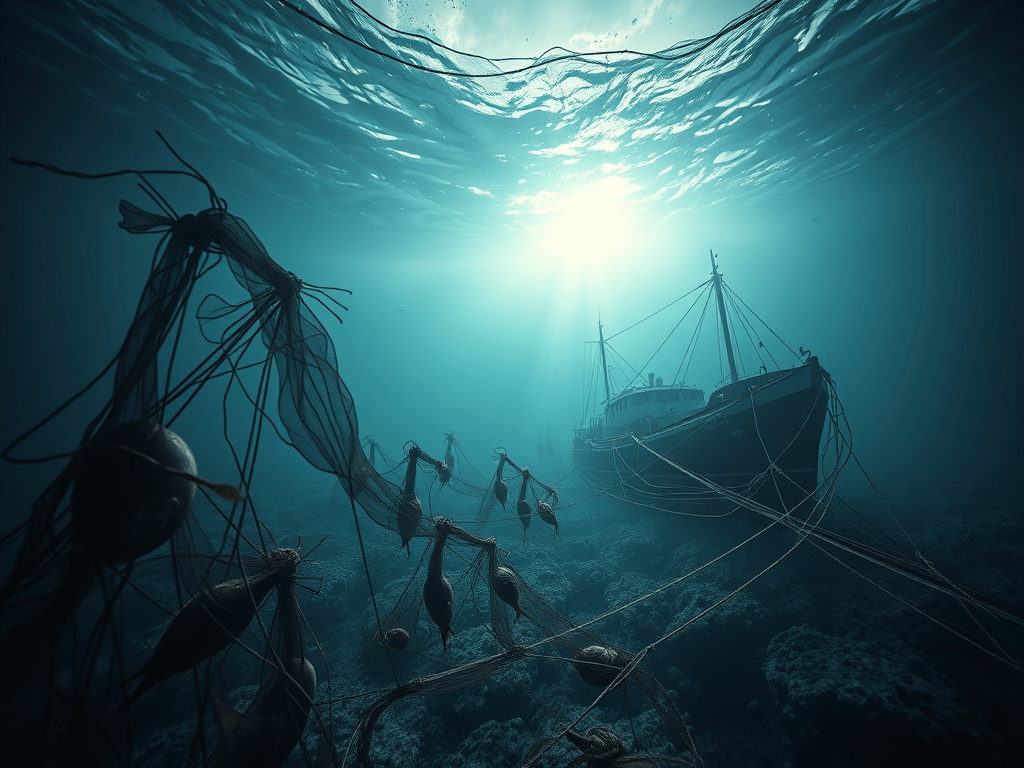
Ghost fishing refers to lost, discarded, or abandoned fishing gear—such as nets, lines, and traps—that continues to catch marine life. Trapped animals may suffer from exhaustion, starvation, suffocation, and eventually die, attracting other marine creatures that also become ensnared. In the North Atlantic alone, around 25,000 nets are discarded annually, each potentially weighing over 4,500 kg. Ghost gear harms delicate habitats like coral reefs, facilitates the spread of invasive species, and can damage coastlines and vessels. Because modern fishing gear—especially plastics—is highly durable, these impacts can persist for decades. Although remotely operated underwater drones can assist in retrieving this gear, the task is complex, hazardous, and costly.
Poisons and Explosives
Historically, some indigenous groups have used natural toxins to stun fish for easy collection. For instance, Native American groups in California have used soaproot, which contains saponin, as well as California buckeye, a source of aesculin, in freshwater streams. Similarly, the Gondi people in India use dried and powdered Olax leaves as fish poison. Once stunned, the fish float to the surface for manual harvesting.
On the other hand, blast fishing, also known as dynamite fishing, uses illegal explosives to kill or stun large groups of fish. This destructive method is widespread in regions like Southeast Asia, coastal Africa, and the Aegean Sea. Shock waves from underwater explosions immobilize fish, some of which float to the surface, although only about 20% of the total catch becomes retrievable. This practice also kills many unintended species. In the Philippines, destructive fishing methods have damaged about 70% of coral reefs and led to a loss of around 175,000 tonnes of fish. In response, countries such as Tanzania, Indonesia, and the Philippines have introduced restrictions or outright bans on the sale of ammonium nitrate, a key ingredient used to make explosives.
Part 2: Overexploitation
Overfishing has resulted in the collapse of numerous fisheries. A fishery collapse refers to a severe and long-term decline in fish populations to levels where commercial recovery is no longer possible. A well-known example is the collapse of the cod fishery in the Grand Banks off Newfoundland, Canada.
Overfishing and the Collapse of the Grand Banks Cod Fishery (Newfoundland)
- In 1992, the northern cod population fell to just 1% of historical levels due to intense overfishing.
- A major factor was the introduction of advanced fishing technology, such as radar and sonar, which allowed trawlers to efficiently locate fish.
- Canadian cod catches peaked between the late 1970s and early 1980s, with harvest rates far exceeding the cod’s natural reproduction rate.
- Multiple countries fished in the Grand Banks, including France, Germany, Greenland, Portugal, Spain, and the USA.
- Non-commercial by-catch, such as capelin (a key food source for cod), was frequently discarded, further disrupting the food chain and affecting cod survival.
- In 1968, cod catches peaked at 810,000 tonnes, nearly three times the sustainable maximum before super-trawlers were introduced.
- From 1647 to 1770, 8 million tonnes of cod were caught; this same amount was caught by factory trawlers in just 15 years.
- Factory trawlers with onboard refrigeration could stay at sea for months, increasing pressure on cod stocks.
- In 1986, scientists recommended a 50% reduction in cod fishing, but this was not implemented in time.
- By 1992, the cod fishery collapsed, triggering a moratorium on cod fishing and causing 37,000 job losses in the fishing industry.
- Newfoundland suffered economic hardship and population out-migration following the collapse.
- In 2000, the World Wildlife Fund (WWF) listed cod as an endangered species.
- Global cod catches fell by 70% over 30 years.
- By 2002, despite a decade-long ban, cod numbers remained low. Capelin had started feeding on juvenile cod, reversing roles in the food chain.
- A 2015 report showed some signs of cod recovery, but other studies warned that climate change and warming waters would hinder population recovery.
- Experts are cautiously optimistic that cod stocks may recover to pre-collapse levels by 2030.
Part 3: MSY
Maximum Sustainable Yield (MSY) and Its Challenges
- MSY (Maximum Sustainable Yield) aims to keep a population at the size where it grows the fastest.
- It does this by harvesting only the number of individuals that would naturally be added to the population, allowing it to remain productive over time.
- MSY represents the highest possible rate of harvest that can be maintained long-term without depleting the stock.
- Determining the exact MSY is often difficult due to variability in ecosystems and population data.
- MSY is widely used in fisheries management to guide sustainable harvesting practices.
Impacts and Current Status of Global Fish Stocks
- Cod populations in the North Atlantic have been severely impacted by overfishing and illustrate the challenges of applying MSY effectively.
- The top ten fish species, which make up about 30% of global marine capture fisheries, are fully exploited, leaving little or no room for increased catches.
- Specific stocks that are fully exploited include:
- Anchoveta in the southeast Pacific
- Alaska pollock in the north Pacific
- Blue whiting in the Atlantic
- Among the seven major tuna species, about one-third are considered over-exploited, putting pressure on long-term sustainability.
Part 4: Climate Change and Ocean Acidification
Impacts of Climate Change and Ocean Acidification on Marine and Freshwater Ecosystems
Causes and Trends
- Climate change and ocean acidification threaten the stability of marine and freshwater ecosystems and may lead to population collapses.
- Oceans naturally absorb carbon dioxide (CO₂); since 1850, they have absorbed around 33% of human-emitted CO₂.
- This absorption has led to a 30% increase in ocean acidity.
- If CO₂ emissions continue at the current rate, ocean surface pH could fall from 8.1 to 7.7 over the next century.
- From 1955 to 2015, atmospheric CO₂ rose from ~315 ppmv to ~400 ppmv.
- Oceanic CO₂ content increased from 325 patm in 1990 to 375 patm in the 2010s.
- Seawater pH fell from 8.13 (1990) to 8.05 (2013).
- The burning of fossil fuels is the main driver of rising CO₂ and acidification.
Impacts on Ecosystems and Species
- Ocean acidification disrupts marine life, food chains, and biodiversity.
- It affects species’ survival, reproduction, and shell-building abilities (e.g., oysters, mussels, and squid).
- These species are crucial to marine ecosystems and represent a large share of the seafood industry.
- Shellfish larvae struggle to survive in more acidic waters, reducing future populations.
- Seagrasses may grow faster with increased dissolved CO₂, but this can disrupt ecological balance.
- Any change in species abundance affects predators and the broader food web.
Human and Economic Impacts
- Ocean acidification threatens food security, coastal economies, fisheries, tourism, and recreational activities.
- An estimated 500 million people rely on coral reefs for food, income, and coastal protection.
- Coral reefs, like Australia’s Great Barrier Reef, are increasingly vulnerable to bleaching events due to warming seas, and acidification slows their recovery.
- In Puget Sound, Washington (USA), the Suquamish people’s economy and culture are heavily dependent on salmon and shellfish.
- Acidification reduces the population of shellfish and sea butterflies, which are crucial food sources for salmon.
- This threatens the Suquamish’s traditional way of life.
Broader Ecological Effects
- Ocean acidification impacts food chains, especially species reliant on calcifying organisms.
- Example: A decline in baleen whales (which feed on such organisms) may reduce killer whale populations, which feed on baleen whales.
- The U.S. seafood industry could face significant losses — for instance, oysters, clams, and scallops alone contribute $400 million annually.
- In some areas, acidification is worsened by coastal runoff from acidic soils and gravel-based bedrock.
Part 5: Mitigation
Mitigating Unsustainable Exploitation of Aquatic Ecosystems
Policy and Legislation
- Sustainable fishing can be promoted through policy and legal frameworks targeting the fishing industry and consumer behaviour.
- Actions occur at international, national, local, and individual levels.
- Common regulatory tools include:
- Fishing permits
- Catch quotas
- Fishing seasons
- Net mesh size regulations
- Designated fishing zones
- Food labelling requirements
- Critics argue that current measures (e.g. bans, quotas, area closures) often fail to address core issues.
- There are too many fishers and too few fish.
- Too many juvenile fish are caught before they can reproduce.
Industry Restructuring and Efficiency
- To protect fish stocks and ensure long-term competitiveness:
- The number of fishing vessels and fishermen must be reduced.
- At the same time, technological advancements should be embraced to improve efficiency.
- According to a 2008 World Bank and FAO report:
- Up to US$ 50 billion per year is lost due to inefficiency and mismanagement in global fisheries.
- Cumulative losses over 30 years were estimated at US$ 2.2 trillion.
- Although vessel numbers are increasing slowly, each boat has greater fishing capacity due to technology.
- Overcapacity leads to wasted investment, as technological improvements aren’t matched by fish stock availability.
- Fish catches have plateaued in the last decade, meaning more effort is required for fewer results due to depleted fish stocks.
Changing Consumer Behaviour
- Consumer awareness of overfishing and bio-rights is driving demand for sustainably sourced seafood.
- The Marine Stewardship Council (MSC):
- Identifies and certifies sustainable fisheries.
- Offers the MSC eco-label, now found in 149 countries.
- Certified fisheries account for 10% of global wild-capture seafood.
- MSC-certified operations have led to nearly 1,000 improvements in sustainability practices.
- The Aquaculture Stewardship Council (ASC):
- Sets standards for responsible aquaculture (farmed seafood).
Media and Public Awareness
- Documentaries, books, and campaigns have played a major role in:
- Raising public awareness.
- Encouraging sustainable fishing practices.
- Pressuring governments and the fishing industry to change.
Future of the Fishing Industry
- Managing fisheries sustainably remains complex, as it involves:
- Political sensitivity
- Economic interests
- Environmental concerns
- No single solution exists, but coordinated strategies and global cooperation are essential for long-term sustainability.
Conservation of Resources
| Action | Type of Measure | Objectives |
|---|---|---|
| Technical Measures | Small, meshed nets, minimum landing sizes, boxes | Protect juveniles and encourage breeding, discourage marketing of illegal catches |
| Restrict Catches | Total Allowable Catches (TACs) and quotas | To match supply to demand, plan quota uptake throughout the season, protect sensitive stocks |
| Limit Number of Vessels | Fishing permits (could be traded inter- or intra-nationally) | Applicable to EU and other countries’ vessels fishing in EU waters |
| Surveillance | Check landings by EU and third-country vessels (logbooks, computer/satellite surveillance) | To apply penalties to overfishing and illegal landings |
| Structural | Structural aid to the fleet | Finance fleet modernization (new vessels commissioning closely controlled) and reimburse scrapping, transfer, and conversion |
Socio-Economic Measures
| Action | Type of Measure | Objectives |
|---|---|---|
| Reduction in Unemployment & Increased Productivity | Inclusion of zones dependent on fishing in Objectives 1, 2, and 5b of Structural Funds | Facilitate industry restructuring, finance alternative local development, and encourage early retirement schemes |
Markets
| Action | Type of Measure | Objectives |
|---|---|---|
| Tariff Policy | Minimum import prices, restrictions on imports | To ensure EU preference (while complying with WTO regulations) |
Other Measures
| Action | Type of Measure | Objectives |
|---|---|---|
| Restrict Number of Vessels | Fishing licenses | Large license fees discourage small, inefficient boats |
| Increase Accountability of Anglers | Rights to fisheries | Auction off seabed areas for stationary fish (e.g., shellfish); quotas could be traded allowing some to leave the fishery |
![ESS 8.1.3 [AHL] Biocapacity and Environmental Migration](https://mypytrclass.com/wp-content/uploads/2025/12/image-4.png?w=1024)




![ESS 8.3.4 [AHL] Photochemical Smogs and Tropospheric Ozone](https://mypytrclass.com/wp-content/uploads/2025/12/image-1.png?w=1024)
 PYTR Class