
Learning Objectives
- Describe the key provisions of the UN Convention on the Law of the Sea (UNCLOS), including exclusive economic zones (EEZs) and the challenges of regulating high seas fishing.
- Discuss the ethical considerations surrounding the harvesting of seals, whales, and dolphins, including animal rights and Indigenous cultural practices.
Part 1: Exclusive Economic Zone, EEZ
- Under the UN Convention on the Law of the Sea (UNCLOS), coastal states have an Exclusive Economic Zone (EEZ) that extends up to 370 km (200 nautical miles) from their coast.
- Within the EEZ, the coastal state has the right to regulate fishing and exploit marine resources, such as fish, minerals, and energy.
- The EEZ begins at the edge of the territorial waters, which extend 12 nautical miles (approximately 22.2 km) from the coast.
- About 60% of the ocean lies beyond national EEZs, classified as high seas, where there is limited international governance.
- Equity and justice concerns arise when countries sell access to their EEZs for foreign fishing rather than prioritizing local communities.
- The United Nations is working to establish an international treaty aimed at protecting the high seas.
Key Information of EEZ
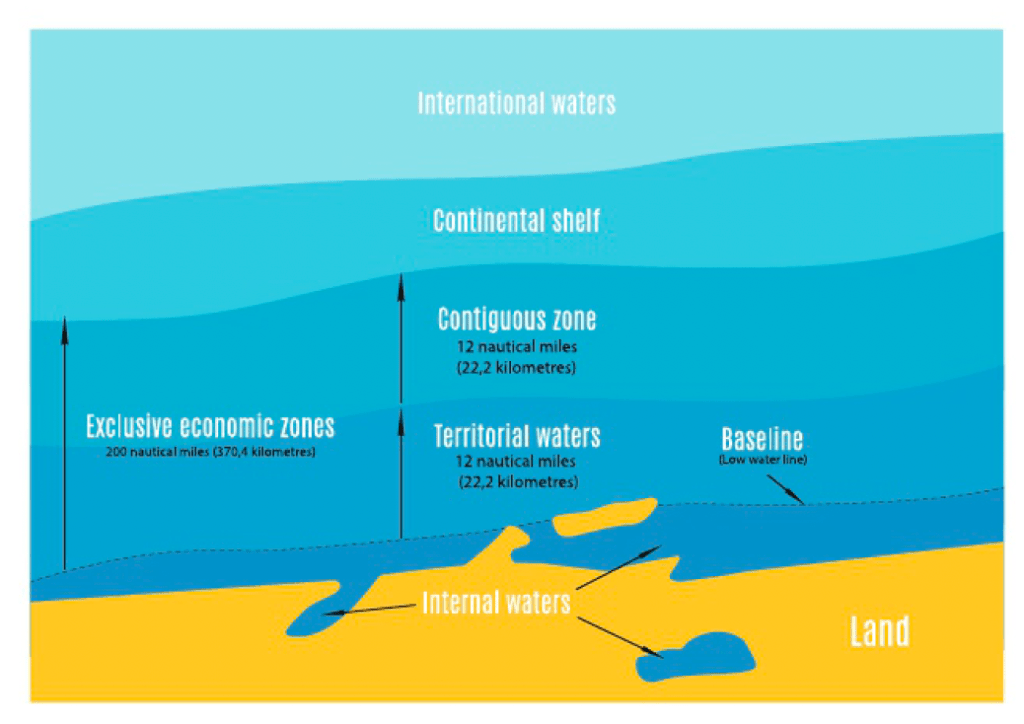
- Territorial Sea (up to 12 nautical miles)
- Countries have full sovereign rights over the waters.
- Contiguous Zone (12–24 nautical miles)
- Forms the outer edge of territorial waters; countries can enforce laws related to customs, immigration, and pollution.
- Exclusive Economic Zone (EEZ) (up to 200 nautical miles)
- Countries have special rights to explore and exploit marine resources below the ocean surface.
- Overlapping EEZ Claims
- When claims overlap, any point in the disputed zone should fall under the EEZ of the nearest country.
- High Seas
- Areas beyond national jurisdiction, considered common resources with limited regulation and high risk of overexploitation.
Disputes and Surveys of EEZ
- Historical Development of EEZs:
- Initially extended only 3 nautical miles.
- In 1982, UNCLOS extended EEZs to 200 nautical miles.
- Disputes Over EEZs:
- Iceland gradually expanded its fishing zone from 3–4 NM (1952), to 12 NM (1958), and finally to 200 NM (1976).
- This led to the “Cod Wars” between Iceland and the UK (1958–1961, 1972–1973, 1975–1976); Iceland prevailed in each case.
- A final agreement favoring Iceland was reached in 1976.
- As of 2023, the Beaufort Sea is a disputed EEZ area between Canada and the USA due to potential oil reserves.
- Survey of EEZ Fishing Practices:
- Fleet sizes are quantified and regulated in only 20% of global EEZs.
- Regulation is more common in high-income EEZs than low-income ones.
- Foreign fishing access is granted in over 50% of EEZs, particularly in low-income regions.
- In about 33% of low-income EEZs (mainly in Africa and Oceania), most fishing is done by foreign fleets from the EU, South Korea, Japan, China, or the USA.
Part 2: Animal rights and Indigenous hunters

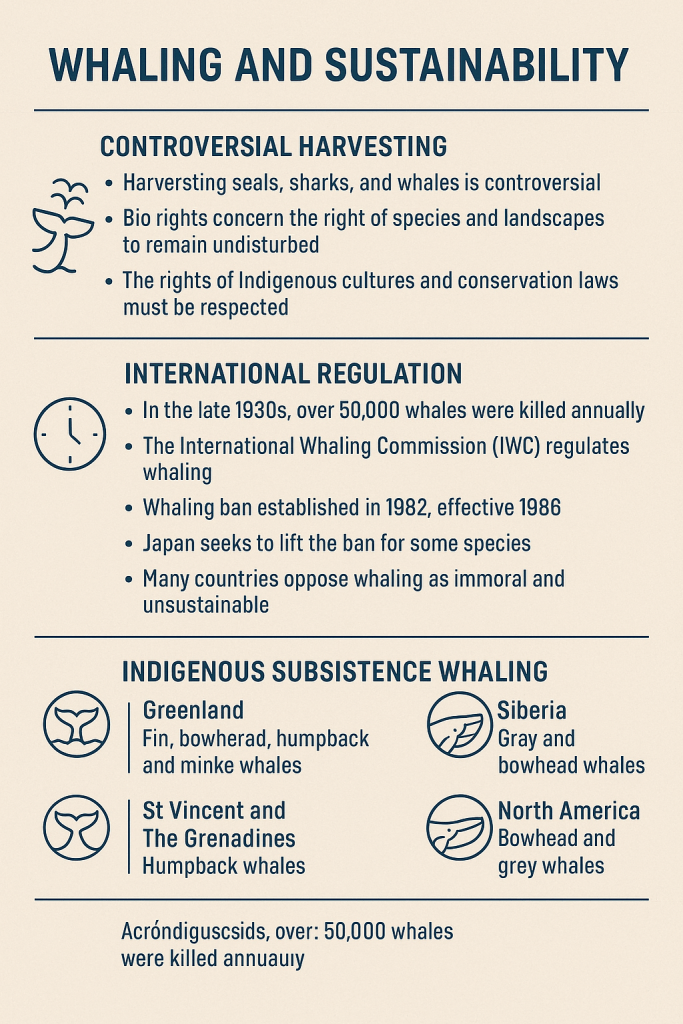
- Controversial Species Harvesting
- Harvesting species like seals, sharks, and whales raises ethical and environmental concerns.
- Bio Rights
- There are ethical considerations regarding the rights of endangered or unique species, and landscapes, to exist undisturbed.
- Cultural and Legal Rights
- The rights of Indigenous cultures and the role of international conservation legislation must be respected.
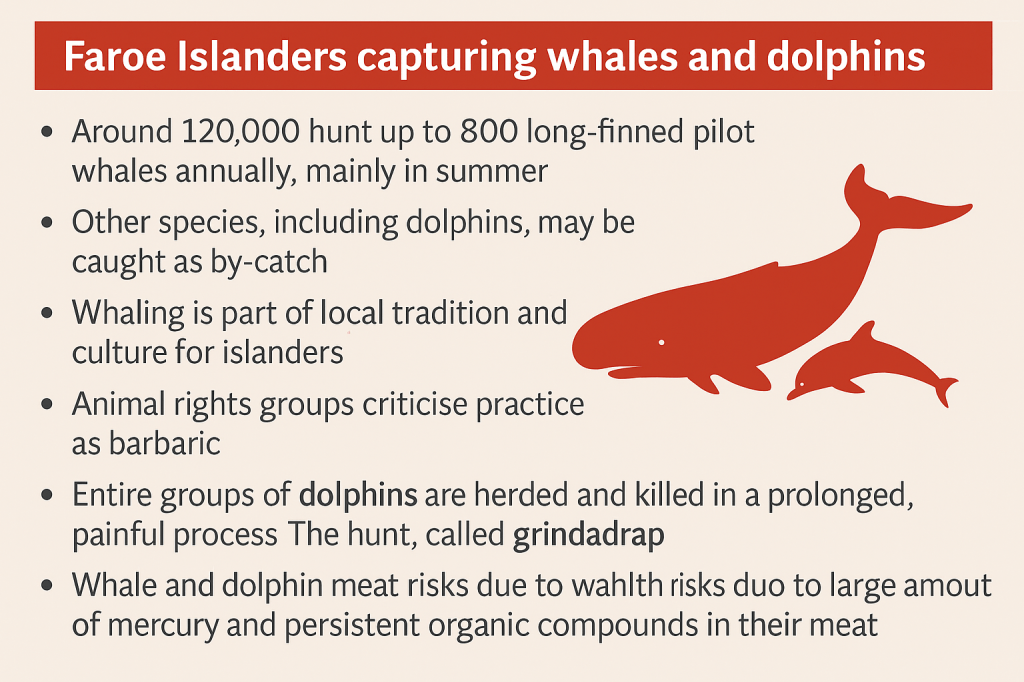
Historical Whaling – In the late 1930s, over 50,000 whales were killed annually.
- International Whaling Commission (IWC)
- Established to regulate whale hunting and set quotas based on scientific research.
- Whaling Ban
- In 1982, the IWC voted to ban commercial whaling; the ban took effect in 1986.
- Japan’s Position
- Japan advocates lifting the ban on species with recovering populations.
- Opposition to Whaling
- Many countries and environmental groups argue that whaling remains immoral, unsustainable, and that whale species are still vulnerable.
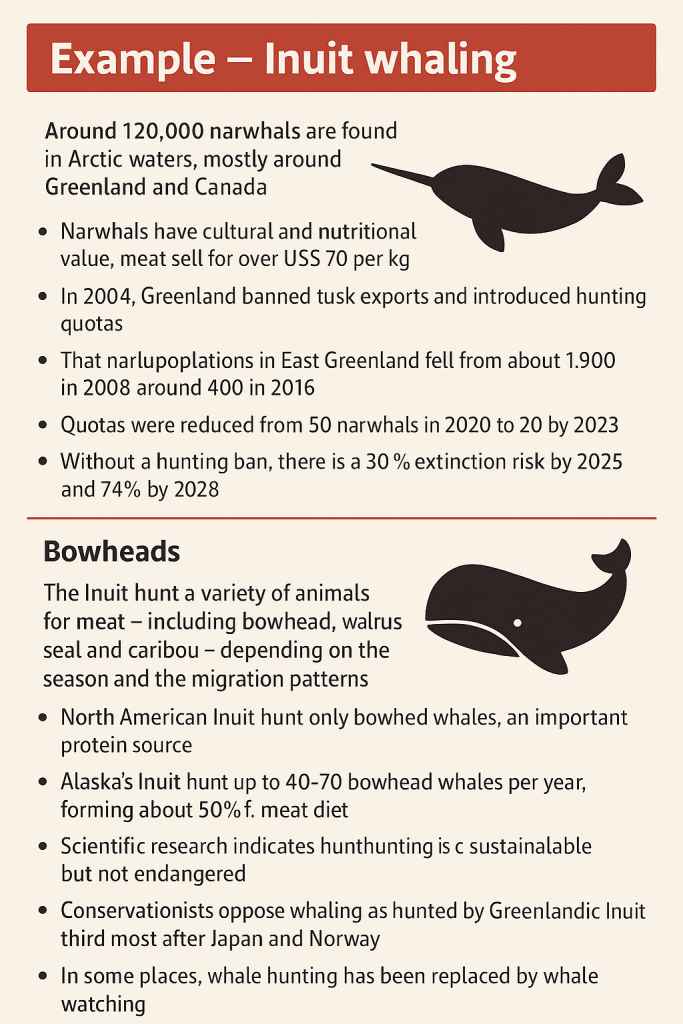
- Indigenous Subsistence Whaling:
- Greenland: Fin, bowhead, humpback, and minke whales
- Siberia: Grey and bowhead whales
- St Vincent and The Grenadines: Humpback whales
- North America: Bowhead and grey whales
Part 3: Whaling Case Studies
![ESS 8.1.3 [AHL] Biocapacity and Environmental Migration](https://mypytrclass.com/wp-content/uploads/2025/12/image-4.png?w=1024)




![ESS 8.3.4 [AHL] Photochemical Smogs and Tropospheric Ozone](https://mypytrclass.com/wp-content/uploads/2025/12/image-1.png?w=1024)
 PYTR Class