Describe how mutation and sexual reproduction contribute to genetic diversity.
Explain how reproductive isolation can occur through geographic separation or ecological and behavioural differences, even within the same area.
Recognise that biodiversity is unevenly distributed across the planet and that some regions contain high concentrations of rare and endangered species.
Explain how human activities can alter selective pressures in ecosystems, leading to evolutionary changes in species.
Describe how artificial selection can reduce genetic diversity and decrease species resilience.
Part 1: Sources of Genetic Variations
Prior Knowledge on Terminologies:
Phenotype
We know that in order to survive, an individual needs to be able to adapt to the environment
These adaptations are based upon the physical traits (also called phenotype)
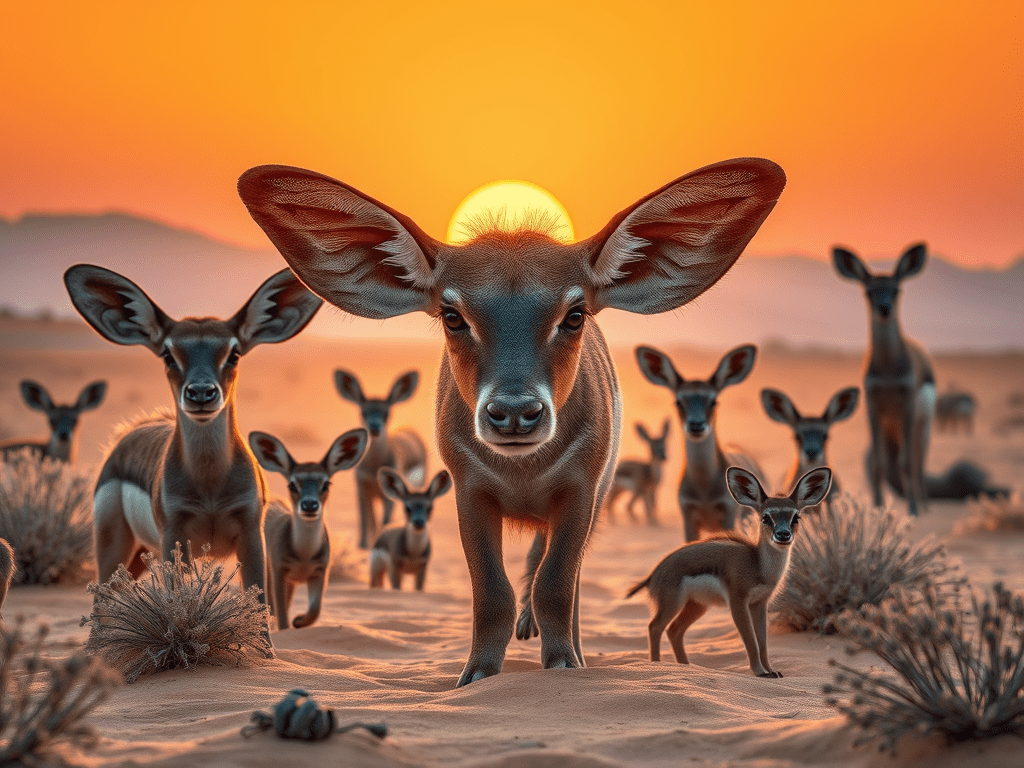
For example, a big pair of ears is an advantageous phenotype for animals living in the desert as it helps to regulate body heat by losing more heat to the surrounding. The big ears are made by the gene of the animal
These physical traits are direct and indirect result of protein (chains of polypeptide that have been processed) coded by the DNA.
Genotype and genes
As we know the gene gives us the physical traits. Gene is a set of DNA codes in a chromosome that gives us this physical trait.
To put into perspective, a human has around 19 900 genes.
Apparently, for each gene, there are at least two different versions.
One version comes from the mother, and the other comes from the father. Together, these genes are called the genotype
Allele
A gene may have at least 2 different versions or forms of it. Each version of a gene is called the allele.
An allele can be found in a specific segment of a chromosome.
Some genes may have many different versions and it can cause a continuous variations (a variation with intermediate traits such as skin colour).
A DNA mutation can occur to any allele and this will result in genetic and physical variations. For example, the genes for eye colour have multiple versions (allele). Mutation on these alleles can cause the lack of pigmentation. Therefore, mutated gene for eye colour will give blue eye colour whilst normal gene will give darker eye colour
Did you know?
The original version (allele) for human eyes is code for certain level of melanin that result in brown eyes. Due to mutation and errors in replication, new versions of this gene appear (these are now new alleles). They will then be expressed by individuals carrying them. Today, individuals with mutated genes may show range from blue, green, and to light brown eye colours
DNA Replication
DNA is replicated as part of cell cycle in growth where two DNA molecules are produced from 1
During this process, errors can occur and the new copy may have a new DNA coding. This is called DNA mutation.
Transcription and translation
Two processes that use DNA codes (of genes) to make proteins. These proteins will later be processed in cells
Some processed proteins can be seen directly as a physical traits. For example hair is a keratin protein.
Some other proteins can be seen as a physical traits indirectly. For example: ability to sing, intelligence etc.
Variation in a Population of a Species
As a species reproduce and over-reproduce, they enable to sources of variation to impact the gene within their population:
Mutation
Caused by errors during DNA replication and/or exposure to mutagens such as radiation and chemicals.
DNA mutations result in a formation of a new allele (note that this will still give the same physical need but with varied appearance for example, allele for eye colours though the eyes are still formed)
The change in the genotype will be observed as a new variety i.e new physical traits (phenotype) in a population
This mutation can cause variation and can be passed down to the next generations
Diversity in bacteria (and all other living organisms that perform asexual reproduction mode) relies on the mutation rates. These organisms do not perform sexual reproduction that offers them the more sources of genetic variation by meosis and fertilisation
Meiosis
Crossing over at chiasma during prophase I and, independent assortment during metaphase I both result in increase variation of allele combinations in each gamete (sperm or ovum for animals, pollen or ovule for plants).
Fertilisation of gametes
Ova and sperms carrying different combination of alleles will further vary the offspring genotype as the two fuse to form a zygote
Part 2: Isolations and Speciation
Reproductive Isolation
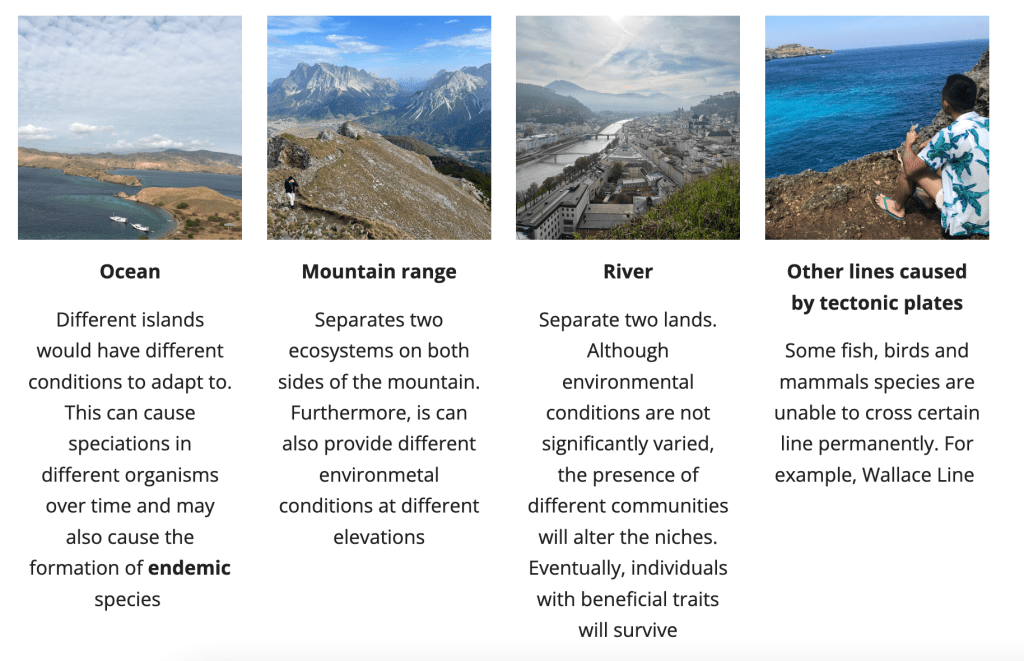
The following are different examples of geographical isolation
After two populations of a species isolated geographically, they eventually form two communities (different species)
This requires the selective pressure
On top of that, speciation requires geographical isolations (and sometimes temporal isolation as well)
Plate Tectonic Movements Result in Geographical Isolation
Tectonic Movement
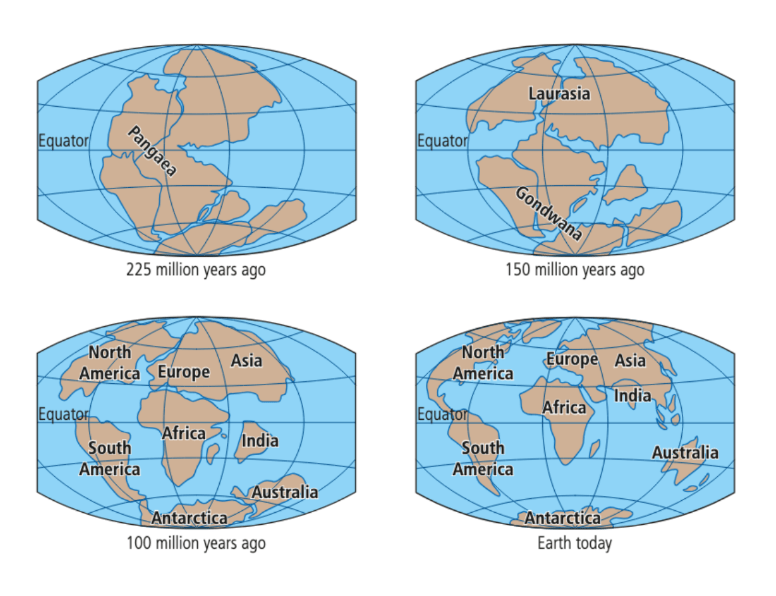
The land on Earth used to be a single supercontinent known as Pangaea (duirng Paleozoic and Mesozoic eras, about 250 million years ago)
175 million years ago, the land mass split into two separate supercontinents, Laurasia (today’s North Americam Eurasia and Greenland) and Gondwana (todays’ South America, Africa, Australia ,Antarctica and India
The distribution of all extinct and extant, still living, species found in these geographical areas today can be explained in terms of these ancient land masses.
When tectonic plates meet (crush each other) they cause the following
Earthquakes
Barriers such as mountain ranges and volcanoes
Opening of ocean
Bringing
Creating island chains and rift valleys
The results will be exposing different species to a new environment. Some environments may be harsh and can cause extinctions.
More importantly, isolation is created and enable endemism
Other Isolations
Ecological
Example: dung beetles living in canopy do not mate with dung beetles living on the ground
Behavioural differences
Example: Certain mating behaviours such as dancing can only attract a certain species
Temporal isolation
Example: Two flowers that bloom at different times cannot cross pollinate
Human Impact on Evolution
Humans play an important role in preserving and conserving biodiversity
Humans also are responsible for some of the new adaptive characteristics shown in some species
This may be by direct or indirect actions:
For example:
Tuskless Elephants in Gorongosa, Mozambique
Tusk is an advantage for elephants for protection and defence.
Apparently this was also useful for human during wartime. The tusks were sold for ivory and the fund was used for the war
The percentage of tuskless elephants rose from 18% to 33% before and after the civil war in Mozambique
Part 3: Artificial Selection
In addition to natural selection that leads to formation of new gene species, human can also intervene in the selection of matings.
When human is the one selecting individuals in a species to mate, this is now called artifical selection or selective breeding
Often, this is to meet demand in the market
Example 1: High yield or disease resistant crops
Example 2: Breed of pets such as dogs and cats
Example 3: Juicy red meat
Selective breeding is done by selecting individuals (plants or animals) with desired traits. The two will be the egg and sperm (or pollen) donors.
The gametes are then fertilised en vivo. This can be done by
leaving the two individuals isolated from the rest of the population,
transferring pollen to stigma and keeping the stigma closed,
artificial insemination
Selective breeding works in the following way
An animal or plant with a desired feature, for example disease resistance, is selected.
This individual is bred with another individual that has similar desirable characteristics.
The offspring that have inherited the desired gene are identified.
These offspring are bred together.
Selected offspring are continued to be bred together. Other individuals are not allowed to reproduce.
This process increases the number of animals or plants with the desired feature.
This process is continued over many generations
Part 4: Biodiversity Hotspot
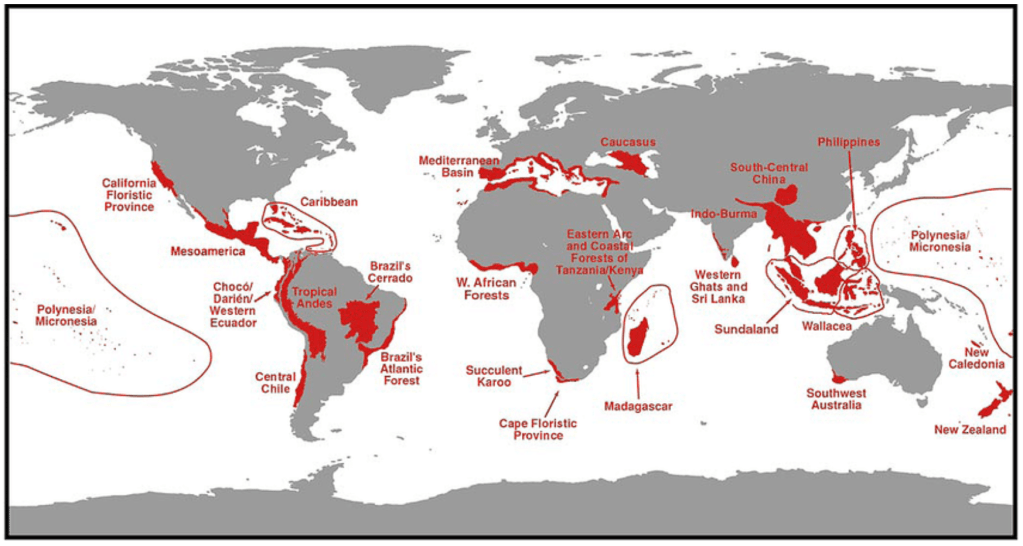
Map of biodiversity hotspots
Biodiversity is spread unevenly across the globe with certain areas cover large proportion of the Earth’s biodiversity and with rare and endangered species
In general, the world’s biodiversity has been on a decline due to the following factors
Human factors
Pollutions
introduction of invasive species
overharvesting
habitat loss and fragmentation
Natural factors
Natural disasters
Diseases
Radiation
Due to the limited time and resources to address all environmental threats across the globe, scientists have proposed the concept of “biodiversity hotspots” – specifically targeted for protection
Protection of these hotspots helps preserving the current state and to make these genetic resources for future generations.





![ESS 8.1.3 [AHL] Biocapacity and Environmental Migration](https://mypytrclass.com/wp-content/uploads/2025/12/image-4.png?w=1024)


![ESS 8.3.4 [AHL] Photochemical Smogs and Tropospheric Ozone](https://mypytrclass.com/wp-content/uploads/2025/12/image-1.png?w=1024)
 PYTR Class