
Learning Objectives
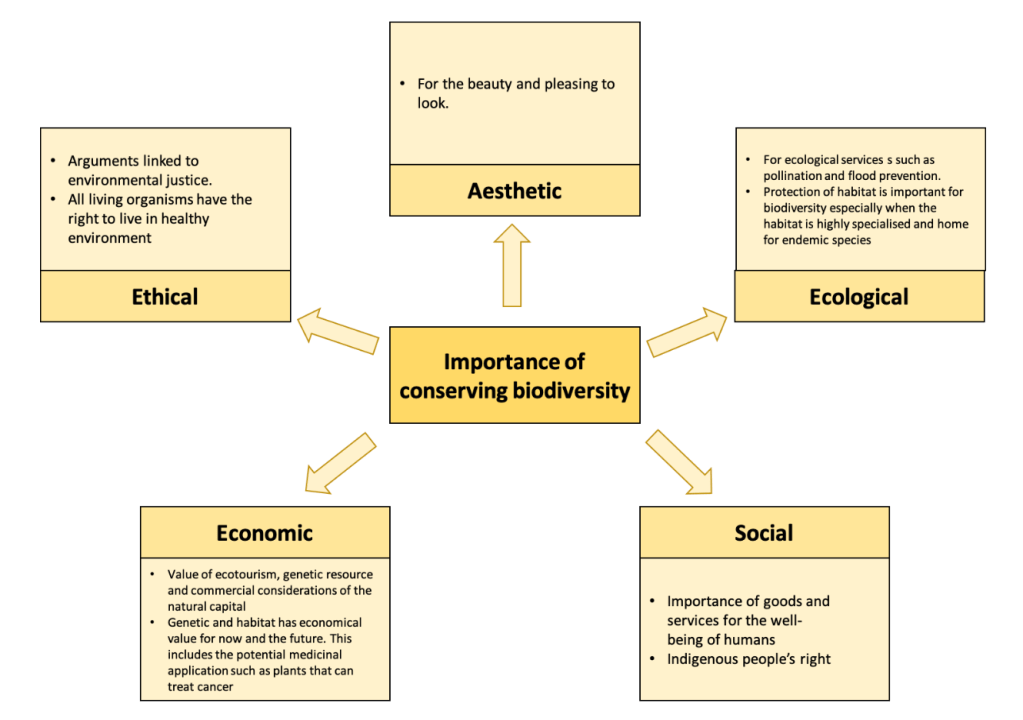
- Evaluate the various justifications for species and habitat preservation, including aesthetic, ecological, economic, ethical, and social perspectives.
- Distinguish between species-based (typically ex situ) and habitat-based (typically in situ) conservation strategies.
- Describe cases where mixed conservation approaches are used, combining both habitat and species-level interventions.
- Explain the role of the Convention on Biological Diversity (CBD) as a global treaty addressing both species and habitat conservation.
- Analyse how habitat conservation strategies support species protection through natural environment preservation and active ecological management.
- Assess the importance of species biology and the size/shape of protected areas for the effective conservation of biodiversity in reserves and national parks.
- Define rewilding and explain how it contributes to the regeneration of natural ecosystem processes.
- Describe how conservation and regeneration efforts can help reverse biodiversity decline and keep humanity within the biodiversity planetary boundary.
- Discuss how different environmental perspectives and value systems influence the conservation strategies adopted by societies.
Part 1: Arguments for Preservation of the Biodiversity
Conservation strategies include the following approaches:
- Species-based conservation
- Habitat-based conservation
- Mixed conservation
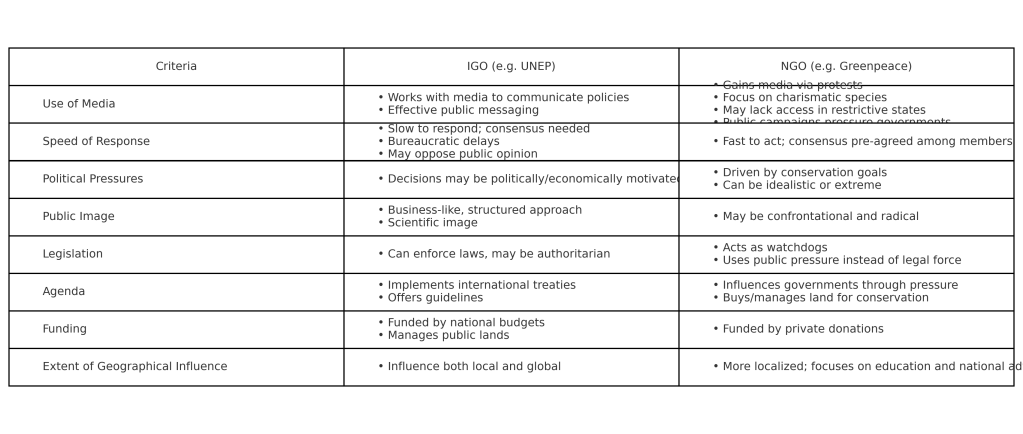
Inter-governmental organisation and non-governmental organisations are working together so some extent in the conservation approaches. For instance, CBD addresses the critical need to protect ecosystems, species, and genetic diversity in response to rising threats such as habitat loss, climate change, and pollution.
The Convention on Biological Diversity (CBD)
- is a UN treaty addressing both species-based and habitat-based conservation.
- Objectives
- to develop national strategies for the conservation and sustainable use of biological diversity.
- to identify protected marine areas outside of national jurisdictions.
Part 2: Species-based Conservation
Conservation biology is the scientific study of nature and of Earth’s biodiversity with the aim of protecting species, their habitats, and ecosystems from excessive rates of extinction and the erosion of biotic interactions. Species-based conservation can be done by two approaches (possible to separately or both applied upon a species):
- Ex situ
- Species is conserved outside their natural habitat (such as botanical garden, zoos etc)
- For captive breeding and reintroduction programmes
- Aims to focus one specific vulnerable species (usually animals)
- For plants, it also includes seed banks
- Example: CITES
- In situ
- Species is conserved within their natural habitat within a boundary (usually fenced conserved areas)
- Usually will indirectly conserve the entire habitat (the habitat and ecosystem)
- Results in preservation of many other species
Ex situ Approaches
CITES
- established in 1973 on March the 3rd 2023
- aims to prevent trades of endangered plant and animal species.
- varied degree of protection for about 35 000 species
- ensures that any trade of plants and animals does not threaten the survival of the species
- Uses Appendix system.
- Appendix I = illegal trade activities
- Appendix II = traded is permitted under strict control to permit the process
- Did you know?? African elephant species was moved from Appendix I to Appendix II.
- Countries that signed the agreement with CITES are subject to import and export monitoring of endangered species and their products.
- This enable some species to be moved to a safer environment and eventually can grow the population of the species
- Illegal trades will result in imprisonment, fine and seizures.
Zoos, captive breeding and reintroduction programmes
- Zoos are now very focused in conserving some species
- Some zoos have priority system or list based on the following questions:
- How to select a species to conserve?
- Is ex situ or in situ a better option for the selected species?
- Will the intervention help growing the population of the species? This is done by research / survey in the wild
- How breeding programme is managed?
- How will the zoo population be managed? This includes the inter-specific and intra-specific social interactions of animals in the zoos. There are 5 freedoms that the zoo must provide. These are the freedom…
- from thirst
- from thermal and physical discomfort
- from pain, injury and disease – zoos must be able to provide rapid treatment
- to express normal behaviours
- from fear and distress
In situ Approaches
- A selected species is protected in a bordered area such as national parks
- As protection is applied upon the whole area, the habitat is also conserved. This will be discussed further in Part 4 of this page
Flagship Species
- Species that is ‘charismatic’ that appeals the public such as pandas, meerkats, gorillas etc
- The flagship species can be the targeted species for protection but it can also be a species that has least concern but living in the same habitat as the targeted species. Some may see this as a disadvantage although at the end of the day, the endangered species is protected
- The presence of the flagship species attracts attention and can contribute to the funding of the conservation efforts in place.
- Zoos are also applying the flagship species strategy to attract more visitors. For example, having flamingos and pandas in European zoos. The major disadvantage of this is, even though the endangered species is protected in the zoos, the natural habitat may continue to degrade in the wild
Mixed Approaches
- Combining both in situ and ex situ methods can be the best solution
- Example: Successful breeding program in thr zoos and the wild of giant pandas (also a flagship species)
- Listed in Appendix I by CITES in March 1984
- Breeding programmes of giant pandas:
- Chengdu Zoo began in 1953
- Beijing Zoo began in 1963. (there is a very impressive house and has been successful)
- Since 1963, the giant panda has been bred in 53 zoos and nature reserves within China and internationally.
Part 3: Habitat-based Conservation
- Often involves nature reserves and national parks
- Effective conservation depends on:
- an understanding of the biology of target species and,
- an understanding on the effect of the size and shape of conservation areas.
Criteria of protected areas
In most countries, large areas of land are used for urban development that includes:
- Agriculture and farming,
- Residential development,
- Cities and
- firms.
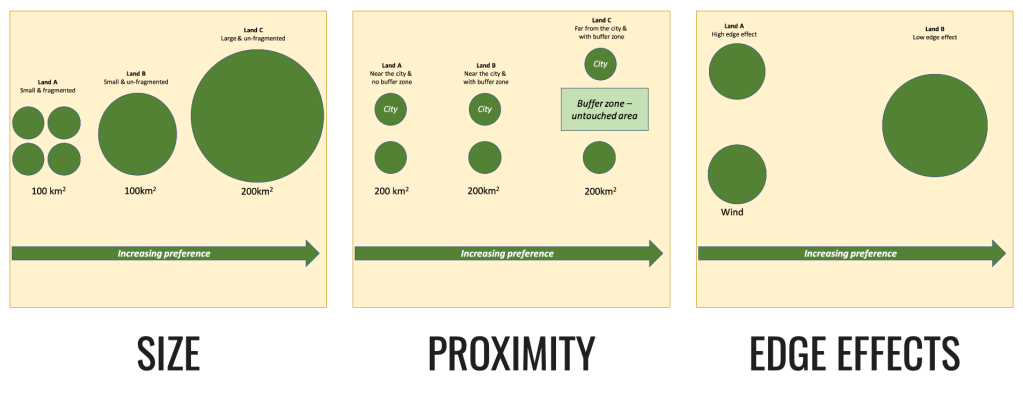
The remaining areas can be made into protected areas by isolating them. Some limitation of assigning the protected areas too near to cleared land would be having pollutions inlcuding noise and the edge effects. Biodiversity will still decline if the isolated and protected areas are surrounded by cleared or developed lands. Therefore, the understanding on the biological systems within and without the protected area is important to ensure the effective conservation. The following are criteria that can be used when designing a protected area:
Remember SPECS!

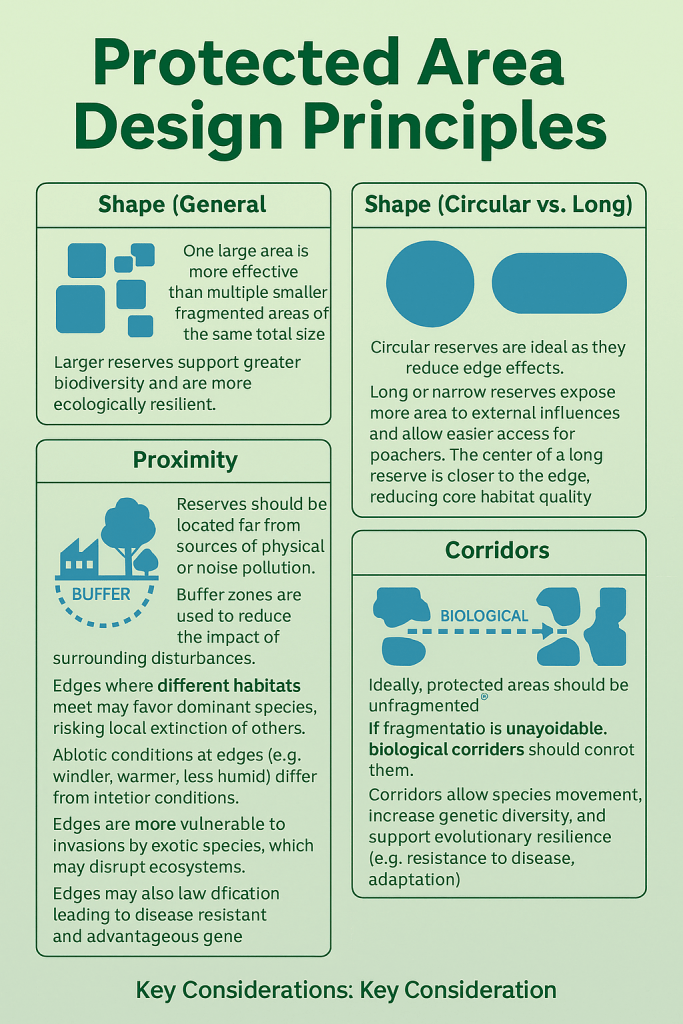
Protected Area Design Principles – Key Considerations
🔷 Shape (General)
- One large area is more effective than multiple smaller, fragmented areas of the same total size.
- Larger reserves support greater biodiversity and are more ecologically resilient.
🔷 Shape (Circular vs. Long)
- Circular reserves are ideal as they reduce edge effects.
- Long or narrow reserves expose more area to external influences and allow easier access for poachers.
- The center of a long reserve is closer to the edge, reducing core habitat quality.
🔷 Proximity
- Reserves should be located far from sources of physical or noise pollution.
- Buffer zones are used to reduce the impact of surrounding disturbances.
🔷 Edge Effects
- Edges where different habitats meet may favor dominant species, risking local extinction of others.
- Abiotic conditions at edges (e.g., windier, warmer, less humid) differ from interior conditions.
- Edges are more vulnerable to invasions by exotic species, which may disrupt ecosystems.
🔷 Corridors
- Ideally, protected areas should be unfragmented.
- If fragmentation is unavoidable, biological corridors should connect them.
- Corridors allow species movement, increase genetic diversity, and support evolutionary resilience (e.g., resistance to disease, adaptation).
Part 4: Rewilding
to undo the declines in biodiversity and lead to the restoration of ecosystems. This can be done by…
- returning an area to its natural processes and wildlife,
- reintroduces lost animal species to natural environments,
- Keystone and/or apex predators that have a significant effect on the food web and trophic levels in an ecosystem.
- establishing a corridors between fragmented areas
- banning agriculture or resources harvesting in assigned areas
The success of conservation depends on:
- community support
- adequate funding
- education and awareness
- appropriate legislation
- scientific research.
Furthermore, the selection of conservation approach also depends on the EVS of an individual or a community/institution
![ESS 8.1.3 [AHL] Biocapacity and Environmental Migration](https://mypytrclass.com/wp-content/uploads/2025/12/image-4.png?w=1024)




![ESS 8.3.4 [AHL] Photochemical Smogs and Tropospheric Ozone](https://mypytrclass.com/wp-content/uploads/2025/12/image-1.png?w=1024)

 PYTR Class