
Learning Objectives
- [AHL] Identify and explain the major factors that influence soil formation, including climate, organisms, geomorphology, geology, and time.
- [AHL] Compare and contrast the properties of soils dominated by sand, silt, or clay, focusing on particle size and chemical characteristics.
- [AHL] Analyze soil properties using data on texture (sand, silt, and clay percentages), organic matter content, water content, infiltration rate, bulk density, color, and pH.
- [AHL] Explain how carbon is released from soils in the form of methane and carbon dioxide.
Part 1: Factors of Soil Formation
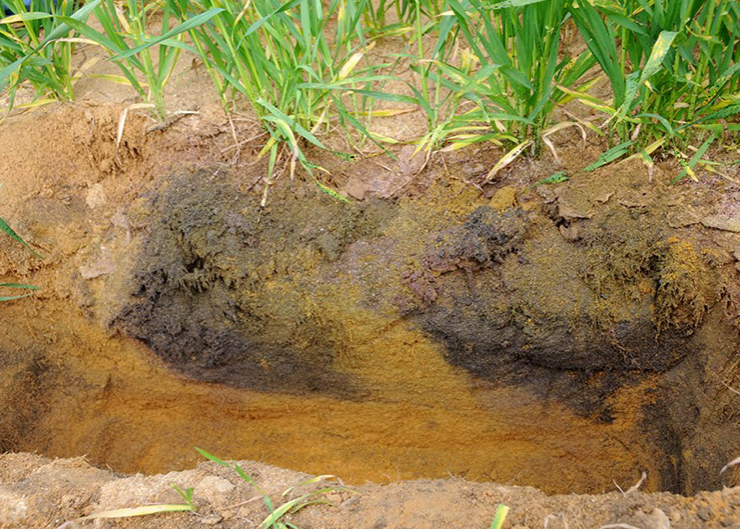
Soil formation is a complex and lengthy process that can take anywhere from decades to thousands of years, depending on various interacting factors. Among these, climate plays a dominant role, as both precipitation and temperature influence the rates of chemical reactions involved in soil development. Climate also determines the extent of leaching and evaporation, with water deficiency potentially leading to the formation of nutrient-poor oxisols, while excessive moisture can wash away essential nutrients and reduce soil fertility. In waterlogged conditions, oxygen is displaced from the soil pores, causing plant roots to suffocate and die, while denitrification increases and soil acidity rises.
Organisms also play a critical role in soil development. Each soil functions as its own ecosystem, hosting a variety of organisms such as nitrogen-fixing bacteria, fungi that help accumulate phosphorus, and plant roots that anchor the soil and contribute to the build-up of organic matter through decomposition. Burrowing soil animals further enhance the structure and aeration of the soil by allowing gases and water to circulate more freely.
Topography, or the physical shape of the land, also affects soil formation. On steep slopes, rainwater tends to run off rather than infiltrate the ground, leading to erosion and the development of shallow soils. Elevation influences temperature, with higher altitudes experiencing cooler conditions that slow down soil-forming processes. Additionally, the orientation of slopes affects exposure to sunlight, making some slopes drier and warmer than others.
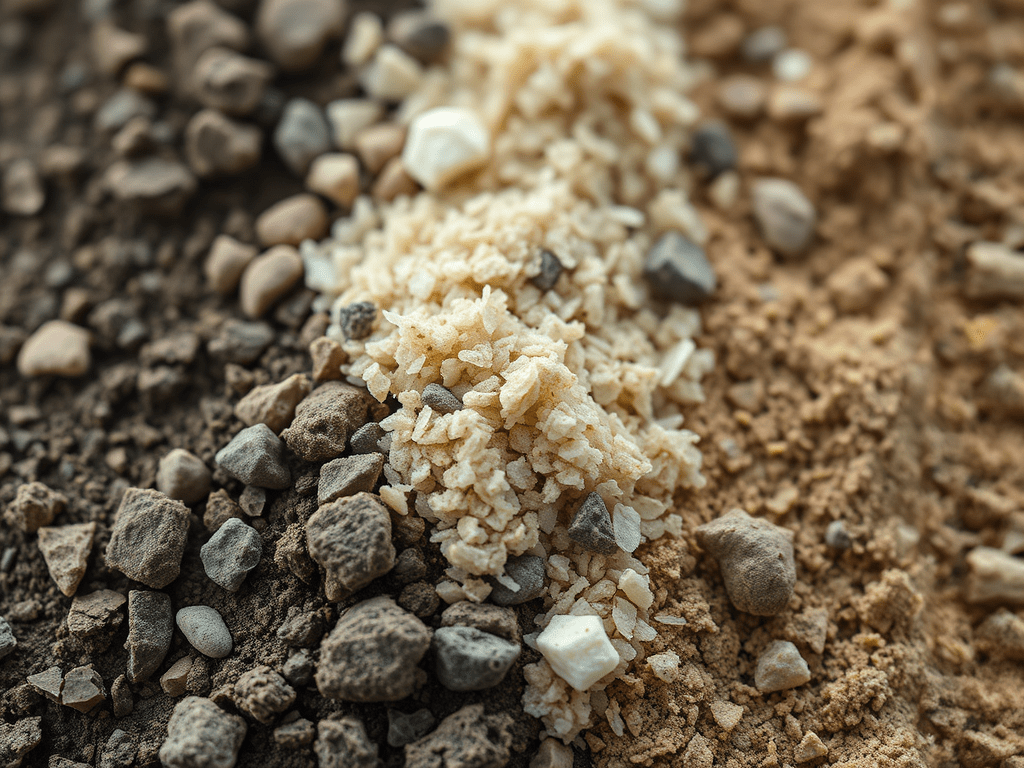
Finally, geology—or the nature of the parent material—provides the mineral foundation for soils. This material, derived from rock, is broken down through weathering and moved by erosion or deposition. Weathering can be physical, such as freeze-thaw cycles breaking rock into smaller fragments, or chemical, involving reactions like the dissolution of minerals in water or oxidation in air. Different types of parent materials result in different soil characteristics. For instance, calcareous rocks like chalk and limestone, formed from marine organisms, produce alkaline soils with high pH but generally low fertility due to limited organic matter and nutrients. In contrast, volcanic rocks such as basalt or granite form young, fertile soils called andisols. These are rich in minerals like magnesium and potassium and are often enhanced by layers of volcanic ash, making them especially valuable for agriculture.
Part 2: Soil Composition
Soil Properties and Analysis
- Soil properties can be determined through analysis of:
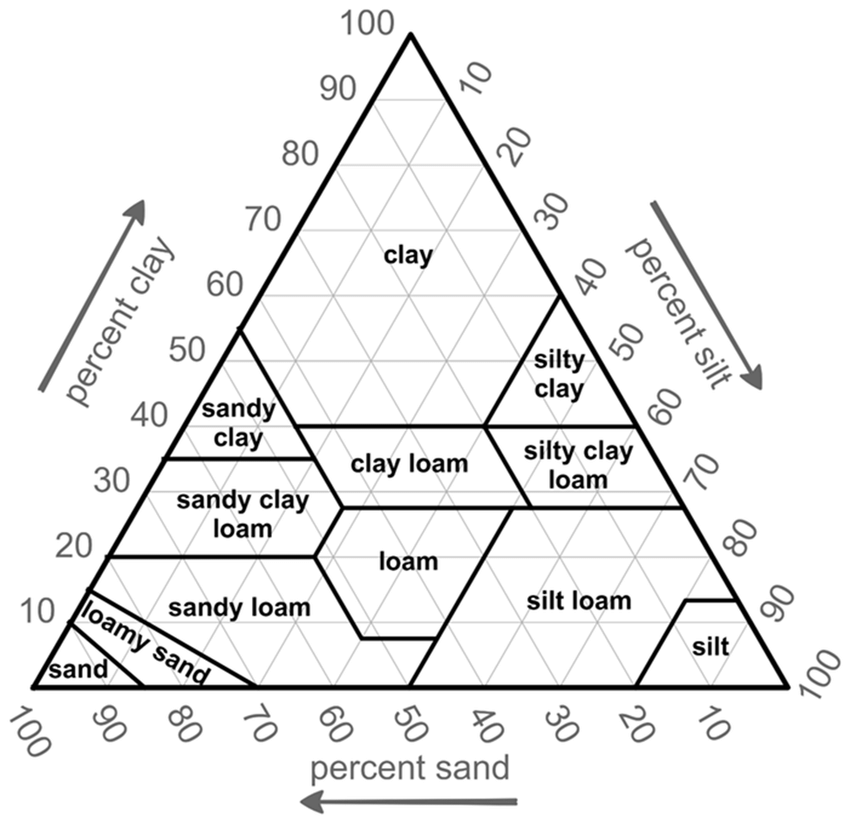
- Sand, silt, and clay percentages (soil texture)
- Organic matter content
- Water content (percentage)
- Infiltration rate
- Bulk density
- Soil color
- pH level
- A soil texture triangle is used to classify soils based on sand, silt, and clay percentages.
Cation-Exchange Capacity (CEC)
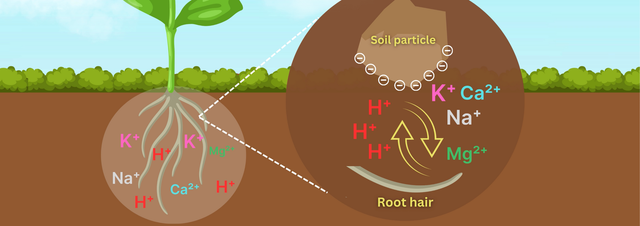
- CEC measures the ability of soil particles to retain positively charged ions (cations).
- Sand and silt (from quartz) have low CEC.
- Clay particles (complex silicates) have high CEC, enhancing nutrient availability.
- CEC influences the soil’s capacity to retain nutrients and reduce fertilizer loss.
- Important plant-available cations include:
- Potassium (K⁺)
- Ammonium (NH₄⁺)
- Magnesium (Mg²⁺)
- Calcium (Ca²⁺)
Porosity and Permeability
- Porosity = the total space between soil particles.
- Permeability = the ability of gases and liquids to pass through soil.
- Clay soils:
- High microporosity but low permeability.
- Water is retained as a film around clay particles, making it hard for roots to access nutrients.
- Can be nutrient-rich but low in fertility.
- Sandy soils:
- Fewer but larger macropores.
- High permeability and good drainage.
- Lower nutrient retention due to reduced CEC.

Part 3: Sustainability of Soil
Soil Acidification
- Clay soils are prone to acidification due to water absorption.
- Clay binds hydrogen ions (H⁺), increasing acidity.
- Higher acidity:
- Reduces retention of essential cations (K⁺, Mg²⁺, NH₄⁺) due to leaching.
- Increases solubility of toxic aluminium (Al³⁺) and iron (Fe²⁺/Fe³⁺) ions.
- Acid rain has caused widespread soil acidification in northern European forests, damaging evergreens through needle loss.
Soil Fertility
- Fertile soil is a non-renewable resource with limited natural renewal capacity.
- Soil formation rate: ~1 tonne/ha/year under ideal conditions (0.05–0.1 mm/year).
- Soil fertility is sustained by nutrients like:
- Nitrates
- Phosphates
- Potassium (NPK)
- Various micronutrients
- Nutrient losses occur via leaching and crop harvesting.
- Nutrient replacement methods include:
- Chemical fertilizers
- Legume cultivation
- Crop rotation
- Organic matter (manure, compost)
Topsoil and Its Importance
- Topsoil = the A horizon, rich in organic matter and essential for plant growth.
- Contains:
- High levels of oxygen
- Organic matter and microorganisms
- Active nutrient cycling
- Root growth and biological activity
- Most vulnerable to erosion and degradation, especially under intensive agriculture.

Threats to Soil Health
- Intensive agricultural practices leading to degradation
- Soil compaction from heavy machinery
- Loss of biodiversity due to monoculture farming
- Pollution from:
- Pesticides
- Heavy metals
- Pharmaceuticals
- Plastics
- Land abandonment and neglect
Part 4: Soil as C Source
- Soils act as sources of greenhouse gases, including carbon dioxide (CO₂), methane (CH₄), and nitrous oxide (N₂O).
- In natural systems, soil stores about three times more carbon in the top meter than the atmosphere does.
- Human activities, especially agriculture, disrupt the natural carbon cycle and accelerate carbon release.
- Carbon is released from soils faster than it is replaced, reducing their role as a carbon sink.
- Factors contributing to soil carbon emissions include:
- Increased decomposition due to global warming
- Agricultural practices such as tilling and fertilization
- Drainage of wetlands
- Other land use changes and disturbances
- Rising carbon emissions may trigger a climate tipping point, where warming accelerates the breakdown of methane clathrates (methane frozen in geological structures), releasing even more greenhouse gases.
![ESS 8.1.3 [AHL] Biocapacity and Environmental Migration](https://mypytrclass.com/wp-content/uploads/2025/12/image-4.png?w=1024)




![ESS 8.3.4 [AHL] Photochemical Smogs and Tropospheric Ozone](https://mypytrclass.com/wp-content/uploads/2025/12/image-1.png?w=1024)

 PYTR Class