

Learning Objectives
- Explain why land is a finite resource and evaluate the challenges of feeding a growing global population.
- Analyse how land-use decisions affect marginalised groups and why their inclusion is essential for equitable outcomes.
- Assess global food production, distribution, and waste to understand why hunger persists despite sufficient overall supply.
- Define food security and explain its importance for ensuring physical and economic access to a balanced, healthy diet for all individuals.
Part 1: Facts about food and agriculture

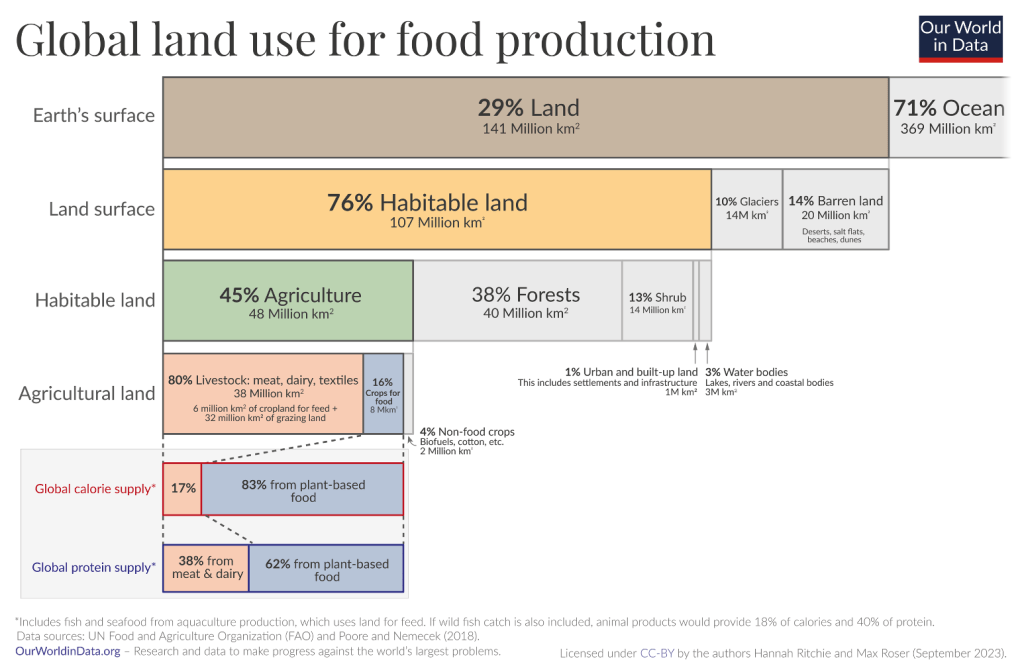
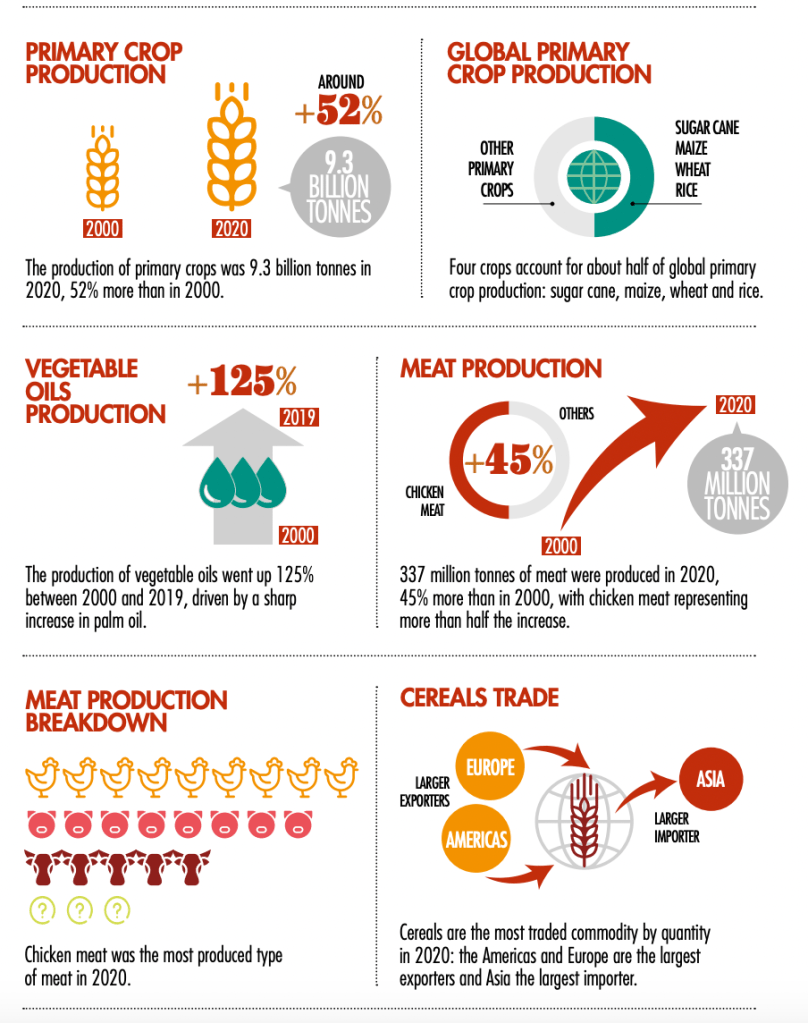
FAQ. 2022. World Food and Agriculture — Statistical Yearbook 2022. Rome. https://doi.org/10.4060/cc2211en (CC BY-NC-SA 3.0)
Part 2: Factors influencing sustainability of agriculture
Activity: Discuss with peers, which one is more sustainable? – Commercial farming or subsistence agriculture
Factors influencing agricultural sustainability
Read more of this content when you subscribe today.
Part 3: Food Security
The four dimensions of food security according to Word Bank Group includes:


FAQ. 2022. World Food and Agriculture — Statistical Yearbook 2022. Rome. https://doi.org/10.4060/cc2211en (CC BY-NC-SA 3.0)
For a more detailed analysis, reference can be made to the Food and Agriculture Organization (FAO) report The State of Food and Agriculture: Moving Forward on Food Loss and Waste Reduction.
Subscribe to get access: Marginalised populations and food waste
Read more of this content when you subscribe today.
Shared of land area by type and region
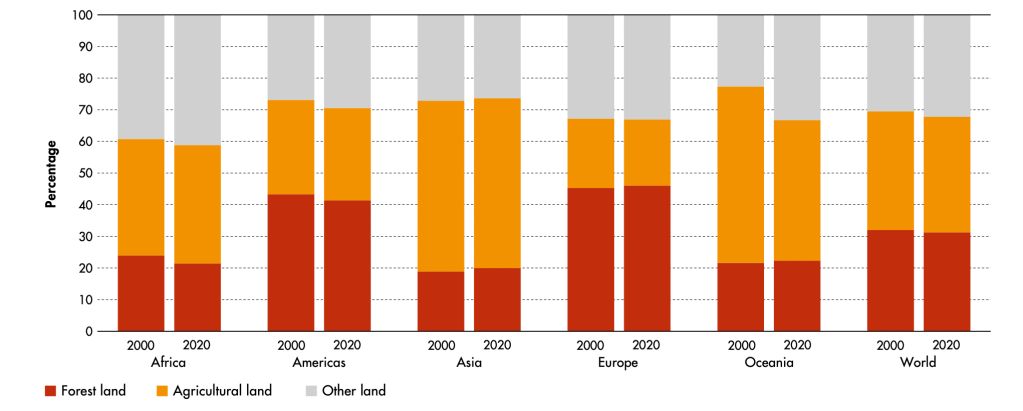
https://doi.org/10.4060/cc2211en-fig59
Food Security
Food security refers to the physical and economic accessibility of food that enables all individuals to obtain a balanced diet necessary for an active and healthy life. Conversely, food insecurity occurs when such access is restricted.
Ukraine, located in Eastern Europe, possesses exceptionally fertile soils (mollisol, chernozem, or “black earth”), rich in humus. This natural endowment enables Ukraine to play a significant role in global food production, accounting for approximately 10% of the world’s wheat, 15% of maize, 13% of barley, and more than 50% of sunflower oil.
The outbreak of the Ukraine–Russia conflict in 2021 severely disrupted agricultural production and exports. By this time, food commodity prices in Ukraine had reached a ten-year high, while fuel costs had escalated dramatically. These developments contributed to a tripling of fertilizer prices and steep increases in food prices globally.
In 2022, the World Food Programme (WFP)—a United Nations agency—warned that the combined effects of armed conflict, the COVID-19 pandemic, the climate crisis, and rising costs placed up to 828 million people worldwide at risk of severe food insecurity.
According to the WFP, four primary drivers contribute to food insecurity:
- Conflict remains the most significant factor, with approximately 60% of the world’s food-insecure population living in areas affected by war and violence. The war in Ukraine illustrates how conflict exacerbates hunger by displacing populations and eliminating sources of income.
- Climate change and related disasters devastate crops, livelihoods, and infrastructure, thereby reducing people’s ability to feed themselves.
- The economic repercussions of the COVID-19 pandemic have intensified global hunger to unprecedented levels.
- Rising costs further exacerbate food insecurity. By 2022, the WFP’s monthly operating costs had increased by 44% compared to the 2019 average—an additional USD 73.6 million per month. Funds previously sufficient to feed four million people for a month were redirected toward covering operational expenses.
Geographically, the most acute hunger crises are concentrated in the Central American Dry Corridor and Haiti; the Sahel, Democratic Republic of the Congo, Tigray, Sudan, and the Horn of Africa; as well as in Syria, Yemen, and Afghanistan.
The severity of food insecurity has also driven displacement. Populations flee their home countries in search of safety and sustenance, with refugee numbers rising from 20.7 million at the end of 2021 to 35.3 million by the end of 2022. When combined with internally displaced persons (IDPs)—those forced to migrate due to hunger or conflict but who remain within national borders—the figure exceeds 100 million individuals. This equates to roughly one in every 78 people on Earth.
Class Task
Formative Task : Analyse how Ukraine-Russian conflict contributes to food insecurity [9]
Read more of this content when you subscribe today.
![ESS 8.1.3 [AHL] Biocapacity and Environmental Migration](https://mypytrclass.com/wp-content/uploads/2025/12/image-4.png?w=1024)




![ESS 8.3.4 [AHL] Photochemical Smogs and Tropospheric Ozone](https://mypytrclass.com/wp-content/uploads/2025/12/image-1.png?w=1024)
 PYTR Class