

Learning Objectives
- Compare agricultural systems worldwide in relation to variations in soils and climates.
- how different factors shape farmers’ choices and the implications for economic, social, and environmental sustainability?
- how traditional agricultural techniques such as nomadic pastoralism and slash-and-burn farming, and assess their role in sustaining low-density populations?
- Explain the innovations of the Green Revolution and critically evaluate its sociocultural, economic, and environmental impacts.
- Distinguish between the role of synthetic fertilisers in intensive farming and alternative soil fertility methods used in sustainable agriculture.
Class Activity:
Part 1: Agricultural Systems
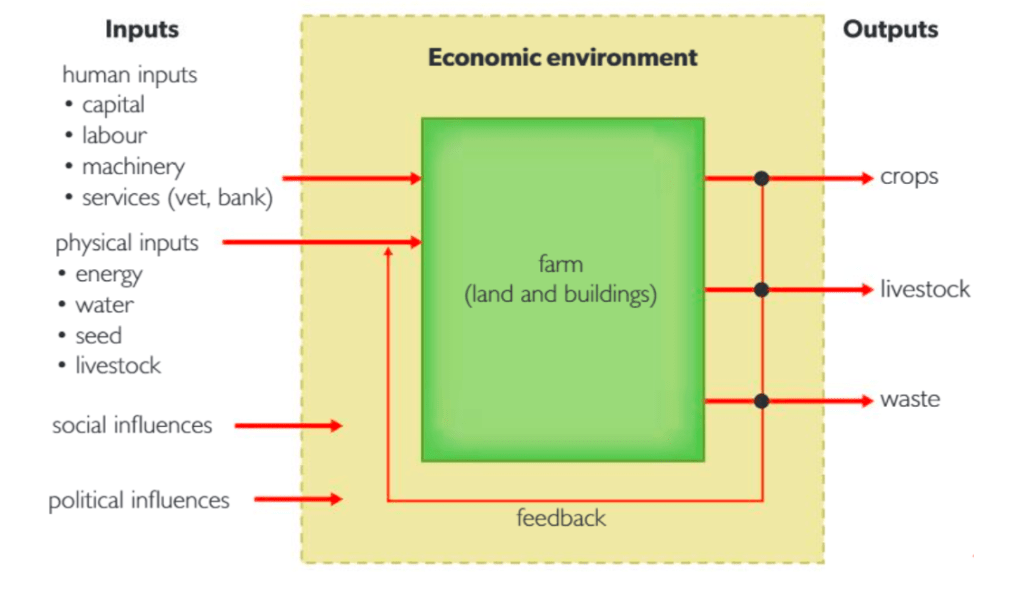
The suitability of land for agricultural production is determined by various physical and environmental factors, including land aspect, altitude, latitude, and slope. The presence of large rocks near the surface may hinder cultivation, while soils with low nutrient levels, contamination, high irrigation demands, or susceptibility to flooding also restrict agricultural potential. Furthermore, socio-cultural, political, and economic factors influence farming practices. For instance, cultural traditions, dietary preferences, government subsidies, incentives, or penalties shape farmers’ decisions. Since agricultural production is closely tied to markets, farmers must operate efficiently to avoid financial losses that may threaten the viability of their enterprises.
| Farming System | Example of Where | Type | Inputs | Outputs | Efficiency | Environmental Impact |
|---|---|---|---|---|---|---|
| Shifting cultivation | Amazon rainforest | Extensive, subsistence | Low – labour and hand tools | Low – enough to feed the family | High | Low – if enough land to move to and time for forest to regrow |
| Cereal growing | Canadian Prairies | Extensive, commercial | High use of technology and fertilizers | Low per hectare, high per farmer | Medium | High – loss of natural ecosystems, soil erosion, loss of biodiversity |
| Rice growing | Ganges Valley | Intensive, subsistence | High labour, low technology | High per hectare, low per farmer | High | Low – padi rice has a polyculture, stocked with fish; also grow other crops |
| Horticulture & dairying | Western Netherlands | Intensive, commercial | High labour and technology | High per hectare and per farmer | High | High – greenhouses for salads/flowers are heated and lit; dairying involves fertilized grass and waste from cows |
Part 2: Classifications of Agricultural System
Agricultural systems may be classified according to:
- Outputs of the system – arable (crop-based), pastoral (livestock-based), monoculture, or mixed farming.
- Purpose of farming – commercial or subsistence, sedentary or nomadic.
- Inputs required – intensive or extensive methods, irrigated or rain-fed approaches, soil-based or hydroponic systems, organic or inorganic methods.
Major Types of Farming
- Subsistence farming
- oriented towards household consumption or local community needs, with little or no surplus.
- Mixed cropping is common, requiring significant human labour but limited fossil fuel or chemical inputs.
- With low levels of technology and capital, yields are minimal, leaving farmers vulnerable to food insecurity.
- Cash cropping
- focuses on producing crops primarily for market sale rather than self-consumption.
- Commercial farming
- is profit-oriented and typically operates on a large scale.
- It often involves monoculture, relying heavily on chemical, technological, and energy inputs to maximise yields per hectare.
- Arable farming
- emphasises the cultivation of crops, either for direct human consumption, animal feed, or biofuel production.
- Mixed farming
- integrates crop cultivation and livestock rearing, with animal manure improving soil fertility and crops serving as livestock feed.
- Pastoral farming
- is based on the rearing of livestock, generally on grasslands or marginal lands unsuitable for crops.
- Nomadic pastoralism
- involves cyclical migration of herders and their animals—such as cattle, sheep, goats, camels, horses, or reindeer—in search of water and pasture.
- Approximately 40 million people worldwide still practice this form of livelihood, including Mongolian nomads, Aboriginal Australians, and the San of Africa.
- Shifting cultivation,
- widespread in the humid tropics of sub-Saharan Africa, Southeast Asia, and South America, follows a “slash-and-burn” method.
- Vegetation is cleared and burned, after which crops are grown on nutrient-rich ash soil for a limited number of seasons before land is left fallow.
- This system, which combines features of both subsistence and extensive farming, remains a traditional method practiced by an estimated 200–300 million people across 64 countries.
Input-Based Farming Systems
- Extensive farming
- relies on low levels of fertilisers, pesticides, machinery, and labour per unit area. Productivity is generally low, but it allows for cultivation or grazing over larger areas with minimal inputs.
- Intensive farming
- seeks to maximise output from a limited land area through high input use, including fertilisers, chemicals, and mechanisation. Examples include feedlots and high-yield crop systems, which depend on inorganic fertilisers to sustain soil fertility.
- Irrigated agriculture
- depends heavily on water resources, accounting for 70% of global freshwater use and over 40% in Organisation for Economic Co-operation and Development (OECD) countries. Irrigation enables consistent crop growth but imposes significant pressure on water availability. Alternatives include rain-fed farming and water capture in tanks or reservoirs.
- Hydroponics
- is a soil-free cultivation system in which plants grow in nutrient-rich water solutions, often supported by inert materials such as gravel. It enables high planting density and reduced land use, but is currently limited to high-value crops like salads and soft fruits, rather than staple crops.
- Organic farming
- avoids synthetic fertilisers and pesticides, instead using natural methods such as crop rotation, compost, and biological pest control to maintain soil fertility and reduce disease.
- Inorganic farming
- depends on synthetic fertilisers and chemicals, often derived as by-products of the petroleum industry, to boost soil fertility and crop yields.
Nomadic Pastoralism and Shifting Cultivation
Nomadic pastoralism and shifting cultivation represent two traditional forms of extensive agriculture that have existed since the earliest periods of human farming. These systems were highly effective under conditions of low population density, providing sustainable livelihoods with minimal ecological disruption. However, in contemporary contexts, the viability of these practices has been increasingly constrained by demographic growth, land-use change, and socio-political pressures.
As sedentary societies expanded, they established permanent settlements such as towns, farms, and national territories. This process of territorial fixation reduced the spatial mobility available to nomadic groups, thereby limiting opportunities for continued migration. In addition to these spatial constraints, modernizing forces—both internal and external—have exerted pressure on nomadic populations to abandon traditional lifestyles. Access to modern conveniences, incompatibility with nomadic mobility, and political pressures from settled communities often compel pastoralists to adopt sedentary forms of livelihood. Such transformations may occur through coercion, persuasion, or state-led policies encouraging integration into settled societies.
Part 3: Green Revolution
Between the 1940s and the 1960s, the Green Revolution marked a significant transformation in global agricultural productivity through the scientific breeding of staple crops such as wheat and rice. By artificially selecting plant varieties with desirable traits—such as disease resistance, shorter stalks, and higher yields—researchers achieved unprecedented increases in crop production. These improvements occurred prior to the advent of genetic engineering, which later introduced the possibility of transferring genes across species.
In Mexico, the introduction of high-yielding wheat varieties enabled the country to achieve self-sufficiency in wheat production and subsequently generate export surpluses. In India, the development of high-yielding varieties (HYVs), such as the IR8 strain of rice, resulted in fivefold increases in yield without fertilizer and tenfold increases with fertilizer application. This transformation substantially reduced the cost of staple foods and positioned India as a major exporter of rice and wheat. Conversely, in parts of Africa, the Green Revolution had limited impact on crop productivity.
Despite its success in alleviating global food shortages, the Green Revolution has faced substantial criticism. Its reliance on intensive inputs—including synthetic fertilizers, irrigation, mechanization, and pesticides—has been associated with negative environmental consequences such as eutrophication, soil salinization, and the accumulation of harmful chemicals in ecosystems and food chains. Additionally, the widespread adoption of uniform high-yield varieties has reduced genetic diversity, as traditional crop strains were often abandoned. This dependency also made farming systems increasingly reliant on fossil-fuel-based inputs, thereby undermining long-term sustainability.
Economically, the Green Revolution had uneven effects. While high-yielding crops contributed significantly to global food supply, small-scale farmers in some regions were disadvantaged by the high costs of inputs and the requirement to purchase new seeds annually. Farmers often had to take out loans to adopt new technologies, leading to cycles of indebtedness. Consequently, while the Green Revolution improved overall agricultural productivity, it also generated social inequalities and environmental challenges, leading to critiques of its long-term economic and ecological sustainability.
![ESS 8.1.3 [AHL] Biocapacity and Environmental Migration](https://mypytrclass.com/wp-content/uploads/2025/12/image-4.png?w=1024)




![ESS 8.3.4 [AHL] Photochemical Smogs and Tropospheric Ozone](https://mypytrclass.com/wp-content/uploads/2025/12/image-1.png?w=1024)
 PYTR Class