
Learning Objectives
- Explain how GHGs and aerosols in the atmosphere cause warming effect and the cooling effect
- Outline the meaning of radioactive forcing
- Explain the mechanism of greenhouse effect
Greenhouse Gasses (GHGs) and Aerosols
Greenhouse Gasses
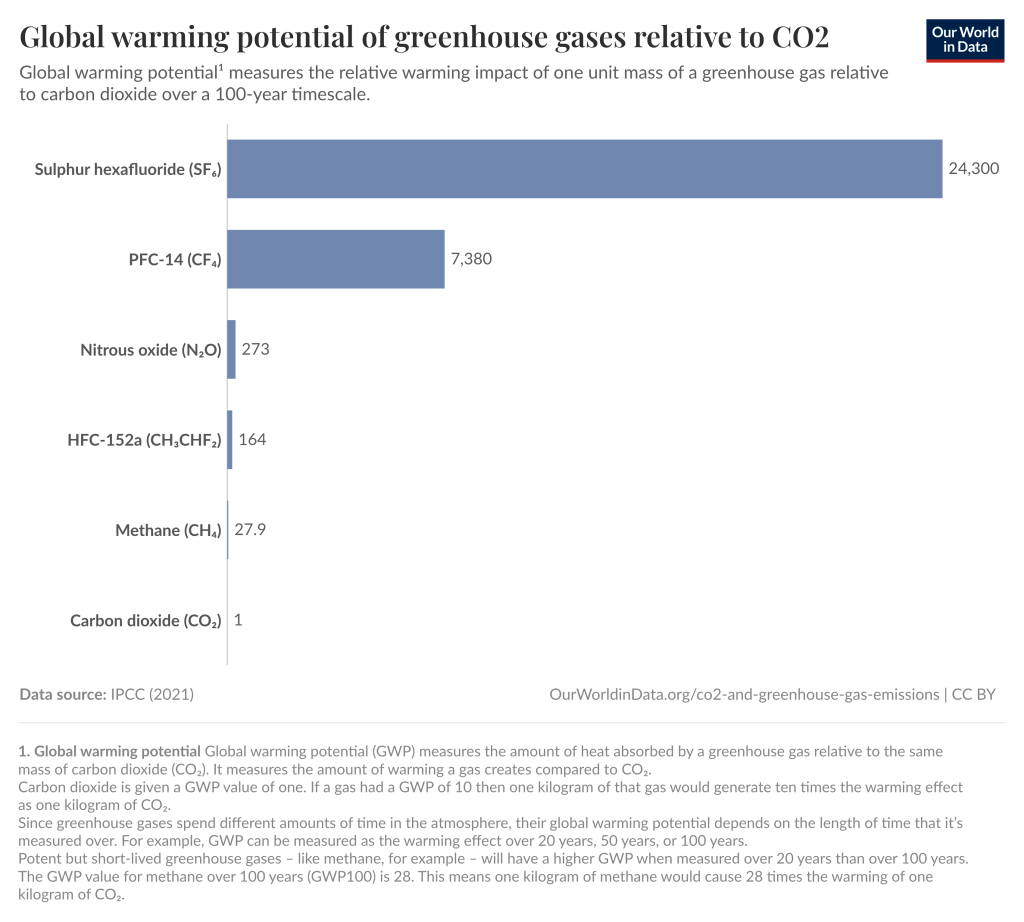
The principal greenhouse gases (GHGs) present in the atmosphere include:
- water vapour
- carbon dioxide (CO₂)
- tropospheric ozone (O₃)
- methane (CH₄)
- nitrous oxide (N₂O)
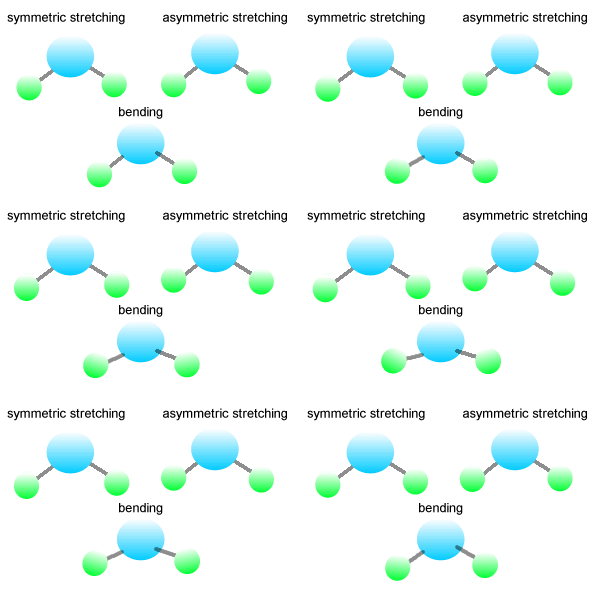
Greenhouse gases allow the transmission of incoming short-wave solar radiation but absorb outgoing long-wave radiation, owing to differences in wavelength between the two processes. While most greenhouse gases contribute to atmospheric warming, certain components can exert a cooling effect. This occurs primarily due to aerosols, many of which—such as sulphur emissions—originate from anthropogenic activities. Aerosols influence the proportion of solar radiation that reaches the Earth’s surface, thereby exerting local or regional effects on temperature. For example, some industrial regions have experienced less warming than expected despite rising GHG concentrations. This phenomenon, referred to as global dimming or regional dimming, arises partly from increased aerosol loading and partly from enhanced water vapour, both of which can augment cloud cover and reflect substantial amounts of solar radiation away from the Earth’s surface.
Black Carbon (Aerosol)
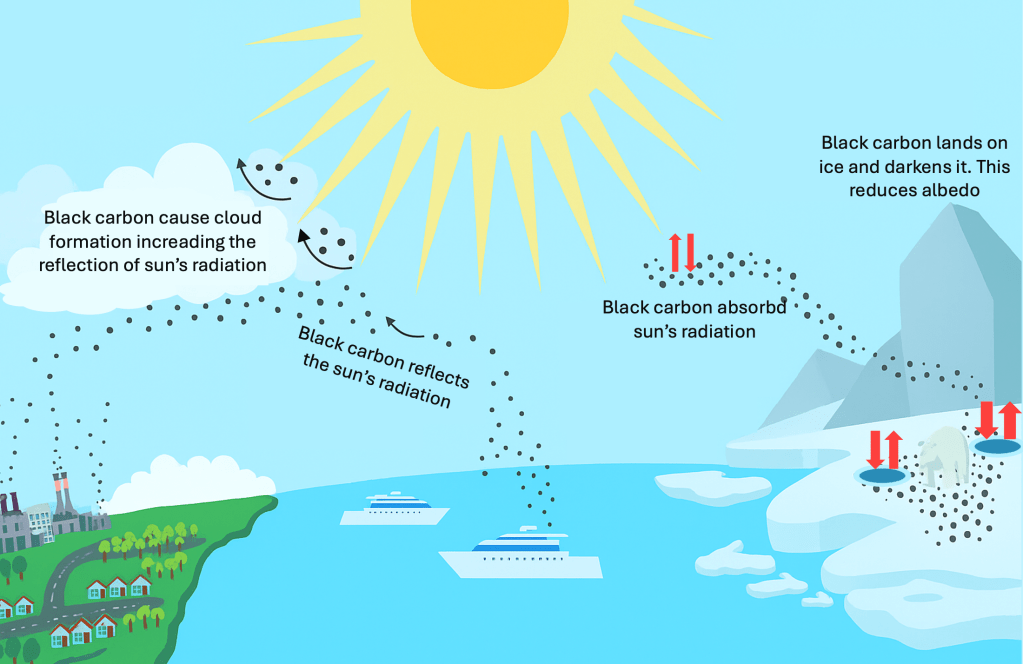
In addition to these gases, black carbon is present in the atmosphere in the form of an aerosol.
Black carbon is produced by the incomplete combustion of fossil fuels, biofuels, and biomass. Approximately 20% of global black carbon emissions originate from biofuels, 40% from fossil fuels, and the remaining 40% from open biomass burning, such as that occurring in savannahs and rainforests. Black carbon consists of fine particulate matter with diameters smaller than 2.5 μm, although it remains in the atmosphere only for a short duration (days to weeks) before being removed by precipitation.
Black carbon influences the climate through several mechanisms:
- Direct effects
- when airborne, black carbon absorbs sunlight and reduces the albedo.
- Semi-direct effects
- absorption of incoming solar radiation alters atmospheric stability and cloud cover.
- Snow and ice albedo effects
- deposition on snow and ice decreases albedo, triggering a positive feedback loop in which surface warming accelerates ice melt, further reducing albedo.
- Indirect effects
- changes in cloud properties influence the absorption and reflection of solar radiation.
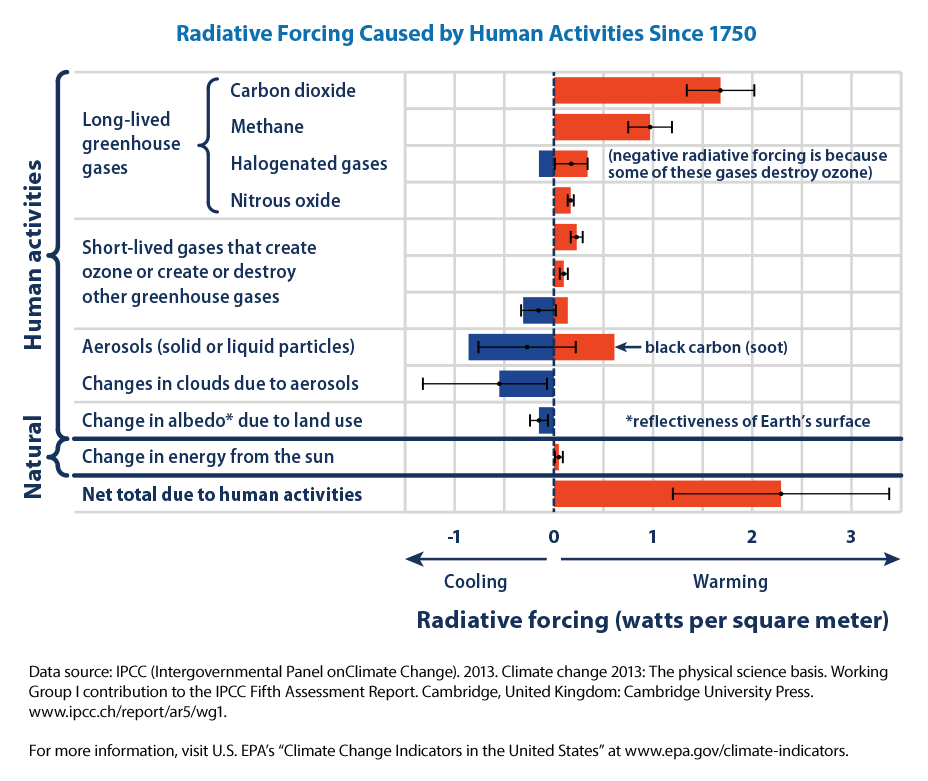
According to the Intergovernmental Panel on Climate Change (IPCC), the combined direct and indirect snow–albedo effects make black carbon the third largest contributor to positive radiative forcing since pre-industrial times. It is also considered a key driver of Arctic ice melt. The IPCC estimates that reductions in snow albedo caused by soot deposition may account for up to 25% of observed global warming.
Radiative Forcing
Radiative forcing refers to the net balance between incoming solar radiation and outgoing long-wave radiation. Positive radiative forcing indicates that the Earth absorbs more energy than it emits back into space. The magnitude of radiative forcing depends on variations in insolation, surface albedo, and atmospheric concentrations of greenhouse gases.
The Greenhouse Effect
The greenhouse effect is a natural atmospheric process in which greenhouse gases and aerosols absorb and re-emit long-wave infrared (IR) radiation emitted from the Earth’s surface. This process traps heat within the atmosphere, thereby warming the planet. The greenhouse effect is essential for sustaining life, as without it the Earth’s average surface temperature would be approximately –18 °C rather than the current global mean of around 15 °C, rendering the planet largely uninhabitable.
Although molecular oxygen (O₂) and nitrogen (N₂) comprise the majority of the atmosphere, they do not absorb or emit long-wave radiation. In contrast, water vapour and trace gases such as carbon dioxide (CO₂), methane (CH₄), nitrous oxide (N₂O), and ozone (O₃) act as greenhouse gases. By absorbing and re-radiating terrestrial radiation, they function as a thermal blanket, producing what is termed the natural greenhouse effect. This phenomenon has been a persistent feature of the Earth’s climate system throughout much of its atmospheric history.
Enhanced (anthropogenic) Greenhouse Effect
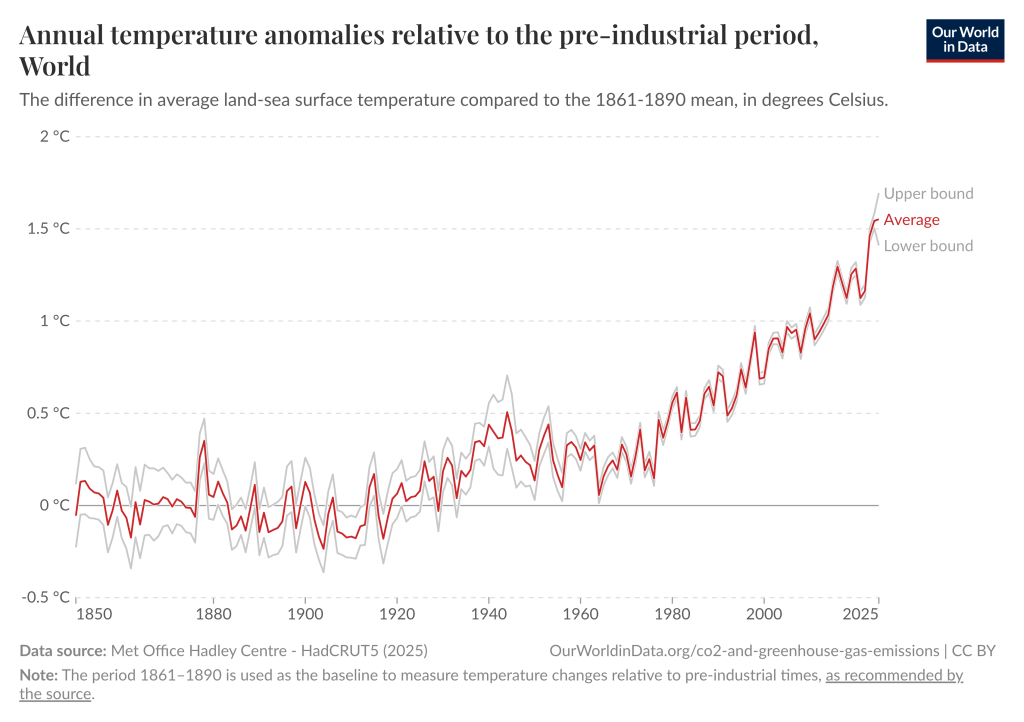
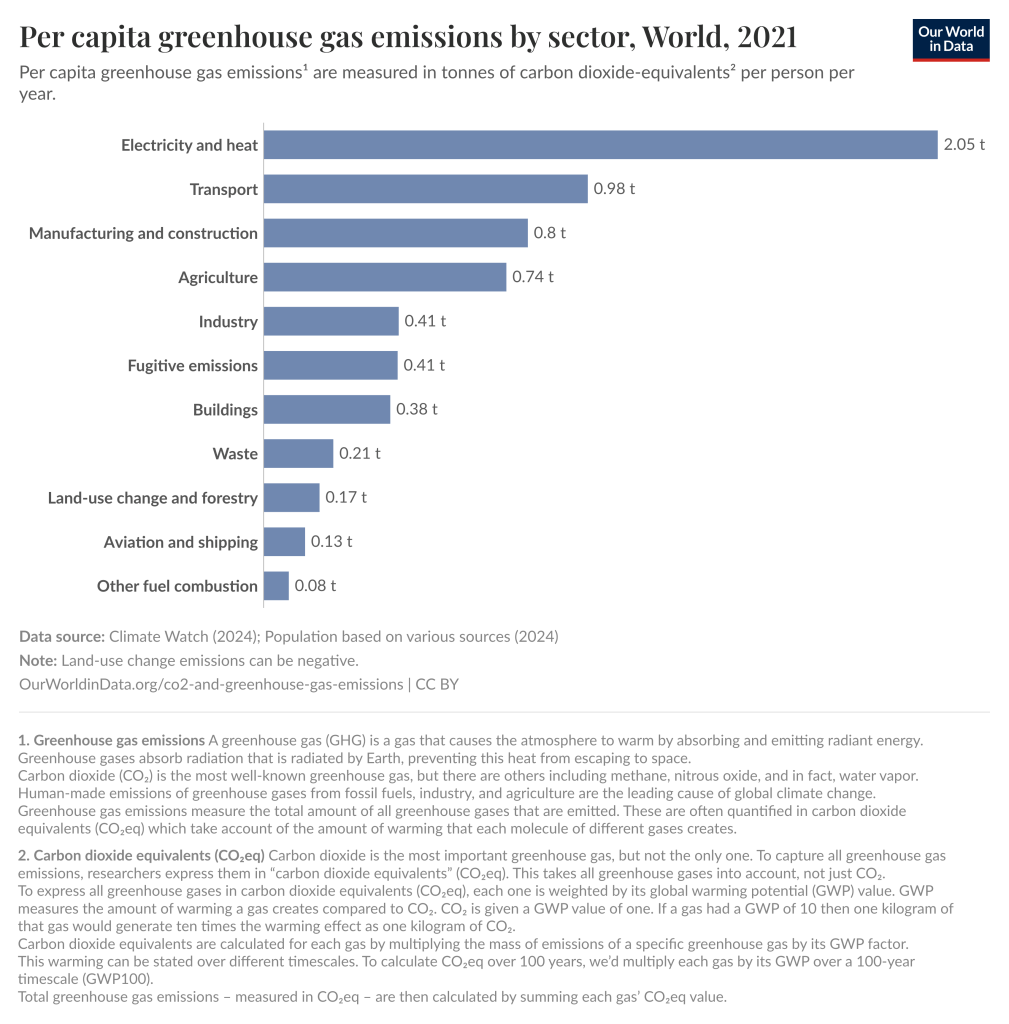
The enhanced greenhouse effect refers to the anthropogenically driven increase in greenhouse gas concentrations, primarily from fossil fuel combustion, industrial processes, and land-use change. This intensification raises global temperatures above their natural baseline, contributing to phenomena collectively referred to as global warming, climate change, or climate crisis. While CO₂ is the most significant greenhouse gas due to its concentration and persistence, other gases—including CH₄, N₂O, and tropospheric O₃—also play critical roles. Collectively, the warming effect of these non-CO₂ gases is estimated to be equivalent to approximately 60% of the radiative forcing attributable to CO₂.
Class Materials
Subscribe to get access
Read more of this content when you subscribe today.
![ESS 8.1.3 [AHL] Biocapacity and Environmental Migration](https://mypytrclass.com/wp-content/uploads/2025/12/image-4.png?w=1024)



![ESS 8.3.4 [AHL] Photochemical Smogs and Tropospheric Ozone](https://mypytrclass.com/wp-content/uploads/2025/12/image-1.png?w=1024)

 PYTR Class