
Learning objectives
- Describe ecological economics in terms of economic growth
- Outline degrwoth and eco-economic decoupling
IB Knowledge Statements
HL.b.1 Economics studies how humans produce, distribute and consume goods and services, both individually and collectively.
HL.b.2 Environmental economics is economics applied to the environment and environmental issues.
HL.b.3 Market failure occurs when the allocation of goods and services by the free market imposes negative impacts on the environment.
HL.b.4 When the market fails to prevent negative impacts, the polluter-pays principle may be applied.
HL.b.5 “Greenwashing” or “green sheen” is where companies use marketing to give themselves a more environmentally friendly image.
HL.b.6 The tragedy of the commons highlights the problem where property rights are not clearly delineated and no market price is attached to a common good, resulting in overexploitation.
HL.b.7 Environmental accounting is the attempt to attach economic value to natural resources and their depletion.
HL.b.8 In some cases, economic value can be established by use, but this is not the case for non-use values.
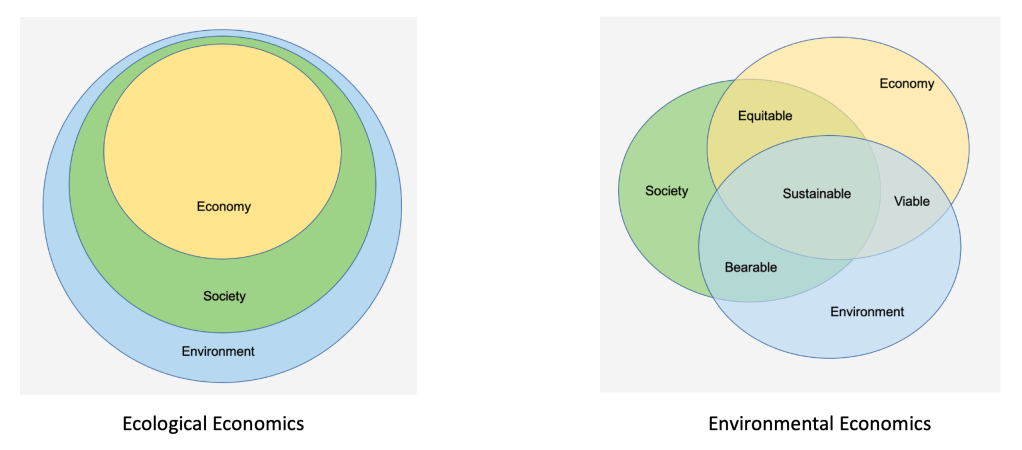
HL.b.9 Ecological economics is different from environmental economics in that it views the economy as a subsystem of Earth’s larger biosphere and the social system as being a sub component of ecology.
HL.b.10 While the economic valuation of ecosystem services is addressed by environmental economics, there is an even greater emphasis in ecological economics.
HL.b.11 Economic growth is the change in the total market value of goods and services in a country over a period and is usually measured as the annual percentage change in GDP.
HL.b.12 Economic growth is influenced by supply and demand, and may be perceived as a measure of prosperity.
HL.b.13 Economic growth has impacts on environmental welfare.
HL.b.14 Eco-economic decoupling is the notion of separating economic growth from environmental degradation.
HL.b.15 Ecological economics supports the need for degrowth, zero growth or slow growth, and advocates planned reduction in consumption and production, particularly in high-income countries.
HL.b.16 Ecological economists support a slow/no/zero growth model.
HL.b.17 The circular economy and doughnut economics models can be seen as applications of ecological economics for sustainability.
Ecological Economics
Unlike environmental economics, which builds on traditional economic theory, ecological economics is transdisciplinary and studies the interdependence of human economies and natural ecosystems across both space and time. While both fields value ecosystem services, ecological economics places even stronger emphasis on their importance.
It focuses on:
- Sustainable scales of economic activity
- Fair distribution and equity between generations
- Efficient resource allocation
- Recognizing natural capital alongside physical, human, and financial capital
- Environmental justice
All these dimensions contribute to human well-being and long-term sustainability.
Ecological economics sees the economy as a subsystem of Earth’s biosphere, and society itself as part of the wider ecological system. Inputs come from solar energy and natural resources, while outputs include goods, waste, and degraded energy (heat). This linear model is being challenged by new approaches like the circular economy and doughnut economics.
One principle of ecological economics is that high-income countries (HICs) should compensate low-income countries (LICs) for preserving natural assets rather than depleting them.
The Precautionary Principle
First introduced in a European Commission communication (2000), the precautionary principle is a risk management approach. It states that if a policy or action has the potential to cause harm to people or the environment, and there is no clear scientific consensus, the action should not proceed.
Key points:
- Can only be applied if there is a potential risk.
- Cannot be used to justify arbitrary decisions.
- Ensures caution is taken when uncertainty exists, prioritizing public and environmental safety.
Economic Growth
Gross Domestic Product (GDP) measures the total monetary value of all goods and services produced by a country over a specific period. While per capita GDP provides a better indication of living standards, it does not account for inequalities in income distribution. Economic growth is driven by supply and demand and is often viewed as a sign of prosperity—defined as the economic success and well-being of a population.
Traditional linear economic models typically overlook waste, pollution, and other factors that contribute to environmental degradation. While prosperity is generally seen as positive, achieving global economic growth by consuming natural resources faster than they can be replenished is unsustainable. This raises the question of whether economic growth can ever be truly sustainable.
Economic growth has both positive and negative impacts on the environment:
- Negative: Rising incomes can lead to higher consumption of non-renewable resources, increased pollution, global warming, and habitat loss.
- Positive: Greater wealth may enable individuals and societies to invest in environmental protection and address issues like pollution.
Sustainable Development Goal 8 (SDG 8) aims to promote inclusive and sustainable economic growth, full and productive employment, and decent work for all. However, the COVID-19 pandemic triggered the most severe global economic crisis in decades, reversing progress toward decent work. According to the Sustainable Development Goals Report 2022:
- Real GDP for low-income countries (LICs) is projected to grow by 4.0% in 2022 and 5.7% in 2023—still below the 7% target set in the 2030 Agenda.
- In 2021, global output per worker rebounded by 3.2%, but productivity in LICs fell by 1.6%.
- In 2021, the average worker in a high-income country (HIC) produced 13.6 times more output than the average worker in a LIC.
- At the start of 2020, 160 million children (63 million girls and 97 million boys) were engaged in child labour worldwide.
What is degrowth, zero-growth or slow growth?
Ecological economists support slow or zero growth. Instead of looking at GDP, they focus on whether a country’s use of resources is balanced with what nature can provide. Traditional economics sees growth as the main sign of a healthy economy. But some economists, like Kate Raworth with her doughnut model, argue that little or no growth can also mean prosperity. It may show that a country has reached its peak level of wealth or has moved from making goods to providing services. In this view, slowing or stopping growth during stable times is not necessarily bad. Progress can also come from using resources more efficiently, working fewer hours, and producing more with less. The problem is that this often leads to higher unemployment, which creates fairness issues.
What is Eco-economic decoupling?
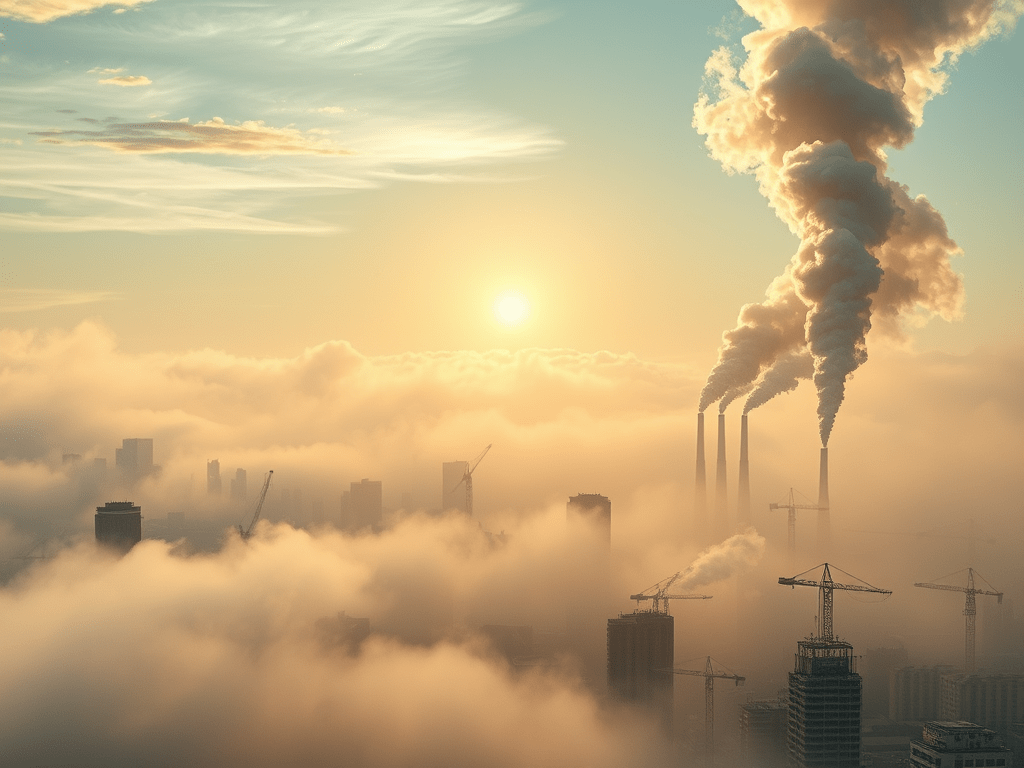
This means separating the “good” of economic growth from the “bad” of environmental harm. Decoupling can be absolute (growth with falling environmental impact) or relative (growth with slower growth in impact). It is often tracked with decoupling indicators, such as comparing pollutant emissions with economic output. In theory, a decoupled economy can grow while reducing its use of natural resources, energy, and clean water, and without adding to environmental damage. In reality, most economies still increase pressure on the environment as they grow.
The doughnut economics model challenges the idea that growth and environmental pressure can be separated so easily, arguing for a broader rethink of what prosperity means. Environmental pressure is often measured by pollutant emissions because they are easier to track. But relying only on these indicators can give a partial picture. For example, emissions may fall while other forms of environmental degradation continue. Decoupling also does not automatically mean ecosystems are resilient or healthy.
Cases of long-term, absolute decoupling are rare. Some industrialised countries have reduced CO₂ emissions while growing GDP, but this is often achieved through outsourcing—such as importing energy or purchasing carbon credits—so the environmental harm still occurs, just elsewhere.
![ESS 8.1.3 [AHL] Biocapacity and Environmental Migration](https://mypytrclass.com/wp-content/uploads/2025/12/image-4.png?w=1024)



![ESS 8.3.4 [AHL] Photochemical Smogs and Tropospheric Ozone](https://mypytrclass.com/wp-content/uploads/2025/12/image-1.png?w=1024)
 PYTR Class