

Learning objectives
- Outline the meaning of environmental ethics
- Distinguish ethics, moral and moral standards
- Outline, using named example, intrinsic value and instrumental (extrinsic) value
IB Knowledge Abstract
Abstract
Ethics, a branch of philosophy, examines moral principles guiding right and wrong behavior. Environmental ethics, a subset of this field, explores ethical relationships between humans and the natural environment. Divergent ethical frameworks arise from differing beliefs about this relationship, leading to varying interpretations of moral responsibility toward nature. Central to these discussions are the notions of instrumental value, which concerns an entity’s usefulness to humans, and intrinsic value, which recognizes worth in something for its own sake—concepts that may coexist rather than oppose each other.
Entities with moral standing are those deemed worthy of moral consideration, influencing how humans ought to act toward them. Traditional ethical theories—virtue ethics, consequentialism, and rights-based ethics—offer distinct lenses for evaluating moral action: focusing respectively on character, outcomes, and rights. Virtue ethics emphasizes moral character; consequentialism assesses morality through outcomes; and rights-based approaches evaluate whether actions respect the rights of others.
Further debates include the appeal to nature fallacy, which challenges the assumption that what is “natural” is inherently good. Contemporary environmental and social justice movements, though historically distinct, increasingly converge in their pursuit of equitable and sustainable societies.
Ethics and Environmental Ethics
Ethical Decision-Making in Environmental Contexts
Human beings constantly make ethical decisions concerning their relationship with the environment. Such decisions raise complex questions: Should environmental research be constrained by ethical considerations, or is the pursuit of knowledge inherently valuable? What obligations do humans bear toward future generations? Is it ever justifiable to cause the extinction of a species for human benefit? To what extent should deforestation and biodiversity loss continue in service of human needs, given that humanity constitutes only one species among many? Moreover, can human rights and the rights of other living beings be said to exist as universally as physical laws such as gravity?
Individual perspectives on right and wrong are shaped by cultural, social, and communal influences. Morality may be understood as the belief in the inherent rightness or wrongness of particular behaviors, while ethics concerns the shared standards of good and bad upheld by a specific society or community. Moral standards thus represent the values societies employ to determine acceptable conduct. While certain principles—such as the belief that killing is wrong—are nearly universal, societies may permit exceptions under specific conditions, such as self-defense or just warfare.
The Emergence of Environmental Ethics
Environmental ethics developed during the 1960s and 1970s in response to growing awareness of environmental degradation and the limits of traditional Western ethical frameworks. Historically, ethical thought in the West concentrated primarily on relationships and obligations among humans, neglecting the moral status of non-human or non-living elements of the natural world. Consequently, an essential question for contemporary humanity is: What is our moral relationship with the natural environment?
Different ethical frameworks and conflicting moral values arise from divergent beliefs regarding this relationship. From a Theory of Knowledge (TOK) perspective, ethics involves not only the evaluation of moral issues but also epistemological inquiry into the knowledge underpinning ethical judgments. For instance, rather than asking whether human-induced species extinction is morally acceptable, one might ask: How can we know when it is appropriate to act upon our knowledge of extinction? Thus, the focus shifts from moral prescription to an examination of the knowledge base informing ethical action.
Modern political, economic, and cultural ideologies are largely anthropocentric, emphasizing human interests as the center of moral consideration. This worldview has contributed to industrialization, overexploitation of resources, and unsustainable population growth, resulting in widespread environmental degradation. In contrast, a technocentric perspective regards nature as a resource for human use, while a stewardship perspective recognizes humans as caretakers of the environment. An ecocentric worldview extends moral consideration to all components of nature, viewing humans as part of an interconnected system in which all entities possess intrinsic value and rights.
Instrumental and Intrinsic Values
Ethical discourse distinguishes between instrumental and intrinsic values. Something has intrinsic value if it is valued for what it is in itself, independent of its utility to humans. For example, a mountain, a lake, or even a single insect may be valued for its own sake, regardless of whether humans perceive it or find it aesthetically pleasing. Instrumental value, on the other hand, pertains to the usefulness of an entity as a means to achieve a desired end. Money, for instance, possesses value only insofar as it facilitates the acquisition of goods or services. Similarly, ecosystems hold instrumental value for humans by providing essential goods (such as food and water) and services (such as carbon storage, waste filtration, and water purification).
Importantly, these two forms of value are not mutually exclusive. A forest may be both intrinsically valuable for its beauty and instrumentally valuable for its ecological functions. Likewise, an animal in a zoo may attract visitors (instrumental value) while also being inherently worthy of respect and preservation (intrinsic value).
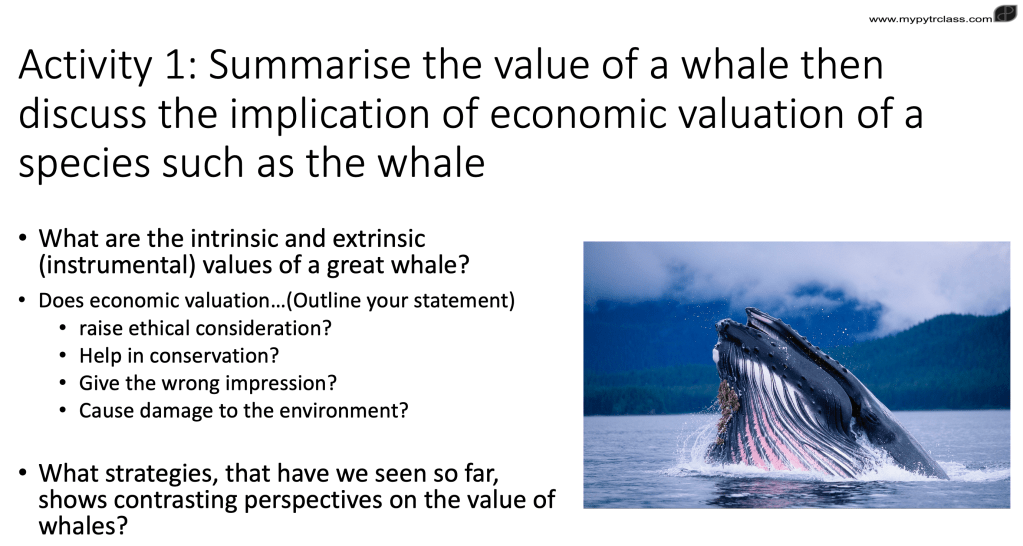
Activity 1: Valuing Whales – A Case Study
Subscribe to get access
Read more of this content when you subscribe today.
Moral Standing and Ethical Consideration
An entity is said to possess moral standing if its treatment has intrinsic moral significance, independent of its effects on others. The question of which beings possess moral standing—whether non-human animals, embryos, or ecosystems—has been deeply shaped by cultural and religious beliefs.
Human interactions with animals vary widely: some animals, such as pets, are cared for lovingly; others are exploited for food, research, or entertainment. The moral status accorded to these animals depends on the motivations behind human behavior. When a farmer tends to animals out of genuine concern for their welfare, the animals are granted moral standing. When care is motivated solely by economic benefit, moral standing is denied.
Anthropocentrism holds that only humans possess moral standing, though this view allows for moral obligations toward other species insofar as their welfare affects humanity. In contrast, animal rights advocates argue that animals deserve moral consideration in their own right, irrespective of human utility. Since the 18th century, philosophers have debated whether the capacity to suffer grants moral significance—a view that underpinned the animal rights movements of the 1970s.
By the late 20th century, this moral consideration extended beyond animals to encompass all living entities and even ecosystems. Thinkers such as Aldo Leopold advanced the ecocentric “land ethic,” asserting that soils, waters, plants, and animals all possess moral standing. Yet this broader moral framework raises enduring questions about how competing interests among humans, animals, and ecosystems should be ethically balanced.
![ESS 8.1.3 [AHL] Biocapacity and Environmental Migration](https://mypytrclass.com/wp-content/uploads/2025/12/image-4.png?w=1024)




![ESS 8.3.4 [AHL] Photochemical Smogs and Tropospheric Ozone](https://mypytrclass.com/wp-content/uploads/2025/12/image-1.png?w=1024)

 PYTR Class