

Learning Objectives
- Describe the strategies in mitigation of climate change
Mitigation Strategies
Mitigation refers to measures aimed at reducing the severity or impact of a problem. In the context of climate change, mitigation involves two primary approaches: (1) reducing or eliminating the sources of greenhouse gas (GHG) emissions and (2) removing GHGs from the atmosphere after they have been emitted.
Given that GHG emissions are the primary drivers of climate change, the main mitigation strategies include:
1. Reducing Greenhouse Gas Emissions
Efforts to reduce GHG emissions focus on multiple sectors and practices, including:
- Carbon dioxide (CO₂) reduction: Achieved by replacing fossil fuels with alternative energy sources, increasing energy efficiency, and expanding the use of renewable energy.
- Nitrogen oxide (NOₓ) reduction: Targeted through improved industrial processes and agricultural management.
- Methane reduction: Particularly in agriculture, through dietary modifications for ruminants, reductions in global livestock numbers, and improved management of methane from landfills.
Additional measures to reduce emissions include:
- Transitioning to low-carbon, resilient urban infrastructure and housing.
- Implementing carbon pricing mechanisms such as carbon taxes.
- Reducing deforestation and promoting sustainable land management.
- Limiting fossil fuel-based transport and promoting alternative modes of transportation.
2. Removing Carbon Dioxide from the Atmosphere
Carbon removal strategies aim to extract CO₂ from the atmosphere and may include:
- Afforestation and reforestation initiatives.
- Rewilding and other sustainable land management practices.
- Technological solutions such as carbon capture and storage (CCS) and bioenergy with carbon capture and storage (BECCS).
- Geoengineering approaches.
Even with significant mitigation efforts, historical emissions continue to influence the climate due to the persistence of GHGs in the atmosphere. It is crucial to distinguish between stabilizing emissions and stabilizing atmospheric concentrations of GHGs. Stabilizing emissions at current levels would not halt the increase in GHG concentrations, as anthropogenic emissions exceed the natural capacity of ecosystems to remove these gases.
To stabilize atmospheric GHG concentrations over the next century, emissions would need to be reduced by approximately 80% relative to peak levels—a target that is currently highly ambitious.
Strategies to Stabilise or Reduce GHGs
Mitigation can also be approached through the following measures:
- Reducing energy consumption:
- Improving energy efficiency in transportation, buildings, and appliances.
- Promoting behavioral changes, such as reducing private vehicle use, cycling, walking, consuming less meat, and adopting circular economy practices.
- Implementing carbon taxes and removing fossil fuel subsidies.
- Establishing national GHG limits and carbon credit systems, including personal tradable carbon credits.
- Shifting development pathways and socio-economic priorities to encourage sustainable practices, e.g., congestion charges and low-emission zones in urban areas.
- Enhancing energy production efficiency.
- Reducing agricultural emissions:
- Modifying livestock diets to reduce methane emissions.
- Capturing methane from landfills.
- Implementing sustainable agricultural practices.
- Transitioning to low-GHG energy sources:
- Replacing fossil fuel-based energy with low-emission alternatives, such as hydroelectric, other renewables, and nuclear power.
Removal of Carbon Dioxide from the Atmosphere
The process of removing carbon dioxide (CO₂) from the atmosphere is commonly referred to as carbon dioxide removal (CDR). Several strategies have been proposed to achieve this:
1. Enhancing Photosynthesis through Land Management
Increasing the rate of photosynthesis can enhance the conversion of atmospheric CO₂ into biomass, creating a carbon sink. This can be achieved through practices such as reforestation, reducing deforestation, and restoring degraded grasslands. An example of such an initiative is the UN-REDD programme (United Nations Reducing Emissions from Deforestation and Forest Degradation), which focuses on sustainable forest management in low-income countries.
2. Carbon Capture and Storage (CCS) and Bioenergy with CCS (BECCS)
CCS involves capturing CO₂ emissions from large industrial sources, including power stations and oil refineries, and subsequently storing it in geological formations. BECCS extends this approach by generating energy from biomass, capturing the resulting CO₂ emissions, and storing them. While these methods have significant potential, they increase the cost of energy production and industrial outputs.
Captured CO₂ can be stored through several approaches:
- Geological storage: CO₂ is compressed and injected into suitable rock formations.
- Mineral carbonation: CO₂ reacts with metal oxides at high temperatures to form stable carbonates, analogous to the natural formation of limestone. This method is energy-intensive and currently limited to pilot-scale applications.
As of 2023, only a few pilot plants have demonstrated CCS technology, and no large-scale CCS power stations have been implemented.
3. Biomass as a Carbon-Neutral Energy Source
Using biomass as a fuel can be effectively carbon-neutral. When crops are replanted annually, the CO₂ released during combustion is recaptured through photosynthesis in the subsequent growth cycle, thereby maintaining a balance in atmospheric carbon.
Geoengineering
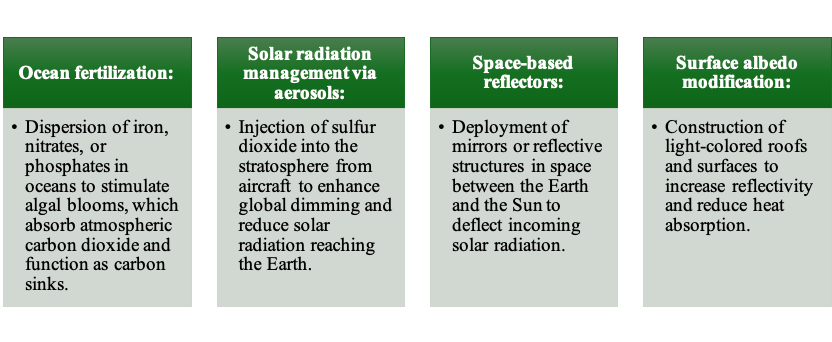
Geoengineering, also referred to as climate engineering, involves large-scale interventions aimed at deliberately altering the Earth’s climate system. Unlike conventional mitigation strategies, geoengineering proposals remain largely theoretical, with most research conducted through computer models rather than practical implementation. These approaches also raise significant ethical, environmental, and governance concerns.
Examples of geoengineering strategies include:
Exercises
1. Research and Discussion
Investigate and discuss strategies that:
(a) have already been adopted, and
(b) could be adopted in the future to help reduce the impacts of climate change by:
- You
- Your school
- Your community
- Your country
2. Management Strategies
Climate change management can focus on three main approaches:
- Altering human activities that cause pollution
- Regulating and reducing emissions at their source
- Cleaning up and restoring damaged environments
Task: Copy and complete the table below.
| Strategy for Reducing Global Emissions | Example of Action |
|---|---|
| Altering the human activity producing pollution | |
| Regulating and reducing pollutants at the point of emission | |
| Clean-up and restoration |
![ESS 8.1.3 [AHL] Biocapacity and Environmental Migration](https://mypytrclass.com/wp-content/uploads/2025/12/image-4.png?w=1024)




![ESS 8.3.4 [AHL] Photochemical Smogs and Tropospheric Ozone](https://mypytrclass.com/wp-content/uploads/2025/12/image-1.png?w=1024)

 PYTR Class