
Learning Objectives
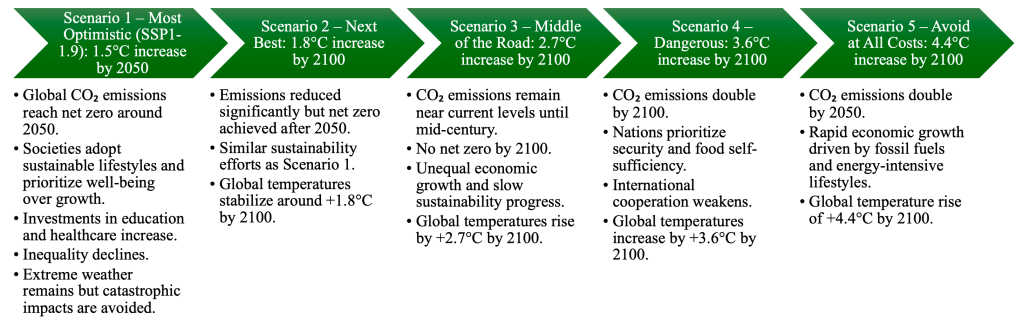
- Outline 5 scenarios of SSP
- Outline the impact of technology and the use of geoengineering in climate change management
- Explain the perspectives surrounding the responses to climate change
Responses to Climate Change
Responses to climate change are coordinated by a diverse range of actors, including the United Nations, regional alliances, national governments, non-governmental organizations (NGOs), activist groups, the media, and other stakeholders. These responses encompass a variety of approaches, such as:
- Economic instruments—for instance, carbon pricing mechanisms, emissions trading schemes, financial incentives and subsidies for renewable energy, and tariffs or taxes targeting fossil fuel consumption.
- Legislative measures—including international agreements, national regulations, and locally specific laws aimed at mitigating or adapting to climate impacts.
- Commitment-based initiatives—such as corporate social responsibility (CSR) policies, B-Corp certification, and voluntary pledges made by companies to the public or their shareholders to reduce environmental footprints.
- Individual behavioral adaptations—including the installation of residential solar panels or wind turbines, reduced use of heating and air conditioning, dietary modifications, and decreased reliance on high-emission travel.
Impact of the UNFCCC
- Primary Objective:
The United Nations Framework Convention on Climate Change (UNFCCC) aims to stabilize greenhouse gas (GHG) concentrations at levels that prevent dangerous interference with the global climate system. - Mechanisms of Operation:
- Works through the Intergovernmental Panel on Climate Change (IPCC) and the Conference of the Parties (COP) summits.
- The IPCC develops emission scenarios to guide climate policy and reduce the risk of catastrophic climate change.
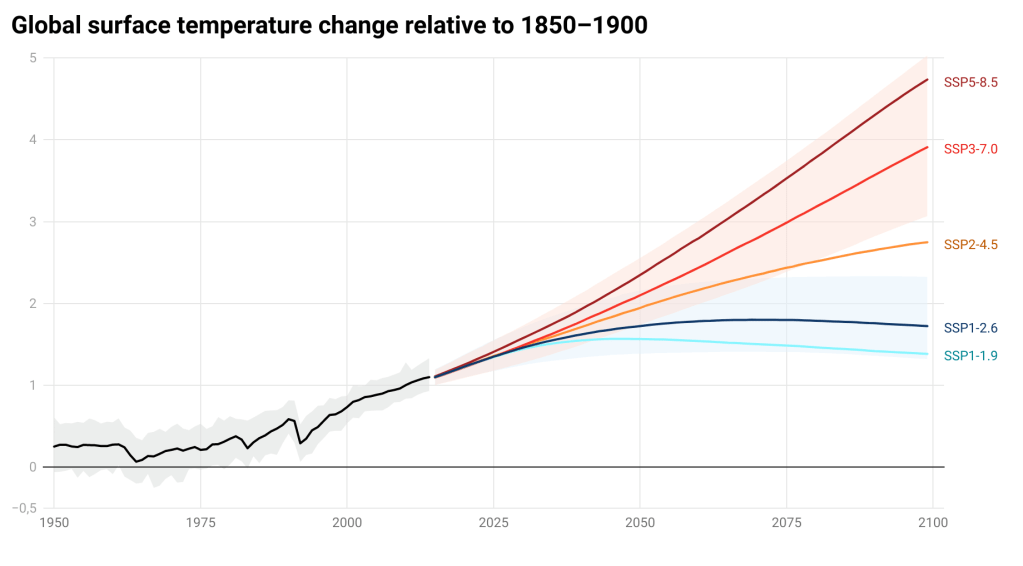
- Emission Scenarios (Shared Socioeconomic Pathways – SSPs):
- Represent plausible future trajectories for GHG emissions based on current evidence.
- Do not predict the future or assign probabilities but illustrate uncertainties related to human activity.
- Aim to inform decision-making by governments and societies.
- The SSPs project possible outcomes up to the year 2100.
- Five SSP Families (IPCC Sixth Assessment Report, 2021):
- SSP1: Sustainability – Focus on green growth and equality.
- SSP2: Middle of the Road – Continuation of current trends.
- SSP3: Regional Rivalry – Nationalistic and fragmented world.
- SSP4: Inequality – Social and economic disparities persist.
- SSP5: Fossil-Fuelled Development – Rapid growth driven by fossil energy.
Geoengineering as a Climate Mitigation Strategy
Impact of Technology
Technological innovation plays a pivotal role in mitigating climate change by enhancing efficiency, reducing emissions, and promoting sustainable practices. Emerging digital technologies, such as smartphone applications and smart city systems, facilitate environmental awareness and behavioural change. These tools provide real-time information on electric vehicle (EV) charging stations, public transport routes, recycling facilities, and peer-to-peer sharing platforms designed to minimize waste generation.
In the industrial sector, ongoing research and development are producing technologies aimed at improving carbon efficiency and advancing methods for the reduction or removal of greenhouse gas emissions. Such innovations are essential for achieving long-term sustainability targets and transitioning toward low-carbon economies.
Geoengineering
Geoengineering represents a deliberate, large-scale intervention in the Earth’s climate system, designed to mitigate the impacts of climate change by addressing its symptoms rather than its root causes. It is an ambitious approach that encompasses various technological and environmental manipulations intended to alter planetary processes.
Despite its potential benefits, geoengineering is associated with significant economic costs, scientific uncertainties, political hesitation, insufficient empirical trials, and the risk of geopolitical tensions.
Geoengineering techniques range from relatively simple interventions, such as afforestation, to more technologically advanced and radical strategies, including:
- Deployment of space-based reflectors to reduce the amount of solar radiation reaching the Earth’s surface.
- Enhancement of cloud albedo to increase atmospheric reflectivity.
- Injection of aerosols into the stratosphere to reflect incoming sunlight.
- Greenhouse Gas Removal (GGR) through biomass carbonization and soil sequestration.
- Bioenergy with Carbon Capture and Storage (BECCS) as a combined mitigation strategy.
- Direct air capture technologies that extract CO₂ from the atmosphere for storage.
- Ocean fertilization to stimulate biological productivity and carbon uptake.
- Addition of alkaline minerals, such as ground limestone, to oceans to raise pH levels and enhance carbon sequestration.
Challenges in Combating Climate Change
The implementation of climate mitigation and adaptation strategies faces multiple social, economic, and political barriers, including:
- Public skepticism, or the widespread disbelief that climate change constitutes a serious global threat.
- Insufficient financial resources and the absence of comprehensive planning or policy frameworks within national governments.
- Weak leadership and coordination among key actors, including governments, non-governmental organizations, political leaders, and multinational corporations.
- Global inequalities, particularly between low-income (LIC) and high-income (HIC) countries, where fossil-fuel-dependent economies often resist transition, exacerbating disparities.
- Divergent social perspectives, particularly between generations and between communities in coastal, low-lying, inland, or upland regions, influencing climate-related priorities and responses.
The Tragedy of the Commons in the Context of Climate Change
The concept of the tragedy of the commons is highly relevant to global climate change. The atmosphere is a shared resource, and when individual nations engage in activities that degrade it—such as the combustion of fossil fuels—the environmental costs are distributed globally. Conversely, when a single nation invests in atmospheric restoration efforts, such as carbon capture and storage (CCS), the associated costs are localized, while the benefits extend to all. This imbalance highlights the inherent collective action dilemma in global climate governance.
Efforts toward international cooperation have gradually advanced. The 27th Conference of the Parties (COP27) to the United Nations Framework Convention on Climate Change (UNFCCC), held in 2022 in Sharm el-Sheikh, Egypt, marked a significant step forward. After extensive negotiations, participating nations agreed to establish a Loss and Damage Fund aimed at supporting countries most vulnerable to the impacts of climate change. This mechanism seeks to provide financial assistance—potentially ranging from USD 160 to 340 billion annually by 2030—to low-income countries (LICs) facing losses from droughts, floods, sea-level rise, and other climate-related disasters. The aid may include measures such as constructing sea defenses or developing drought-resistant crops.
However, the conference’s final declaration reflected ongoing tensions in global climate policy. The terminology adopted—“phase down” rather than “phase out” of fossil fuels—signaled a compromise between competing national interests. Moreover, the emphasis on low-emission energy production, such as natural gas, rather than a full transition to renewable energy sources, underscored the challenges of balancing development and decarbonization.
Despite these limitations, the agreement reaffirmed the urgent need for deep, rapid, and sustained reductions in global greenhouse gas emissions to limit global warming to 1.5°C above pre-industrial levels, in alignment with the most ambitious target of the Paris Agreement.
![ESS 8.1.3 [AHL] Biocapacity and Environmental Migration](https://mypytrclass.com/wp-content/uploads/2025/12/image-4.png?w=1024)



![ESS 8.3.4 [AHL] Photochemical Smogs and Tropospheric Ozone](https://mypytrclass.com/wp-content/uploads/2025/12/image-1.png?w=1024)
 PYTR Class