
Learning Objectives
- Outline the reaction between ozone and CFCs and HCFCs
- Describe the concerns over HFCs
Ozone Reactions with CFCs and HCFCs
Ozone-depleting substances (ODSs) release halogens such as chlorine and fluorine into the stratosphere, where they catalyze the breakdown of ozone molecules. The ozone layer is essential for sustaining life on Earth, as it forms a thin, protective shield over the planet through atmospheric circulation. Without this stratospheric ozone layer, ultraviolet (UV) radiation would reach the surface at harmful intensities, leading to elevated mutation rates and widespread cell death.
Approximately two billion years ago, the evolution of photosynthetic cyanobacteria (blue-green algae) introduced significant quantities of oxygen into the atmosphere, which subsequently facilitated the formation of ozone. By around 600 million years ago, a sufficiently thick ozone layer had developed to protect terrestrial life from UV radiation. This protective layer was a critical factor enabling the Cambrian Explosion, during which the diversity of life on Earth expanded dramatically.
Formation of Ozone Holes at the Poles
Ozone holes are regions of reduced ozone concentration in the stratosphere, primarily caused by anthropogenic chemical reactions. Severe depletion, particularly over the Antarctic region (the “ozone hole”), occurs during the southern hemisphere spring (September–October). This phenomenon results from unique meteorological and chemical conditions. Extremely low winter temperatures in the Antarctic stratosphere facilitate the formation of polar stratospheric clouds (PSCs). Chemical reactions occurring on the surfaces of these clouds, combined with the isolation of polar air within the polar vortex, enable chlorine and bromine radicals to catalyze rapid ozone destruction.
Volcanic eruptions further exacerbate ozone depletion by injecting aerosols into the stratosphere, providing additional reactive surfaces for these chemical processes. A comparable, though less severe, ozone depletion event occurs over the Arctic during the northern hemisphere spring, where relatively warmer temperatures limit the extent of PSC formation and subsequent ozone loss.
The Issue of Hydrofluorocarbons (HFCs)
Hydrofluorocarbons (HFCs) were developed as substitutes for ODSs because they do not directly contribute to ozone depletion. However, they are highly potent greenhouse gases (GHGs) with global warming potentials (GWPs) ranging from 12 to 14,800. HFCs typically persist in the atmosphere for 10–20 years. Their elimination could prevent an estimated 0.5°C rise in global temperature by 2100.
Despite this, HFC emissions are increasing by approximately 8% annually, and projections suggest that by 2050, they could account for 7–19% of total global CO₂-equivalent emissions. China, historically responsible for 70% of global HFC production, prohibited expansion of HFC manufacturing facilities in 2022 as part of its compliance with the Kigali Amendment to the Montreal Protocol, marking a significant step toward global HFC phase-out.
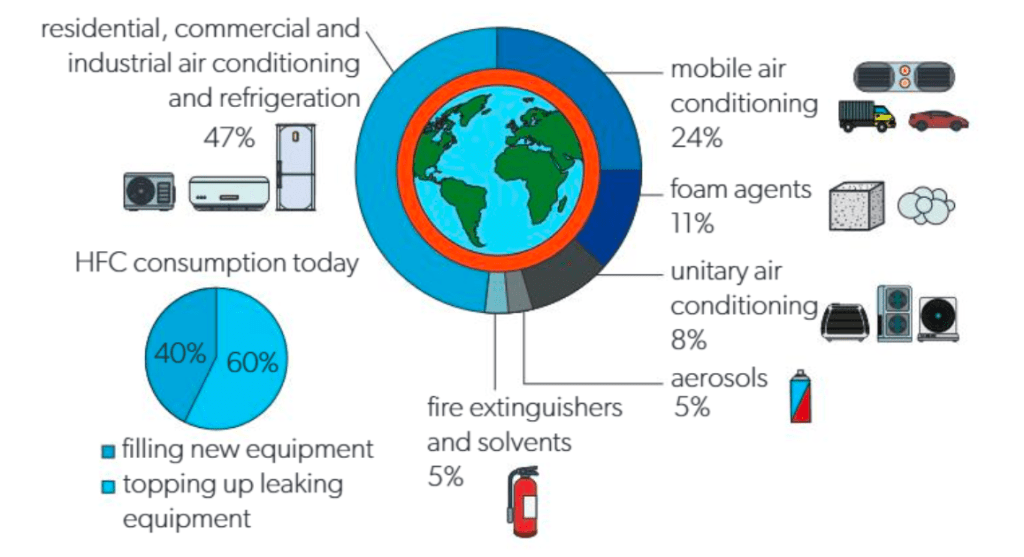
Uses ofHFCs. Adapted from: Climate & Clean Air Coalition. Source: Pearson
Refrigeration, Air Conditioning, and Environmental Impact
Globally, approximately 1.9 billion air conditioning (AC) units are in operation. These systems are energy-intensive and have traditionally used ODSs or HFCs as refrigerants. Additionally, over 200 million refrigerators are sold annually, with around 1.4 billion currently in use worldwide. Together, the refrigeration and cooling industries contribute nearly 10% of total global CO₂ emissions—three times the combined emissions of aviation and shipping.
Proper disposal of outdated refrigeration and air conditioning equipment is crucial. Many older units still contain CFCs, HCFCs, or HFCs. While ODSs can be captured and destroyed through high-temperature incineration (achieving up to 99.99% destruction efficiency), incomplete recovery or illegal disposal allows residual emissions to persist.
Both fridges and AC systems operate on the same thermodynamic principle—evaporation and condensation cycles involving a refrigerant fluid. The refrigerant absorbs heat at low temperatures and releases it at higher temperatures and pressures, cycling between liquid and gaseous states. Leakage of these refrigerants during use or disposal significantly contributes to greenhouse gas emissions and, for older systems, to ozone depletion.
The most common domestic refrigerant, HFC-134a, has a GWP approximately 3,400 times that of CO₂. A typical refrigerator contains 0.05–0.25 kg of refrigerant; if released, this is equivalent to driving 675–3,427 km (420–2,130 miles) in an average passenger vehicle. One of the most damaging HFCs, HFC-23—a by-product of HCFC-22 production—has the highest known GWP among HFCs. Despite global efforts to reduce its release, HFC-23 emissions reached record levels in 2018, indicating inadequate containment during manufacturing and insufficient enforcement of international regulations. Illegal trade in HFCs remains a growing concern, with such substances often incorporated into consumer products.
Alternative Refrigerants
In response to environmental concerns, manufacturers are transitioning toward low- or zero-GWP natural refrigerants. Major global corporations such as Coca-Cola, PepsiCo, and Unilever have committed to phasing out HFCs and adopting alternatives. Common natural refrigerants include ammonia (NH₃), hydrocarbons (such as propane), and carbon dioxide (CO₂). In Europe, most supermarkets now utilize CO₂-based refrigeration systems following EU regulations introduced in 2015 to phase out HFCs. However, natural refrigerants also present challenges: ammonia is toxic, and propane is flammable, requiring careful system design and leak management.
Alternatives to Conventional Cooling Systems
Historically, human societies relied on passive cooling methods such as wind towers in the Middle East, north-facing cold rooms in Europe, and underground ice houses used to preserve food. Modern building design can incorporate similar strategies to reduce reliance on energy-intensive cooling technologies.
Urban greening—through green roofs, walls, and street trees—helps mitigate the urban heat island effect by providing shading and evapotranspirative cooling. Buildings constructed from high thermal mass materials such as stone, brick, or concrete absorb and slowly release heat, moderating temperature fluctuations. Eco-houses partially built underground or with shaded overhangs and compact designs also promote natural cooling. In office environments, strategies such as enhancing ventilation, using blinds, and minimizing heat from lighting systems can reduce cooling demands.
Wind Towers and Passive Cooling Systems
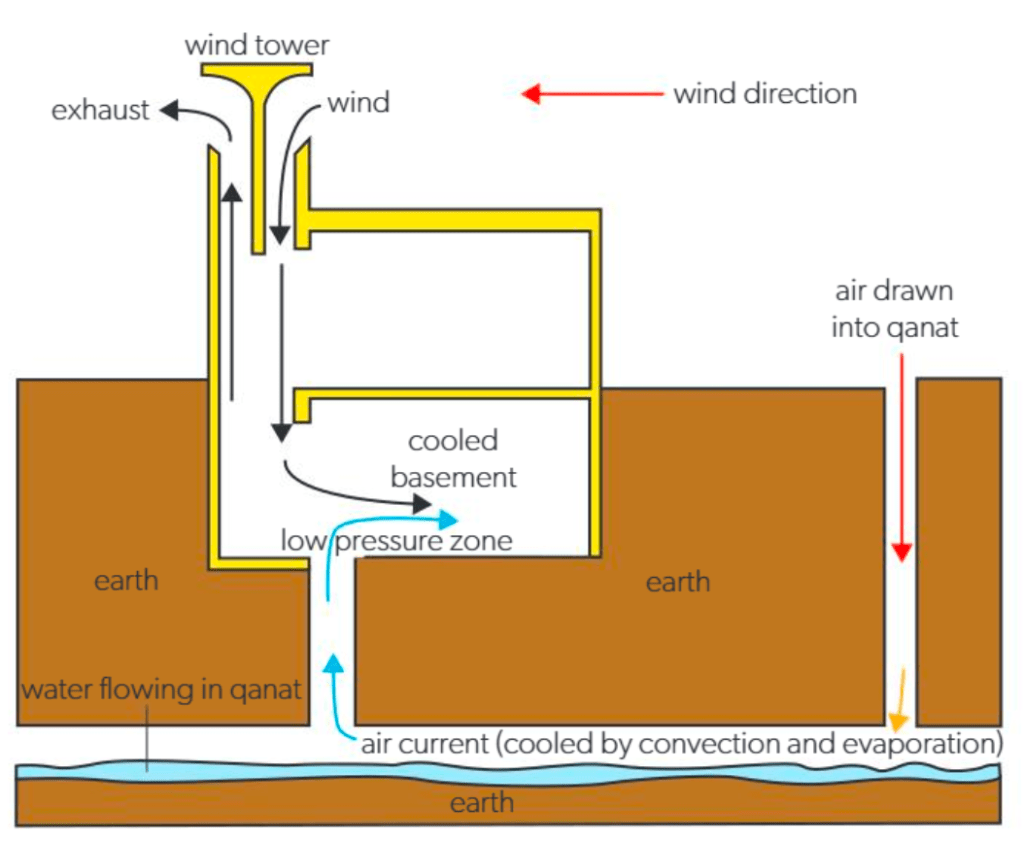
Wind towers or wind catchers, traditional architectural elements from Iran (figure below), are designed to facilitate passive cooling through cross-ventilation. During the night, denser cold air fills the wind tower and becomes trapped beneath warmer air layers. As the day progresses, this stored cool air flows into interior spaces, lowering indoor temperatures.
The cooling effect can be amplified when wind towers are connected to qanats—underground tunnels that convey water from aquifers to inhabited areas . These subterranean systems experience minimal evaporation and are resilient to natural disturbances such as earthquakes and floods. The Bernoulli effect draws cool air from the qanat through the tower, reducing temperatures in basement rooms by up to 15°C. This sustainable cooling technology has been in use for over a millennium.
Notes and Exercises
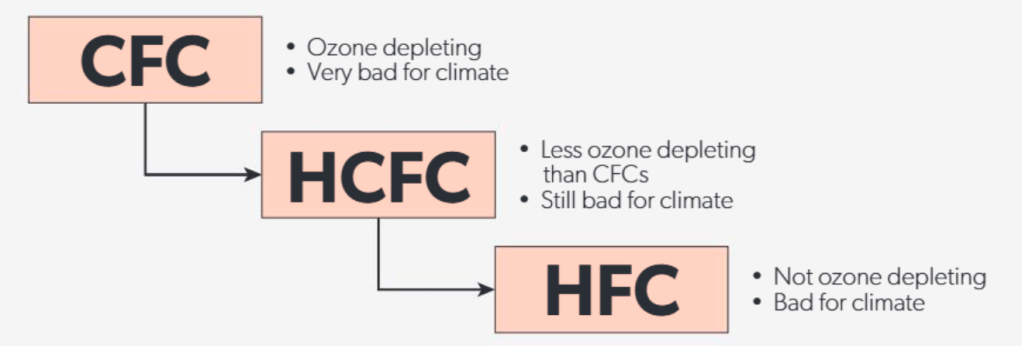
The hole inthe ozone layerover Antarctica, discovered in the 1980s, was caused by chlorofluorocarbons (CFCs). The Montreal Protocol requires the use of hydrochlorofluorocarbons (HCFCs) or hydrofluorocarbons (HFCs) instead ofCFCs. However, these two gases are also linked to environmental problems
Q1. Identify two possible consequences for life on Earth that may result from the depletion of stratospheric ozone. [2]
Q2. Explain why the Montreal Protocol is often regarded as the most successful international environmental treaty. [2]
Q3.Explain why governments agreed to phase out the use of hydrofluorocarbons (HFCs) from 2019 under the Kigali Amendment to the Montreal Protocol. [2]
Q4. Identify one advantage of having staggered phase-out dates for HFCs among countries at different levels of economic development. [1]
Q5. Identify one disadvantage of having staggered phase-out dates for HFCs among countries at different levels of economic development. [1]
Q6. In 2016, the Earth’s atmospheric carbon dioxide concentration reached 400 ppm. Discuss the potential effects of elevated greenhouse gas levels on human societies across different regions. [7]
![ESS 8.1.3 [AHL] Biocapacity and Environmental Migration](https://mypytrclass.com/wp-content/uploads/2025/12/image-4.png?w=1024)



![ESS 8.3.4 [AHL] Photochemical Smogs and Tropospheric Ozone](https://mypytrclass.com/wp-content/uploads/2025/12/image-1.png?w=1024)
 PYTR Class