
Learning Objectives
- Summarise management strategies at various levels
- Describe the roles EIAs
- Outline SDG food production losses
- Outline the relationship between globalisation and resources (materials, food, water and energy)
Summary of Management of Natural Resources
Natural capital encompasses all the resources and services that nature provides without direct human intervention. It forms the foundation of all other forms of capital by sustaining the basic conditions necessary for human societies to exist and by defining the boundaries within which socio-economic systems can operate. However, natural capital is finite and vulnerable to degradation. To ensure that it continues to support human life, management and intervention strategies are essential to guide the way society utilises these resources.
Management and intervention strategies may be implemented at various scales—individual, local, regional, national, or international. At the governmental level, measures may include:
- Implementation of national action plans for the Sustainable Development Goals (SDGs)
- Introduction of pollution taxes, fines, or environmental legislation
- Compensation mechanisms for environmental damage
- Subsidies for renewable energy and higher taxation of fossil fuels
- Investment in research aimed at enhancing sustainability
- Public campaigns to promote resource conservation, such as reducing energy consumption and food waste
- Educational programs addressing sustainability.
At the local level, individuals, non-governmental organizations (NGOs), and businesses can contribute by:
- Reducing waste, recycling, conserving water, and improving energy efficiency
- Transitioning towards circular or doughnut economic models that eliminate waste and rely on renewable materials—for example, manufacturing concrete that can sequester carbon dioxide
- Launching community-based campaigns and using social media to promote sustainable practices.
Local Movements
A wide variety of management and intervention strategies can be implemented at the local scale, targeting almost any natural resource. Such initiatives often succeed because individuals and communities take ownership of them, and the educational component enhances understanding of their benefits.
Examples of sustainability initiatives in schools include:
- Establishing second-hand uniform shops.
- Prohibiting single-use drink bottles and promoting reusable ones
- Installing refillable water fountains
- Replacing printed materials with digital alternatives
- Double-sided printing and photocopying
- Providing separate bins for general waste and recyclable paper
- Reusing single-sided paper
EIAs
An Environmental Impact Assessment (EIA) is a process used to identify and evaluate the potential environmental, social, and economic impacts of a proposed development project that would alter land use, such as afforestation or the conversion of farmland to recreational use. EIAs assist decision-makers in determining whether projects should proceed by weighing their potential advantages and disadvantages. The resulting report must provide adequate information about anticipated impacts and is made available to the public to promote participatory decision-making.
EIAs assess current environmental conditions and predict possible changes resulting from development, considering both positive and negative outcomes. Although primarily focused on the natural environment, EIAs must also evaluate potential effects on human populations, particularly in relation to health and economic well-being.
While the specific structure of EIAs varies between countries, they generally include three key components:
- Identifying Impacts (Scoping)
- Assess potential environmental, economic, and social effects.
- Engage stakeholders in the evaluation process.
- Conduct baseline studies of abiotic and biotic components to predict possible changes.
- Predicting the Scale of Potential Impacts
- Quantify potential alterations in microclimate, biodiversity, and aesthetic or recreational value.
- Limiting Impacts (Mitigation)
- Consider alternative project designs.
- Evaluate the effectiveness of proposed mitigation measures.
- Establish monitoring and management frameworks to reduce adverse effects.
EIAs are typically required for large-scale developments such as road networks, airports, ports, power stations, dams, reservoirs, mining operations, and housing projects.
Historical Context and Limitations of EIAs
The concept of EIAs originated in the United States with the passage of the National Environmental Policy Act (NEPA) in 1969, which mandated federal agencies to integrate environmental considerations into land-use planning. The NEPA framework elevated environmental priorities to a level comparable with economic concerns. Within two decades, many other countries had incorporated EIAs into their planning regulations.
Despite their global adoption, EIAs have limitations:
- Variability in standards across countries complicates comparison and consistency.
- Decision-makers are not always required to prioritize environmental protection.
- Defining appropriate spatial and temporal boundaries for assessments is challenging.
- Indirect or cumulative impacts are often difficult to predict and may be overlooked.
SDG and Resource Management
The SDGs acknowledge the interdependence of economic, social, and environmental dimensions of development. Only renewable resources can be managed sustainably; non-renewable resources such as fossil fuels are inherently finite. Even renewable resources may be exploited unsustainably due to unsustainable extraction, transportation, or processing methods.
Sustainability Challenges in Food Production
Although food production can be sustainable, inefficiencies exist across all stages of the food supply chain. Nearly one-third of all food produced globally is wasted, representing significant resource and energy losses.
Read the following case study and outline 4 areas where food production is not efficient
Sustainability in Food Production: A Case Study of Food Waste in the United States
Food production and consumption patterns in the United States illustrate significant sustainability challenges, particularly in relation to food waste. Despite being one of the largest agricultural producers in the world, the United States wastes nearly one-third of all food produced annually (FAO, 2021). Feeding America (2023) estimates that approximately 54 billion kilograms of food, valued at USD 408 billion, are discarded each year. These losses occur at all stages of the food supply chain—harvesting, transportation, processing, and consumption—reflecting systemic inefficiencies that undermine environmental and economic sustainability.
Losses during the harvesting stage often arise from a combination of biological, technological, and market-related factors. Crops may be damaged by pests, plant diseases, or extreme weather conditions linked to climate variability (Gustavsson et al., 2011). Poor or outdated harvesting technology can lead to mechanical damage or incomplete collection, while inadequate on-farm storage accelerates spoilage, particularly for perishable produce (Parfitt, Barthel, & Macnaughton, 2010). Market oversupply also discourages harvesting when prices fall below production costs, and aesthetic grading standards imposed by retailers result in the rejection of “imperfect” but edible fruits and vegetables (Aschemann-Witzel et al., 2015). In California’s Central Valley, for example, vast quantities of fresh produce are left unharvested because they do not meet retail appearance criteria (ReFED, 2022). Overproduction, a common practice to meet contract quotas and ensure reliability in supply chains, further contributes to agricultural waste (FAO, 2021).
Transport and storage inefficiencies constitute another major source of food loss. The absence of reliable refrigeration systems during transport, combined with open or poorly maintained vehicles, exposes produce to environmental stressors such as heat, humidity, and pests (Lipinski et al., 2013). Rough handling, overloading of trucks, and substandard packaging design can cause mechanical damage. Furthermore, poorly managed storage facilities at farms, wholesalers, or retailers often enable the spread of fungal and bacterial contamination (Buzby, Farah-Wells, & Hyman, 2014). According to the U.S. Department of Agriculture (USDA, 2018), approximately 12% of fresh fruits and vegetables in the U.S. are lost during transportation and storage, primarily due to inadequate temperature regulation and improper packaging.
Significant losses also occur during food processing. Mechanical handling during washing, sorting, and grading can damage produce and result in unnecessary discarding of food items that fail to meet market standards (Gustavsson et al., 2011). Excessive peeling and trimming practices remove edible portions, while juicing, canning, and other industrial processes generate large volumes of by-products that are often discarded rather than repurposed (Parfitt et al., 2010). For instance, the orange juice industry in Florida discards substantial quantities of peel, pith, and pulp that could otherwise be converted into livestock feed or compost, representing a lost opportunity for circular resource management (ReFED, 2022).
The consumer stage accounts for the largest proportion of total food waste in the United States. Household waste represents approximately 39% of national food waste, while commercial sectors such as restaurants and catering contribute about 61% (Feeding America, 2023). Key factors include retailer aesthetic standards, oversized portion servings, marketing promotions that encourage over-purchasing (e.g., “buy one, get one free”), and consumer misunderstanding of food labels such as “best before” and “use by” dates (Neff, Spiker, & Truant, 2015). Inadequate food storage practices also lead to spoilage before consumption.
Conclusion
Food waste represents a critical sustainability issue with both environmental and economic dimensions. Environmentally, decomposing food in landfills emits methane, a potent greenhouse gas that contributes to global warming (EPA, 2022). Economically, wasted food implies a parallel waste of natural capital—land, water, energy, and labor—that was invested in its production (FAO, 2021). Addressing these inefficiencies requires a multi-level strategy involving technological innovation, policy reform, and consumer education. Improvements in post-harvest storage and transport infrastructure, coupled with incentives for food redistribution programs, can significantly reduce losses. Educational initiatives to raise public awareness about portion control, proper storage, and food labelling can also contribute to behavioral change (Aschemann-Witzel et al., 2015). A shift towards circular economy models—where waste is minimized and by-products are reused—represents a sustainable pathway for the U.S. food production system.
References
Aschemann-Witzel, J., De Hooge, I., Amani, P., Bech-Larsen, T., & Oostindjer, M. (2015). Consumer-related food waste: Causes and potential for action. Sustainability, 7(6), 6457–6477.
Buzby, J. C., Farah-Wells, H., & Hyman, J. (2014). The estimated amount, value, and calories of postharvest food losses at the retail and consumer levels in the United States. USDA Economic Information Bulletin No. 121.
Environmental Protection Agency (EPA). (2022). Food waste in the United States: Facts and figures. Washington, D.C.
Food and Agriculture Organization (FAO). (2021). Global food losses and food waste: Extent, causes and prevention. Rome: United Nations.
Feeding America. (2023). Food waste in America: Facts and solutions. Chicago, IL.
Gustavsson, J., Cederberg, C., Sonesson, U., van Otterdijk, R., & Meybeck, A. (2011). Global food losses and food waste: Extent, causes and prevention. Rome: FAO.
Lipinski, B., Hanson, C., Waite, R., Searchinger, T., Lomax, J., & Kitinoja, L. (2013). Reducing food loss and waste. World Resources Institute.
Neff, R. A., Spiker, M. L., & Truant, P. L. (2015). Wasted food: U.S. consumers’ reported awareness, attitudes, and behaviors. PLOS ONE, 10(6), e0127881.
Parfitt, J., Barthel, M., & Macnaughton, S. (2010). Food waste within food supply chains: Quantification and potential for change to 2050. Philosophical Transactions of the Royal Society B, 365(1554), 3065–3081.
ReFED. (2022). Roadmap to 2030: Reducing U.S. food waste by 50%. New York, NY.
U.S. Department of Agriculture (USDA). (2018). Postharvest food losses in the United States: An overview. Washington, D.C.
Environmental Costs of Lithium Extraction
While lithium batteries play a critical role in reducing carbon emissions, their extraction carries significant environmental costs. Approximately 500,000 liters of water are required to produce one tonne of lithium, and the process often disrupts local hydrological systems. Contaminated wastewater can lead to ecosystem degradation and human health issues. Extraction in arid regions such as the Atacama Desert exacerbates freshwater scarcity, while battery production generates high carbon emissions and substantial waste.
Globalisation
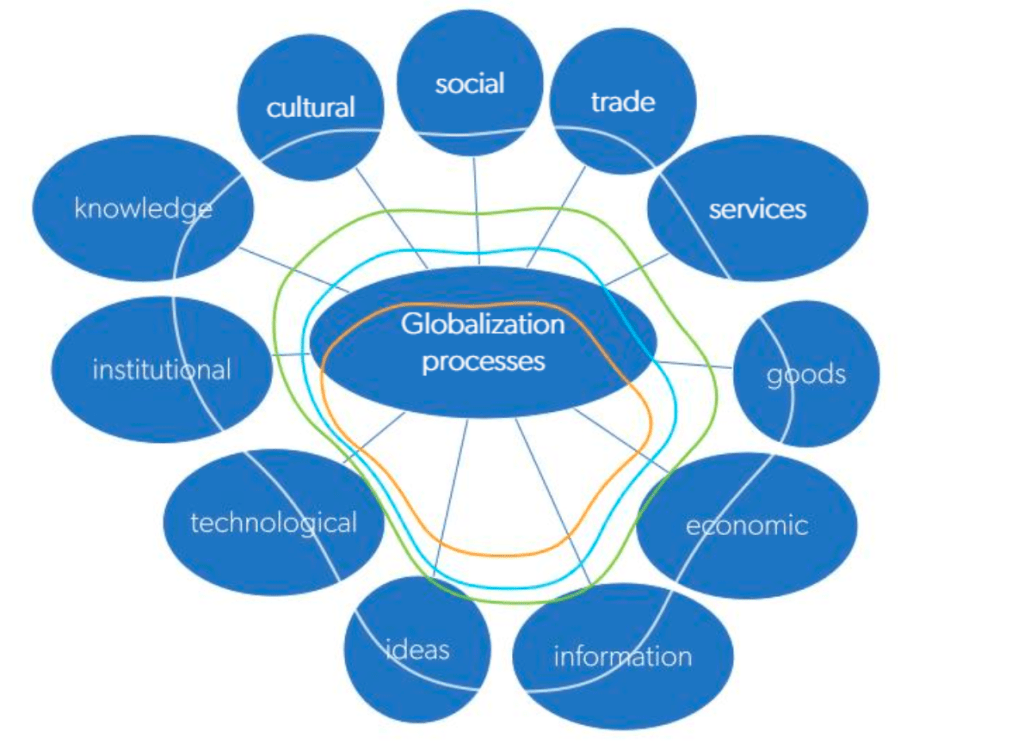
Globalisation and Resource Security
Globalisation describes the increasing interconnectedness of economies, cultures, and societies. Although it facilitates technological exchange and economic growth, it also contributes to environmental degradation and social inequality.
Globalisation and Food Systems
Globalisation has reshaped food production and consumption patterns, promoting the global availability of diverse foods while threatening local food cultures and small-scale producers. Multinational supermarket and fast-food chains have displaced traditional markets but have also introduced improved food safety standards and greater convenience.
Globalisation and Food Security
According to the 1996 World Food Summit, food security exists when all individuals have consistent physical and economic access to sufficient, safe, and nutritious food. In many low-income countries (LICs), globalisation has shifted agricultural priorities from subsistence to export-oriented production, undermining local food security. Export dependency and competition from subsidised imports often force communities to purchase, rather than produce, staple foods at higher prices.
Globalisation and Water Security
Globalisation interacts with climate change to exacerbate water insecurity. The commodification of water has transformed it from a public good into a market-driven resource. Cross-basin water transfers, industrialization, and urbanisation have intensified competition for water, disproportionately affecting low-income populations.
Globalization and Energy Security
Technological advances have globalised energy production and trade, enabling international flows of oil, gas, and electricity. Interconnected energy grids enhance efficiency and reduce carbon emissions through shared resources. Furthermore, globalisation has accelerated investment in renewable energy, particularly in low-income regions with high solar or wind potential.
Overall, while globalisation facilitates technological progress and economic interdependence, it also presents complex challenges for sustainability, equity, and resource governance.
![ESS 8.1.3 [AHL] Biocapacity and Environmental Migration](https://mypytrclass.com/wp-content/uploads/2025/12/image-4.png?w=1024)




![ESS 8.3.4 [AHL] Photochemical Smogs and Tropospheric Ozone](https://mypytrclass.com/wp-content/uploads/2025/12/image-1.png?w=1024)
 PYTR Class