
Learning Objectives
- Discuss waste trading
- Discuss the use of circular economy in solid waste management
Waste Trade
International Trade in Waste
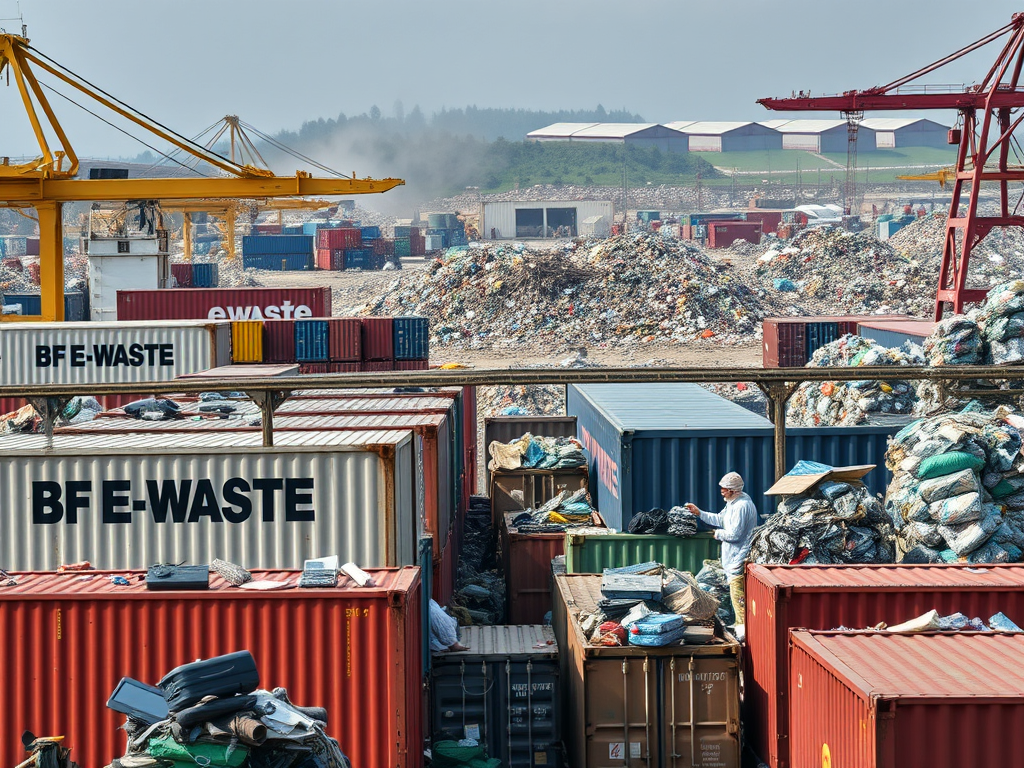
Despite appearing counterintuitive, large volumes of waste—most commonly plastics, recyclable materials, electronic waste (e-waste), and hazardous waste—are traded internationally. For example, shipments of recyclable materials within the European Union have increased by more than 70% since 2000. The export of plastic waste is considered a significant driver of unsustainable patterns of plastic production and consumption.
Most waste flows originate from high-income countries (HICs) and are directed toward low-income countries (LICs). This occurs because exporting waste is often less costly than developing domestic recycling infrastructure. At the same time, exporters reduce energy and labour costs and limit the amount of waste directed to their national landfills. Recipient countries may also benefit through the creation of new businesses and employment opportunities. However, waste flows are poorly monitored, increasing the likelihood of illegal dumping or open burning instead of proper recycling.
E-waste
E-waste consists of discarded electrical and electronic devices that contain a battery or plug. Items may be discarded because they are slow, malfunctioning, or simply obsolete. Small electronic appliances—including phones, microwaves, vacuum cleaners, and kettles—form the largest proportion of e-waste. Approximately 50 million metric tonnes of e-waste are generated annually, equivalent to around 7 kg per person. Much of this waste is shipped to LICs in Asia and Africa, where it is dismantled and recycled.
Hazardous Waste
HICs also gain financially from exporting hazardous waste, while LICs often accept it for treatment, disposal, or recycling. This practice has raised considerable international concern due to the severe environmental and health risks associated with the dumping and improper processing of hazardous materials. Communities in recipient countries are disproportionately affected, while populations in exporting nations often remain unaware of the consequences. As an example, the EU exported nearly 8.2 million tonnes of hazardous waste in 2020.
Impacts of Waste Trading
The international movement of waste has significant environmental, social, economic, and human health implications, with the most severe effects occurring in recipient countries. Illegal dump sites are now widespread, magnifying these impacts.
Effects on Human Health
In many LICs, waste is processed without adequate safety measures, exposing workers and nearby residents to hazardous substances. Common consequences include:
- Chemical burns from direct contact with toxic waste.
- Absorption, inhalation, or ingestion of pollutants through contaminated air, soil, water, or food.
- Increased mortality and widespread health problems such as cancer, diabetes, hormonal disruption, skin lesions, emphysema, and reproductive disorders.
Effects on the Environment
Improper disposal of imported waste often results in:
- Contamination of water and soil by heavy metals, toxic chemicals, and other pollutants.
- Ecological poisoning leading to wildlife mortality.
- Accumulation of persistent organic pollutants (POPs), which bioaccumulate and biomagnify, posing severe risks to birds, fish, and other organisms.
Biodegradability and Half-life
The persistence of waste in the environment depends on its biodegradability and half-life.
- Half-life, relevant to non-biodegradable materials, refers to the time required for a material to degrade to half of its original quantity. Many pollutants take decades or centuries to become harmless.
- Biodegradable materials are broken down by microorganisms into basic elements such as water, carbon dioxide, and methane. Because they degrade quickly, they do not accumulate in ecosystems.
- Non-biodegradable materials cannot be decomposed biologically; many inorganic materials fall into this category. These accumulate in the environment, posing long-term hazards.
Circular Economy
The Sustainable Circular Economy
Most contemporary production systems follow a linear model—“take, make, dump”—in which raw materials (natural capital) are extracted, converted into goods, and discarded once they are no longer useful. This model is fundamentally unsustainable because natural resources are finite and waste cannot truly be disposed of “away.”
The circular economy offers a sustainable alternative. Its objectives include:
- restoring and regenerating environmental systems
- relying on renewable energy sources
- eliminating or reducing toxic waste
- preventing waste generation through careful product design
A key principle of the circular economy is that manufacturers retain ownership of products throughout their life cycle. Companies act as service providers, delivering access to a product rather than selling it outright. When consumers are finished with an item, it is returned to the manufacturer for repair, refurbishment, disassembly, or recycling. This system reduces the consumption of new resources and minimises waste.
Implementing a circular economy requires substantial systemic change, which may involve policy interventions such as taxation, incentives, legislation, education, and improved waste-collection infrastructure.
For instance, transitioning a plastic product into a circular model may require:
- taxes on manufacturers that rely on fossil-fuel-based energy rather than renewable sources
- financial incentives encouraging consumers to return old or damaged plastic items for reuse or recycling (e.g., container deposit schemes that refund money for returned bottles)
- social policies promoting the return of plastic products to manufacturers
- legislation restricting or prohibiting landfill disposal
- educational campaigns highlighting the importance of sustainability and circular economic systems
- improved access to disposal and collection facilities to ensure plastic waste is correctly channelled into recycling or recovery systems
![ESS 8.1.3 [AHL] Biocapacity and Environmental Migration](https://mypytrclass.com/wp-content/uploads/2025/12/image-4.png?w=1024)


![ESS 8.3.4 [AHL] Photochemical Smogs and Tropospheric Ozone](https://mypytrclass.com/wp-content/uploads/2025/12/image-1.png?w=1024)
 PYTR Class