Deduce equations for the reactions with water of the oxides of group 1 and group 2 metals, carbon and sulfur.
Part 1: The Bonding of Period 3 Oxides
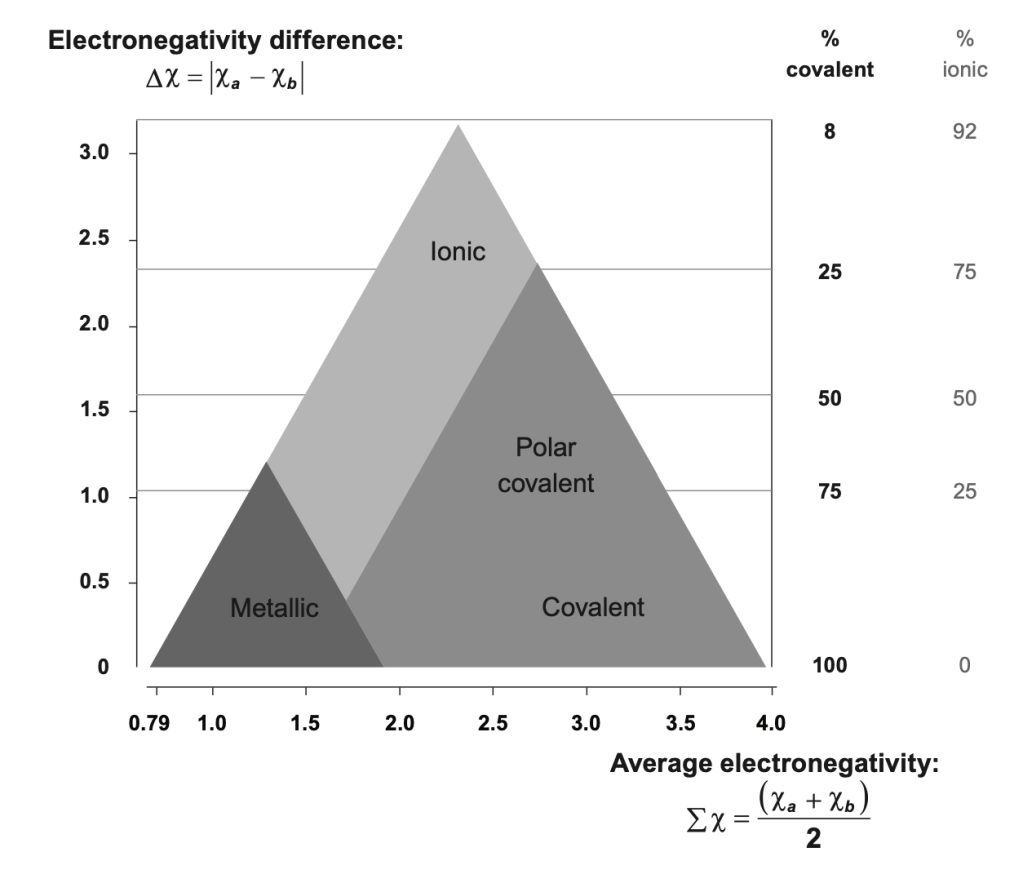
The transition from metallic to non-metallic character in period 3 oxides is reflected in their bonding. Metal oxides (Na to Al) form giant ionic structures, while non-metal oxides (phosphorus, sulfur, chlorine) are molecular covalent. Silicon, being a metalloid, forms a giant covalent oxide. The ionic character of a compound depends on the electronegativity difference between its elements. As oxygen has an electronegativity of 3.4, the ionic character of period 3 oxides decreases from left to right, as the electronegativity of the elements approaches this value.
Bond Triangle
Summary of Period 3 Oxides
Element
Na
Mg
Al
Si
P
S
Cl
Formula
Na₂O
MgO
Al₂O₃
SiO₂
P₄O₁₀ and P₄O₆
SO₃ and SO₂
Cl₂O₇ and Cl₂O
State at SATP
s
s
s
s
s
l and g
l and g
Oxidation state
+1
+2
+3
+4
+5 / +3
+6 / +4
+7 / +1
Electrical Conductivity in Molten State
High
High
High
Very low
None
None
None
Structure
Giant ionic
Giant ionic
Giant ionic
Giant covalent
Molecular covalent
Molecular covalent
Molecular covalent
Solubility in Water
Soluble, forms NaOH
Slightly soluble, forms Mg(OH)₂
Insoluble
Insoluble
Reacts, forms acids (H₃PO₄, H₃PO₃)
Reacts, forms acids (H₂SO₄, H₂SO₃)
Reacts, forms acids (HClO₄, HClO)
Acid-Base Character
Strongly basic
Basic
Amphoteric
Weakly acidic
Acidic
Acidic
Strongly acidic
Part 2: Acid-Base Characters of Oxides
Basic Oxides
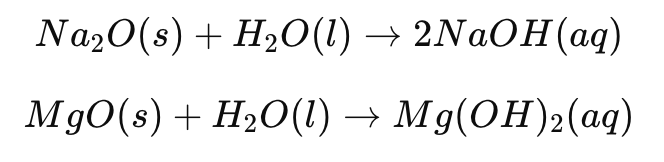
Sodium oxide and magnesium oxide dissolve in water to form alkaline solutions due to the presence of hydroxide ions:
Sodium oxide and magnesium oxides are basic oxides
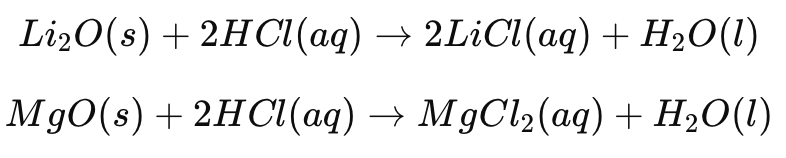
A basic oxide reacts with an acid to form a salt and water. The oxide ion, O2-, combines with hydrogen ions to form water:
Some examples of reactions with acids:
Neutralisation of acidic oxides
Acidic Oxides
Non-metallic oxides are acidic and react with water to form acidic solutions.
Carbon dioxide dissolves in water to form the weak acid, carbonic acid (H2CO3):
Formation of carbonic acid.
Sulfur trioxide reacts with water to produce sulfuric(VI) acid:
Sulfur dioxide reacts with water to produce sulfuric(IV) acid (sulfurous acid):
Sulfur is one of the major impurities in fossil fuels such as crude oil and coal. Therefore, burning these fossil fuels have concerns over the formation of acid rain
Amphoteric Oxides
Aluminium oxide (Al2O3) is insoluble in water and does not affect pH. However, it has amphoteric properties, meaning it can act as both an acid and a base.
As a base, it reacts with sulfuric acid:
As an acid, it reacts with sodium hydroxide:
Exercises
Subscribe to get access
Here are the questions with the numbering reset:
Q1. An oxide of a period 3 element is a solid at room temperature and forms a basic solution. Which element is it? A) Mg B) Al C) P D) S
Q2. Which oxide forms an acidic solution when dissolved in water? A) Na₂O(s) B) MgO(s) C) SiO₂(s) D) SO₃(g)
Q3. Which of the following oxides produce an acidic solution when added to water?
SiO₂
N₂O₅
SO₂ A) I and II only B) I and III only C) II and III only D) I, II, and III
Q4. The melting and boiling points of four oxides are listed below:
MgO
SiO₂ (quartz)
P₄O₁₀
SO₂
Oxide
Melting Point (K)
Boiling Point (K)
MgO
3125
3873
SiO₂
1883
2503
P₄O₁₀
297
448
SO₂
20
263
(a) Identify the state of each oxide under standard conditions. (b) Explain the difference in melting points, referring to the bonding and structure in each case. (c) If the oxides are added to separate samples of pure water, state whether the resulting solution is acidic, neutral, or alkaline. Include the chemical equations for the reactions. (d) Describe the reactions of aluminum oxide with: (i) hydrochloric acid (ii) sodium hydroxide
Q5. Describe the acid-base character of the oxides of period 3 elements, from Na to Ar. For sodium oxide and sulfur trioxide, write balanced equations to illustrate their acid-base character.







![ESS 8.1.3 [AHL] Biocapacity and Environmental Migration](https://mypytrclass.com/wp-content/uploads/2025/12/image-4.png?w=1024)


![ESS 8.3.4 [AHL] Photochemical Smogs and Tropospheric Ozone](https://mypytrclass.com/wp-content/uploads/2025/12/image-1.png?w=1024)
 PYTR Class