
Learning Objectives
- Explain how biological diversity is negatively impacted by both direct (e.g., habitat destruction) and indirect (e.g., climate change) human influences.
- Describe how most ecosystems experience multiple human-induced pressures simultaneously and assess the cumulative impacts on biodiversity.
- Analyse how invasive alien species can decrease local biodiversity through competition for resources, predation, and the spread of diseases or parasites.
- Understand how the IUCN Red List assesses the global conservation status of species based on criteria such as population size, population trends, reproductive potential, geographical range, and known threats.
- Evaluate how assigning a global conservation status supports conservation efforts by informing governments, NGOs, and individuals in selecting and implementing appropriate strategies.
- Investigate and present three case studies:
- One species driven to extinction by human activities,
- One species currently classified as critically endangered,
- One species whose conservation status has improved due to effective intervention.
- Explain the concept of the tragedy of the commons and analyse its implications for the sustainable use of shared resources and biodiversity conservation.
Part 1: Direct and Indirect Threats

- Human activities are in general affected the ecosystem in multiple ways.
- When combined, the impact is amplified and larger scale of threat be significant.
- For example, many human activities consequently cause global warming and climate change. The impact of climate change is global and has reduced resilient of many ecosystems
Direct Threats
- Animals are hunted for
- food
- medicines
- souvenirs
- fashion
- to supply the exotic pet trade.
- Hunting up to a certain level is unlikely to be a threat
- Overharvesting of populations can significantly deplete numbers.
- Overharvesting of North Atlantic cod in the 1960s and 1970s, for example, led to a significant reduction in population size.
- Poaching is illegal capturing or hunting of wildlife
- Example: Elephant tusk ivory
- Illegal pet trade usually involves baby primates and exotic birds
Indirect Threats
Includes habitat loss, climate change, pollutions and introduction of invasive species.
- Pollutions: Substances that can cause harmful effect when released to the environment. Pollution can directly degrade habitats and/or affect some susceptible species. For example, sulfur dioxide and nitrous oxide are gasses that can cause acid rain. The rain reduce the pH of soil futher. As the result some species won’t be able to survive in the new condition
- Introduction of invasive species is an action of releasing a species into a new environment. Due to the lack of competition, the species thrives and becomes a dominant species in terms of population size. The in turn affect the entire habitat.
- Habitat destruction can be caused by natural disaster and human activities. A destruction of habitat is often observed as degradation , fragmentation, and loss. Deforestation is often the major caused of the destruction where land is used for agriculture. In addition, mining and timber consumption is also a driving force of deforestation.
- Tropical biomes are world’s most diverse biomes such as tropical rainforest and coral reefs. Many topical biomes are biodiversity hotspots as they contain a large number of endemic species.
Part 2: IUCN Red List
Objectives of IUCN Red List
- identify species requiring some level of conservation
- raise awareness of animals and plants that face a higher risk of global extinction than others and therefore require conservation efforts
- identify species for which there is concern about their conservation status
- catalogue plants and animals facing a high risk of global extinction
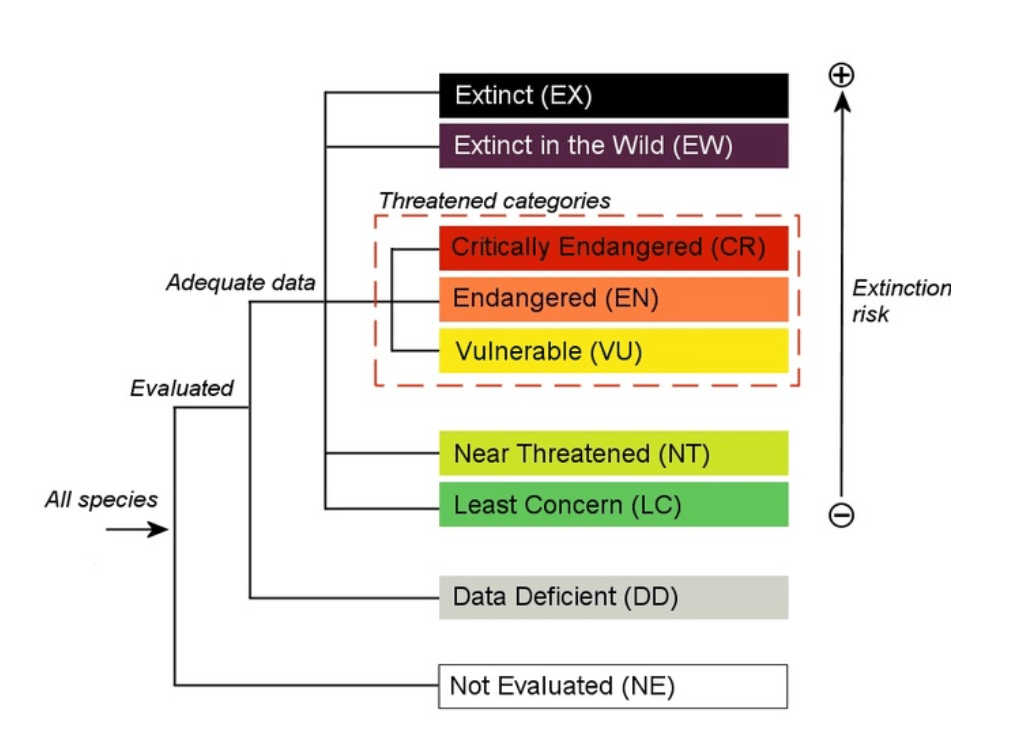
The Publicity of Species Status
- Some species has restricted distribution. This makes them rare and requires highly specialised habitat
- On top of that some rare species has very specialised niches and low reproductive potential. These can also include the top predators and rare endemic plants
- Publicises the vulnerability of species and allows governments, non-governmental agencies and individual citizens to select appropriate conservation priorities and management strategies
- These are wild animals that are making their comeback
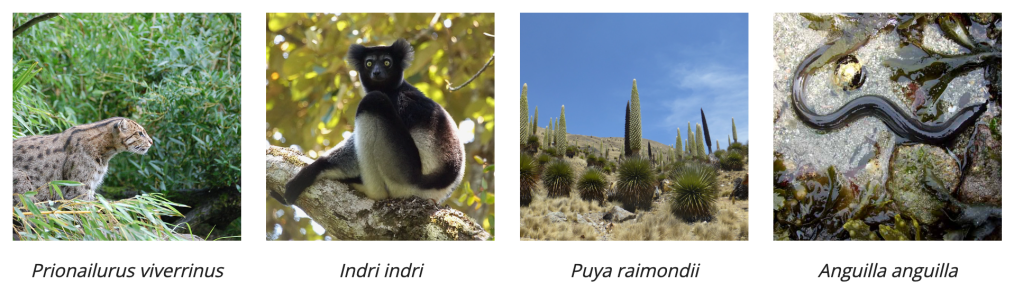
- Here are some examples of species that has been publicised for protections:
Activity 1
- Create a page of the selected species on the IUCN Red List. Species to choose from:
- Falkland Islands wolf
- Iberian lynx
- American bald eagle
- Giant panda
- Bornean orangutan
- The webpage should include:
- Name of species (common and scientific names)
- Origin and/or endemism
- Ecological roles
- The current IUCN status and the previous or projected statuses
- What are the threats to the species / pressures
- What are the current and previous conservation efforts?
- Advantages and limitations to the conservation efforts (mentioned in Q6)
Slide presentation with case studies:
Part 3: Tragedy of the Commons
Tragedy of the commons
- is a concept where individuals with access to a public resource (also called a common) act in their own interest and ultimately deplete the source i.e unsustainably exploiting the common resources
Activity 2
Use this audio to answer the following questions:
- Identify one reason why the trapping of beavers is permitted in Algonquin Provincial Park.
- To what extent does Algonquin Provincial Park provide a model of sustainable management of a protected area?
![ESS 8.1.3 [AHL] Biocapacity and Environmental Migration](https://mypytrclass.com/wp-content/uploads/2025/12/image-4.png?w=1024)




![ESS 8.3.4 [AHL] Photochemical Smogs and Tropospheric Ozone](https://mypytrclass.com/wp-content/uploads/2025/12/image-1.png?w=1024)
 PYTR Class