
Learning Objectives
- Analyse how biodiversity hotspots, particularly in tropical biomes, are threatened by habitat destruction, potentially resulting in significant loss of global biological diversity.
- Identify and evaluate key areas for biodiversity conservation based on their international ecological importance and the uniqueness of their species and habitats.
- Discuss the conflicts that arise in Key Biodiversity Areas (KBAs) between resource exploitation, sustainable development goals, and the need for conservation.
- Examine how traditional indigenous land management practices contribute to sustainability, and evaluate the pressures they face from population growth, economic development, climate change, and insufficient governmental protection.
- Explain the concept of environmental justice and assess its relevance and importance in guiding equitable biodiversity conservation strategies.
- Evaluate the planetary boundary for biosphere integrity, and explain how current extinction rates indicate that this boundary has already been critically exceeded.
Part 1: Biodiversity under Threats
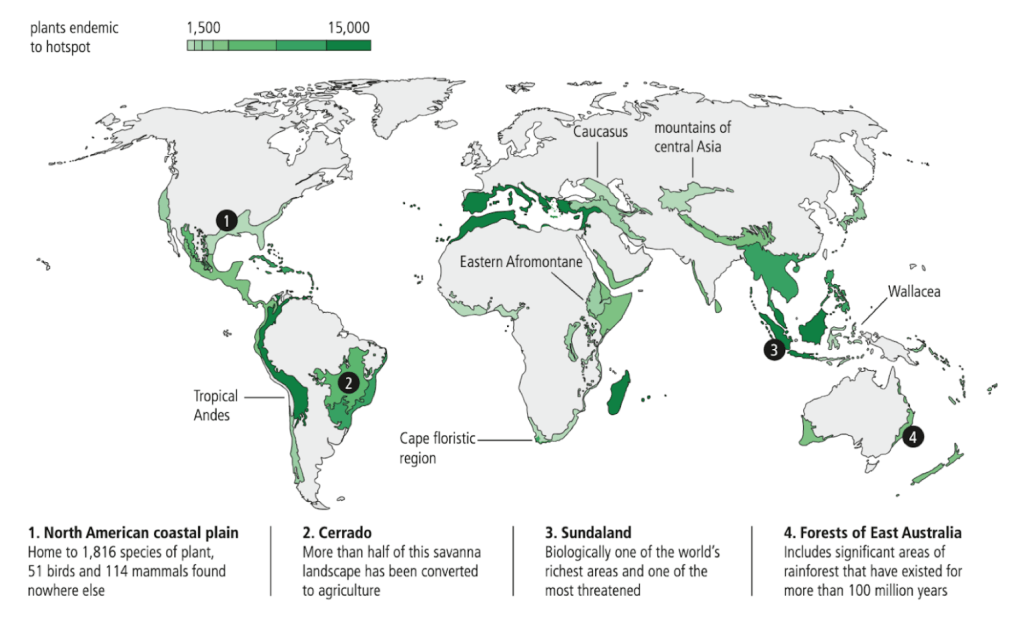
Key biodiversity areas (KBAs)
- are sites that contribute significantly to the global conservation of biodiversity in terrestrial, freshwater and marine environments.
- identified using taxonomic and ecological criteria and thresholds, such as:
- presence of threatened species
- presence of threatened ecosystems
- geographically restricted species
- ecological integrity where the site remains ecologically intact, essentially unaffected by industrial human influence
- biological processes where the site holds a significant proportion of a species’ population during one or more of its life stages, such as nesting, making it important for the continued survival of that species
- irreplaceability where the site has very high irreplaceability for the global persistence of biodiversity
Species extinctions have crossed a critical threshold
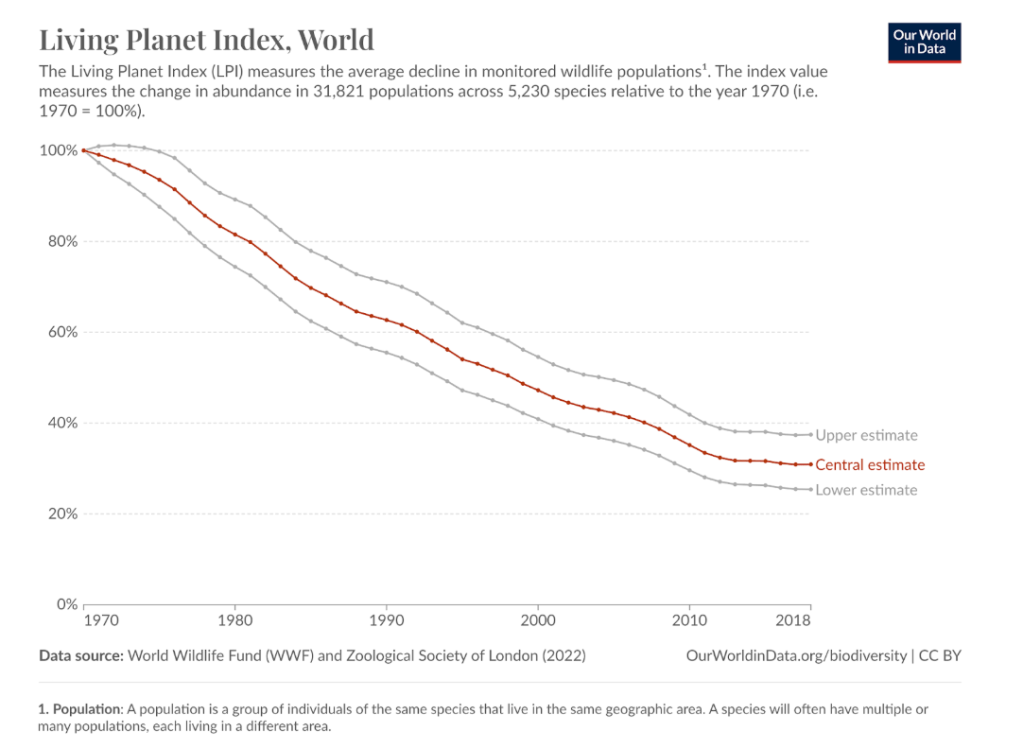
The planetary boundary ‘Loss of biosphere integrity’ indicates that species extinctions have already crossed a critical threshold. Research indicates that animal populations have decreased rapidly by an average of 69% between 1970 and 2018. This decrease has been greatest in Latin America and the Caribbean
Activity 1:
Discuss the conflicts between exploitation, sustainable development and conservation in KBAs
- The spread of palm oil plantations in South-East Asia and the consequences for biodiversity
- CAMPFIRE in Zimbabwe
Part 2: Indigenous Land Management and Environmental Justice
- Indigenous peoples have distinct social and cultural customs
- They share collective ancestral ties to the lands and natural resources where they live.
- Indigenous land management can be seen as more sustainable.
- Challenges: population growth, economic development, climate change and a lack of governmental support and protection.
- Sustainability threats usually come from outside the community.
- They have established more secured economy to overcome the sustainability conerns
Environmental justice and conservation
- The areas of the world that are expected to experience significant negative effects from both the loss of biodiversity and ecosystem functions are likely to be those with large concentrations of Indigenous people, such as rainforests.
- These communities may have a low income and no access to legal support (see 1.3 Sustainability, section Environmental Justice for more info)
Part 3: Planetary Boundary
- The planetary boundary ‘Loss of biosphere integrity’ indicates that species extinctions have already crossed a critical threshold
- There have been a number of natural periods of extinction and loss of diversity.
- More recently, humans have played an increasing role in diversity loss, especially in biodiverse ecosystems such as rainforest and coral reef
- The natural (background) extinction rate, based on fossil records, is estimated at 10 to 100 species per year.
- Human activities have significantly accelerated this extinction rate.
- Only a small fraction of species on Earth have been formally classified, making extinction rate estimates variable and uncertain.
- Tropical rainforest data suggest the Earth may be losing up to 27,000 species per year from those habitats alone.
- Extinction rates vary by organism group; mammals offer a focused example of the trend.
- The average lifespan of a mammal species is about 1 million years.
- With approximately 5,000 known mammalian species today, the background extinction rate for mammals should be 1 extinction every 200 years.
- However, in the past 400 years, 89 mammalian species have gone extinct—45 times the natural rate.
- Additionally, 169 mammal species are currently listed as critically endangered, indicating high risk of near-term extinction.
![ESS 8.1.3 [AHL] Biocapacity and Environmental Migration](https://mypytrclass.com/wp-content/uploads/2025/12/image-4.png?w=1024)




![ESS 8.3.4 [AHL] Photochemical Smogs and Tropospheric Ozone](https://mypytrclass.com/wp-content/uploads/2025/12/image-1.png?w=1024)

 PYTR Class