
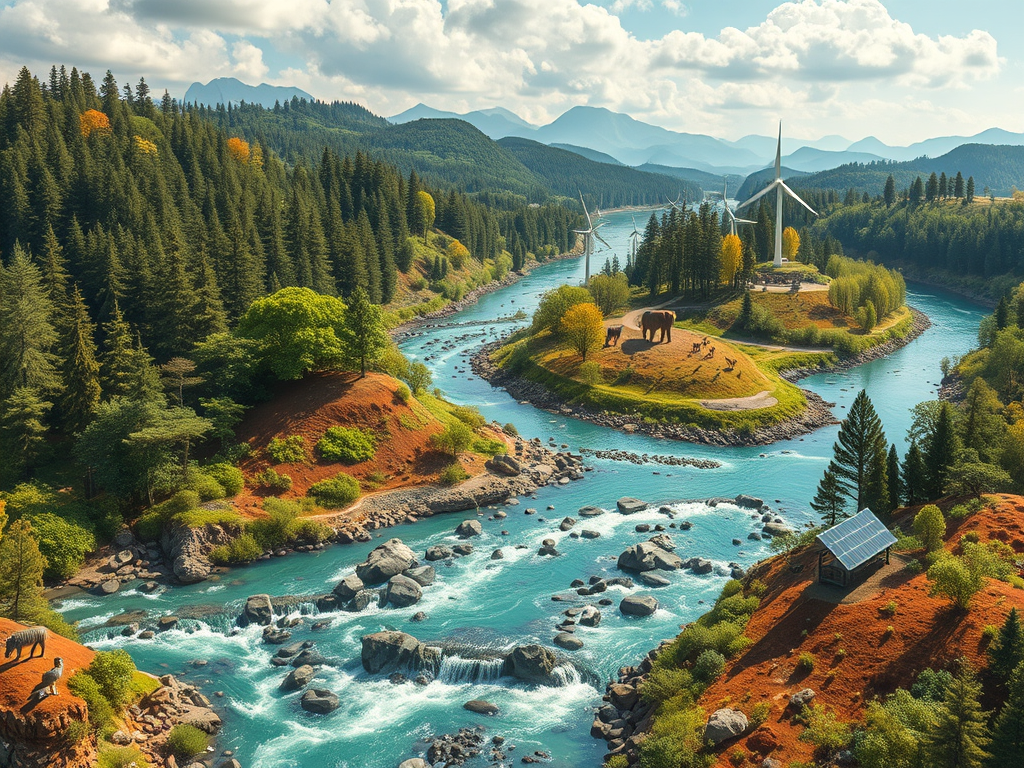
Learning Objectives
- Define natural resource, natural capital and natural income
- Describe the classifications of natural capital
- Summarise how society values natural capital
Abstract
This topic explores the concept of natural resources and natural capital as fundamental components of the Earth’s systems that support human life and economic activity. Natural resources serve as the raw materials and sources of energy used by society, while natural capital represents the total stock of these resources that generate goods and services—referred to as natural income. The notions of natural capital and natural income emphasise a particular perspective on nature as a provider of life-supporting ecosystem services. All resources are finite and can be classified as renewable or non-renewable, with their value shaped by aesthetic, cultural, economic, environmental, social, spiritual, and technological factors. The value of natural capital is dynamic, changing over time due to social and environmental influences. Sustainable management of natural capital is essential to maintain resource security and ensure the long-term availability of natural resources. Ultimately, societal choices in resource use reflect a diversity of values, priorities, and worldviews that shape the path toward sustainability.
Natural Resources, Natural Capital, and Natural Income
Natural resources refer to the raw materials and sources of energy that humans utilise to support life and economic activity.
Natural Capital and Natural Income
Natural capital represents the stock of natural resources available on Earth that possess value to human societies. The terms natural resource and natural capital are often used interchangeably. Natural income refers to the yield, harvest, or flow of services derived from natural capital.
Historically, economists regarded capital as the products of manufacturing, distinct from land and labor. However, contemporary understanding recognizes capital as encompassing:
• Goods: Tangible natural resources that possess direct value to humans, such as forests, soil, water, living organisms, and mineral ores.
• Services: Natural processes that sustain life, including flood and erosion control by forests, oxygen production through photosynthesis, and the maintenance of ecosystem health.
Thus, natural capital encompasses both goods and services that are not manufactured but nonetheless hold value for human societies. These goods and services arise from the physical, chemical, and biological functions of ecosystems. Natural capital can be enhanced or degraded and, with some difficulty, assigned a monetary value. For example, mining for metals or converting trees into timber adds economic value to natural resources without altering their status as natural capital.
Just as economic capital yields economic income, natural capital yields natural income, which refers to the renewable output or services derived from natural systems without depleting the underlying stock. Examples include cherry trees producing fruit, the water cycle providing fresh water, and forests supplying timber.
The true wealth of a nation therefore includes its natural capital, such as mineral resources, forests, and water systems. High-income countries often add value to natural income through manufacturing, whereas low-income countries may possess greater stocks of unprocessed natural capital. The World Bank now incorporates natural resource extraction rates and ecological damage, including carbon dioxide emissions, into its calculations of national wealth.
Classification of Natural Capital
Natural capital can be classified along a continuum based on the time required for renewal relative to the rate of human use. Ultimately, all natural resources are finite.
Non-Renewable Natural Capital
Non-renewable natural capital:
• Exists in finite quantities on Earth
• Cannot be renewed or replaced within a human timescale
• Regenerates only over geological time periods
• Includes resources such as minerals, fossil fuels, soil, and groundwater stored in aquifers
As these resources are extracted and consumed, stocks are depleted, necessitating the discovery of new sources or the development of alternatives.
Renewable Natural Capital
Renewable natural capital has the capacity to regenerate naturally through biological growth or recurring physical processes. However, overexploitation can render even renewable resources unsustainable. Renewable natural capital includes:
• Living species and ecosystems dependent on solar energy and photosynthesis
• Non-living systems such as groundwater and the ozone layer
If renewable natural capital is exploited beyond its natural income, the use becomes unsustainable. Conflicts frequently arise within and between nations concerning the depletion and conservation of natural resources. Extraction, transportation, and processing activities often degrade renewable natural capital, undermining its sustainability.
For example, water can function as either renewable or non-renewable natural capital depending on local conditions. In regions with abundant rainfall, where surface water is replenished frequently, water represents renewable natural capital. In arid regions with slowly recharging aquifers, water constitutes non-renewable natural capital.
Selected Types of Resources
Recyclable Resources
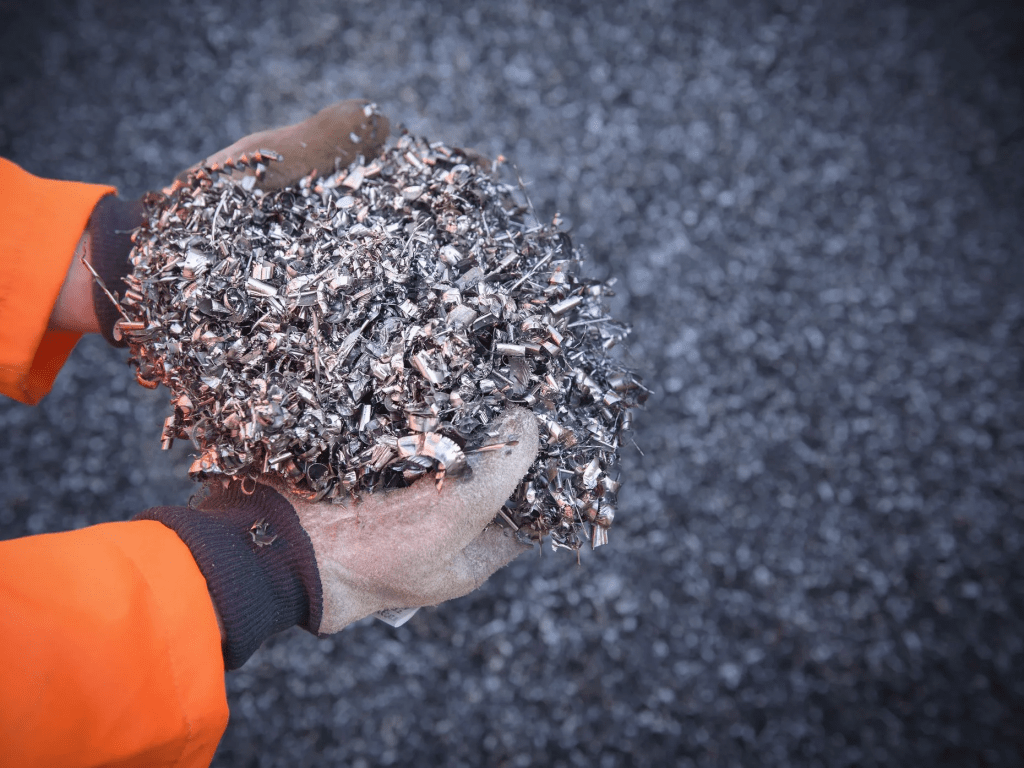
Some non-renewable resources, such as iron ore, can yield recyclable materials. Although iron ore itself is non-renewable, the iron extracted from it can be reused indefinitely. For instance, approximately 65 percent of a car is composed of iron or steel, which can be recovered, remanufactured, and repurposed. Thus, while the ore is finite, the derived metal becomes a recyclable resource. The same principle applies to other metals such as aluminum.
Forests as Natural Capital and Natural Income
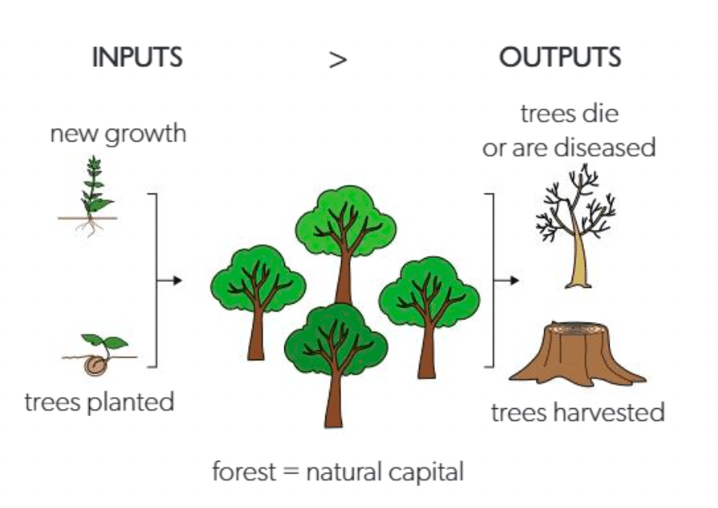
A forest represents a stock of natural capital that yields the natural income of timber. Sustainable forest management requires harvesting at a rate that allows for natural regeneration, minimizes harm to ecosystems, watersheds, and wildlife, and ensures sufficient standing stock for reproduction and ecosystem balance.
In sustainable systems, the inputs to the forest, such as regrowth, must equal or exceed outputs, such as harvest. Unsustainable logging practices, particularly clear-felling, lead to a range of environmental and social impacts, including changes in temperature and humidity, soil erosion and increased flooding, habitat loss and species extinction, and displacement of Indigenous communities and social conflict.
Fish as Natural Capital and Natural Income
Fish populations represent a critical form of renewable natural capital; however, many have been severely overexploited. Unsustainable fishing practices have led to drastic declines in fish stocks, threatening food security and biodiversity. For example, the bluefin tuna population in 2023 was estimated at only 30 percent of its 1970 level, primarily due to technological advances in fishing and increasing global demand.
Life-Support Ecosystem Services
Many ecosystem services are intangible and therefore difficult to quantify in traditional economic terms. While they may not produce tangible goods, these services are essential for maintaining life-supporting systems on Earth. If managed sustainably, such services are renewable; if degraded, they can become effectively non-renewable.
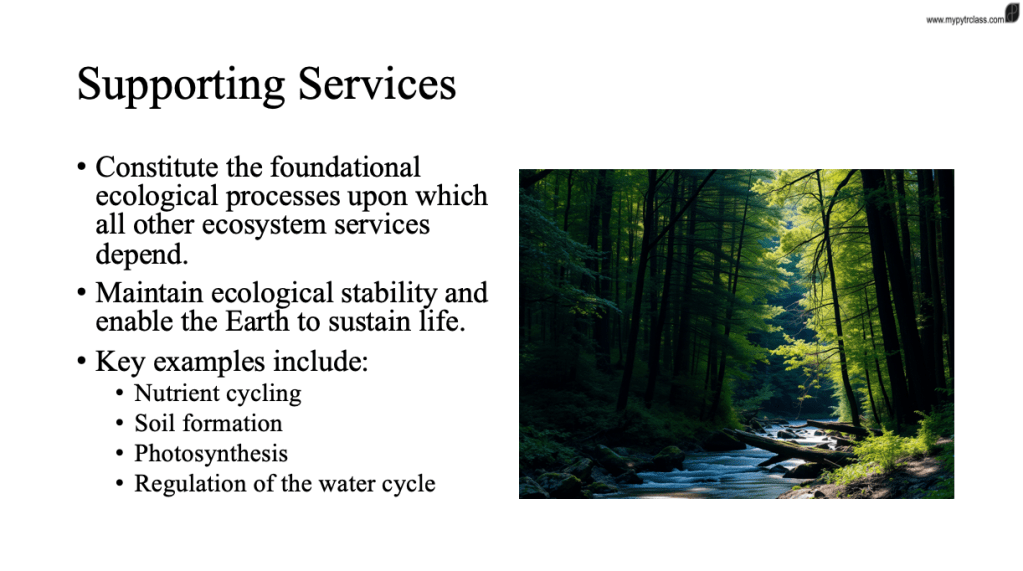
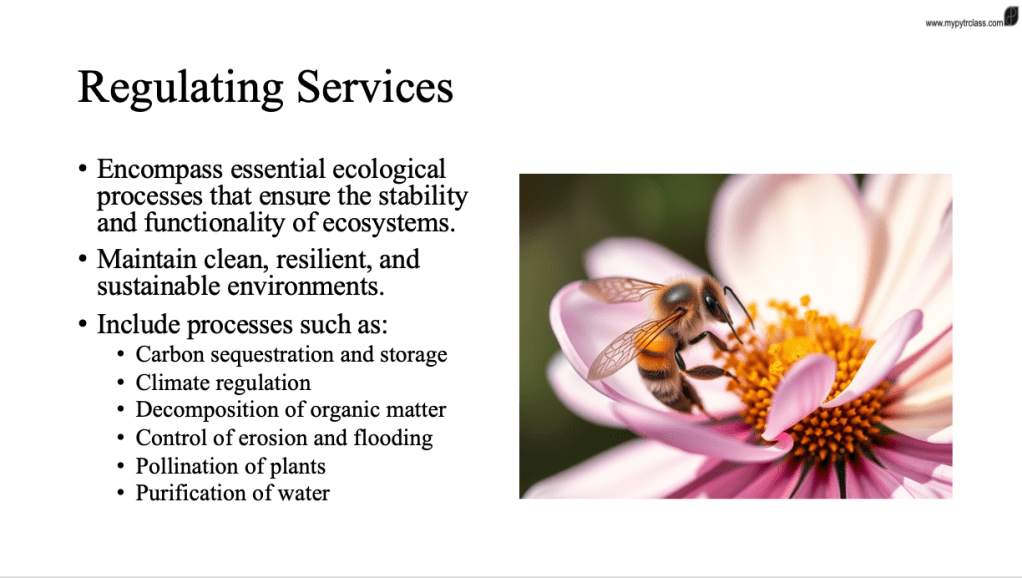
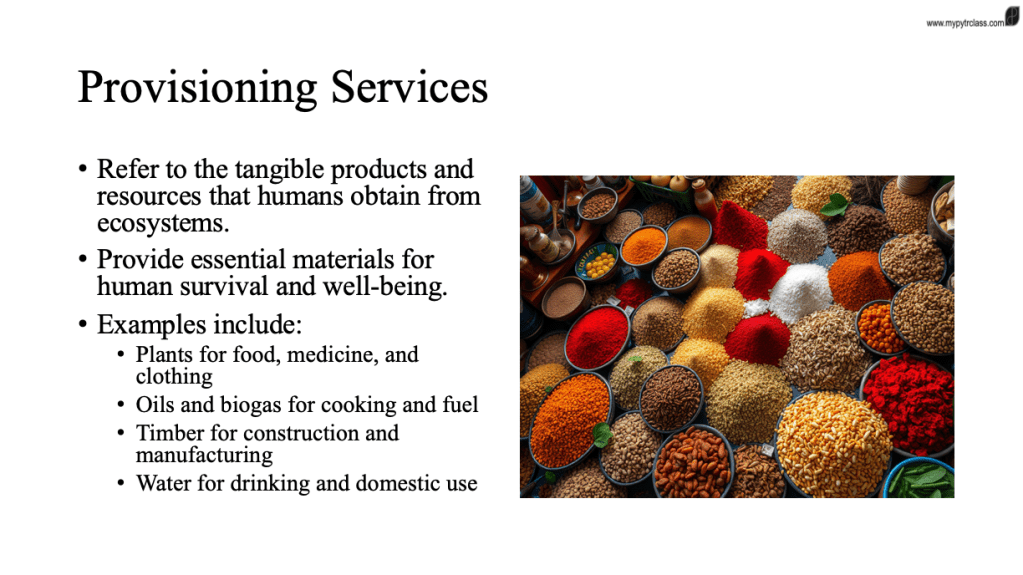
Between 2001 and 2005, the Millennium Ecosystem Assessment (MEA), sponsored by the United Nations, sought to evaluate the consequences of human-induced ecosystem changes, assess the impacts of these changes on human well-being, strengthen conservation strategies based on scientific evidence, and promote sustainable ecosystem management. The MEA identified four major categories of ecosystem services.

Services Provided by Vegetation
Vegetation contributes both tangible goods such as food, fiber, and medicine and vital life-support services. One key service is water replenishment, whereby vegetation facilitates groundwater recharge and regulates the hydrological cycle. By intercepting rainfall, vegetation slows surface runoff, enhances infiltration, and reduces flood risk and soil erosion.
In contrast, urban areas lacking vegetation experience increased flooding due to reduced infiltration capacity. Wetlands are particularly effective in flood mitigation, acting as natural sponges that absorb and gradually release water. Historically, hardwood riparian wetlands along the Mississippi River stored floodwater for up to 60 days; today, due to land clearance and drainage, they retain water for only about 12 days.
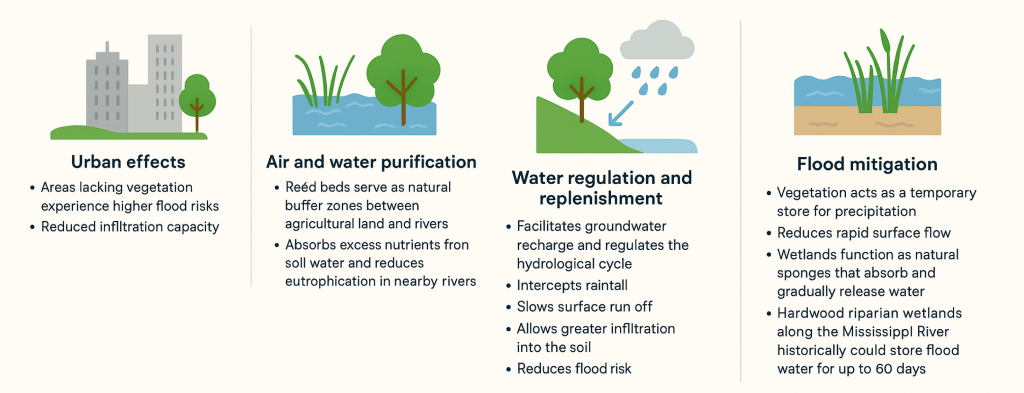
Vegetation also plays a crucial role in air and water purification. Reed beds, for example, function as buffer zones that absorb excess nutrients from agricultural runoff, thereby reducing eutrophication in nearby rivers. Urban trees improve air quality by filtering pollutants such as ammonia, nitrates, sulfates, volatile organic compounds, and particulate matter, while simultaneously sequestering carbon dioxide through photosynthesis.
Valuing Natural Capital
There are multiple approaches to valuing natural capital, each dependent on how the concept of “value” is defined. Value may refer to:
- The financial worth of an asset or resource;
- The importance or utility of something; or
- An ethical consideration, particularly when determining what is right or wrong.
Natural capital can be assessed through different valuation frameworks. One such approach distinguishes between use valuation and non-use valuation:
- Use valuation refers to aspects of natural capital that can be assigned a market price, such as goods and services that generate economic returns.
- Non-use valuation pertains to elements of natural capital that are difficult or impossible to quantify monetarily, including intrinsic ecological rights, potential sources of future knowledge, and the value preserved for future generations.
A common argument is that attributing monetary value to non-use aspects of natural capital can raise awareness of their significance. However, critics contend that this approach may lead to the commodification and potential exploitation of natural resources.
Understanding whether a resource can be used sustainably is essential. For example, agriculture is often perceived as sustainable because it involves cycles of planting and harvesting. Yet, true sustainability in agriculture depends on maintaining soil fertility and structure, as well as preventing environmental degradation. If agricultural practices lead to biodiversity loss, the long-term sustainability of agriculture itself becomes questionable.
Traditional practices such as slash-and-burn cultivation (shifting cultivation) and sporadic logging in virgin forests can be sustainable, provided that ecosystems are given adequate time to recover. However, this sustainability is contingent upon maintaining low human population densities. The critical question, therefore, is whether current environmental recovery periods are sufficient.
Since the early 1980s, the United Nations Environment Programme (UNEP) has implemented a system of integrated environmental and economic accounting, known as the System of Environmental-Economic Accounting (SEEA), to evaluate environmental assets and monitor resource depletion. Incorporating the environmental costs of resource degradation into national economic indicators such as Gross National Product (GNP) would provide a more accurate representation of a nation’s true economic health and sustainability.
The 1992 United Nations Earth Summit in Rio de Janeiro introduced Agenda 21, a comprehensive action plan aimed at promoting sustainable development. As part of this initiative, local councils were encouraged to engage their communities in developing localized sustainability strategies, collectively referred to as Local Agenda 21.
![ESS 8.1.3 [AHL] Biocapacity and Environmental Migration](https://mypytrclass.com/wp-content/uploads/2025/12/image-4.png?w=1024)



![ESS 8.3.4 [AHL] Photochemical Smogs and Tropospheric Ozone](https://mypytrclass.com/wp-content/uploads/2025/12/image-1.png?w=1024)
 PYTR Class