Learning Objectives
- Outline the term metabolism and the roles of enzymes in metabolism
- Explain the action of enzymes
- Outline enzyme immobilisation
What is a metabolism?
Metabolism is all the chemical reactions that take place within cells and organisms. This involves the transformation of molecules to different forms. These molecules involved in metabolism are called metabolites.
Two types of metabolism are:
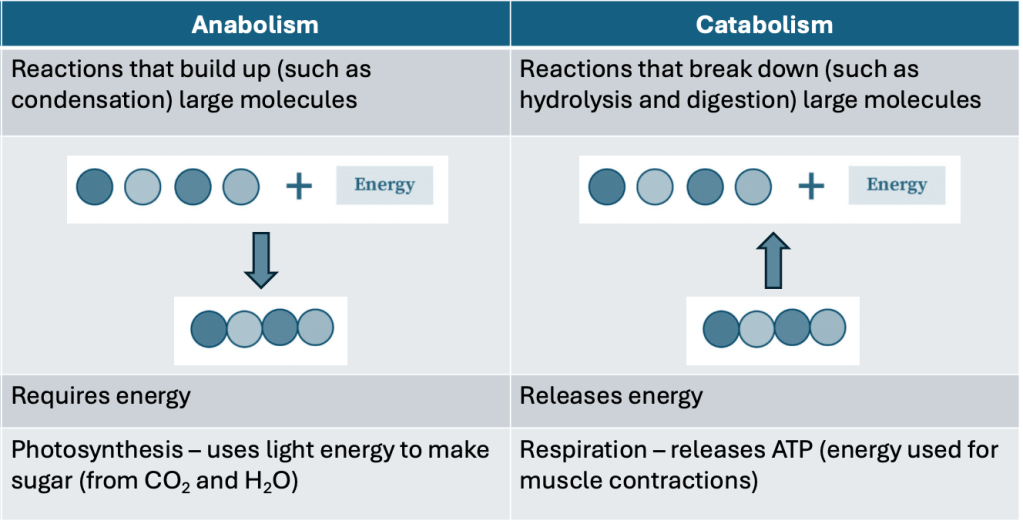
- Anabolism (building up, condensation etc)
- Catabolism (breaking down, hydrolysis etc)
Are all metabolic reactions spontaneously?
No. Anabolism requires energy (known to be endergonic). Hence will have positive Gibbs free energy. In contrast, catabolism is exergonic and has negative Gibbs free energy. Although it sounds like catabolism, such as food digestion, would take place spontaneously, it will take a very long time to break down a large macromolecule such as polysaccharides. Therefore, both anabolism and catabolism require enzymes to proceed at high rate.
For some spontaneous reactions, the event take place at extremely low rate. Without an enzyme, a reaction will only take place with two substrates collide at the right orientation and energy level (velocity).
How many enzymes are needed in a metabolic reaction?
A metabolic pathway can be a linear or cyclic pathway. They usually involve multiple steps to complete. For instance, Krebs cycle in aerobic cellular respiration has eight distinct steps. Each step requires a specific enzyme. Therefore, Krebs cycle requires 8 different enzymes to complete (this will be further discussed in Subtopic C1.2). In other words, no enzyme can be used for more than one reaction. This is called the enzyme specificity. For a simpler example, enzyme that can digest sucrose (table sugar) is called sucrase. Sucrase cannot digest any other substance. This is mainly due to the enzyme’s active site.
How Enzymes Work?
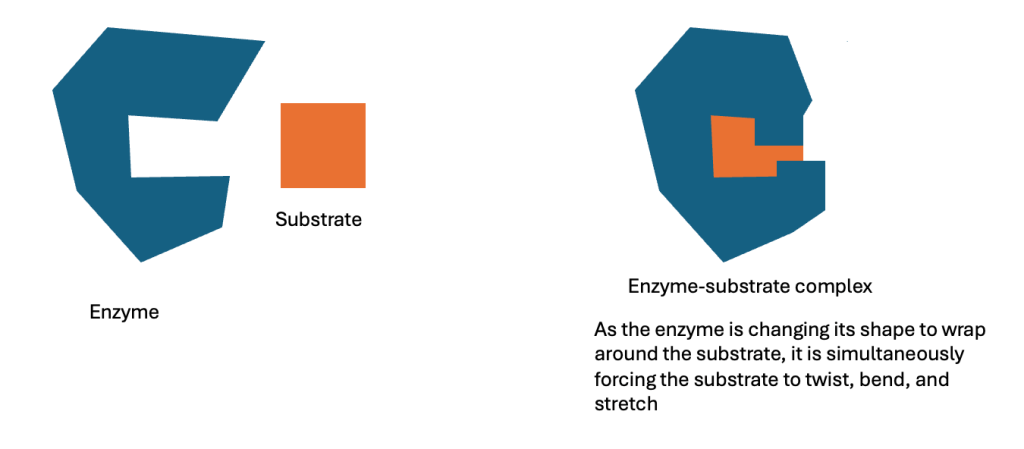
Enzymes are biological catalysts. They are globular protein (tertiary structure, round shaped) with active site for catalysis. An active site is a specifically formed pocket in the enzyme where a substrate can bind to. This binding is called enzyme-substrate-complex where the substrate is raised to a higher energy state called the transition state, making it ready to form a product(s). At the end of the reaction, enzymes remain unchanged can be used for the same reaction again and again.
Properties and roles of an enzyme’s active site
- made by only a few amino acids within the overall 3D globular protein,
- depending on the amino acids, they form intermolecular forces with the substrate during the binding,
- holds the substrate at the brief transition state,
- lowers the activation energy of the reaction.
How induced-fit binding work?
At the active site, the arrangement of the few amino acids matches the substrate’s grouping i.e they are able to form the intermolecular forces, forming the enzyme-substrate complex. As this binding is formed, it induces the change in the shape of the enzyme and substrate. This change in shape is also the reason why the substrate has higher energy state during the transition state, allowing it to react.
The original theory of how enzyme works, the lock-and-key model, has been replaced by the induced-fit model. In the induced-fit model, the active site of the enzyme undergoes conformational changes to improve the binding with the substrate.
In modern science, all enzymes follow induced-fit model. Although some textbooks may state that sucrase and urease are classic examples of lock-and-key model, it is revealed that all enzymes actually undergo changes such as twisting, bending and even just vibrating at a molecular level when binding with their substrates.
How does enzyme speed up the reaction?
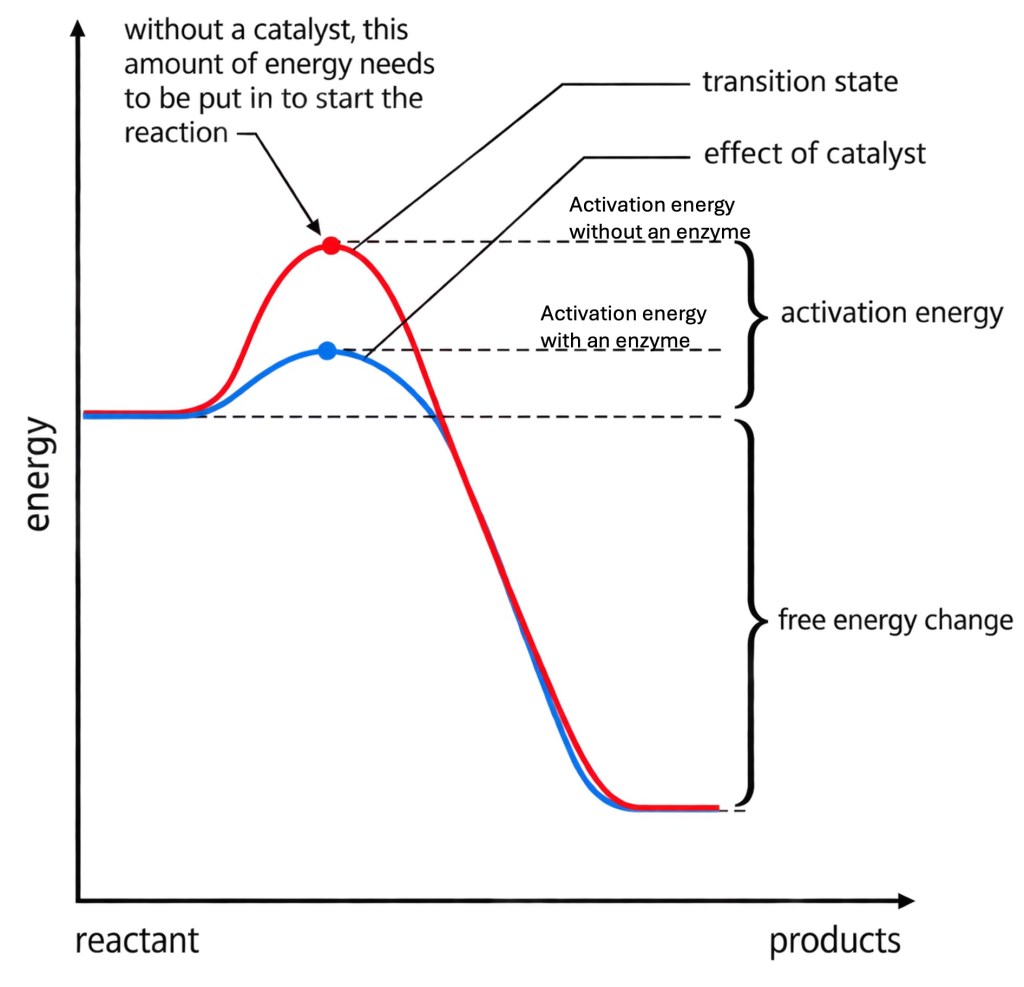
Without enzyme, the transformation of substrate to product takes a very long time and often an insignificant event. This is because of the required energy input called activation energy. Most substrates are trapped behind this energy barrier, preventing them from reacting to form products. The enzyme-substrate complex is a relatively stable transition state that it sits at a lower local energy minimum. This is contributed by the new and temporary bondings formed between the enzyme and substrate. This new alternative pathway has lower activation energy. As the result, more substrates can be transformed to products.
In short, an enzyme speeds up a reaction by lowering the activation as it provides an alternative pathway for the reaction
What is an enzyme immobilisation?
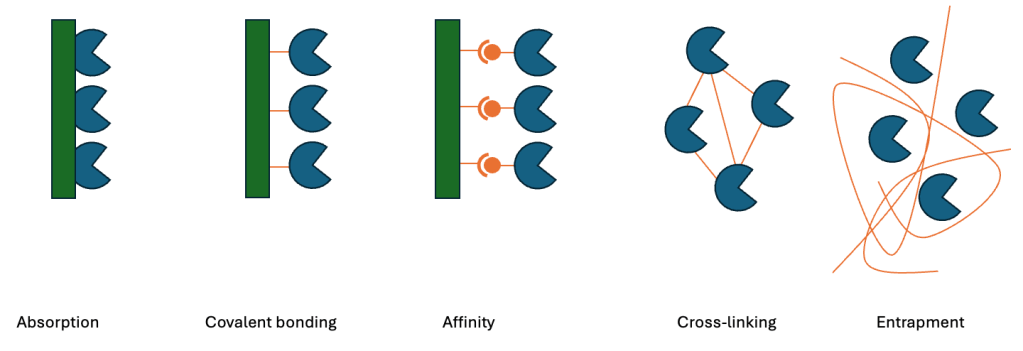
We know that collision must happen in order for a reaction to take place. For this, substrates and enzymes must move. Molecules with higher velocity will have higher frequency of collision, hence increasing the chance for them to collide at the right orientation. As an enzyme is a large globular protein, immobilising it enhances its stability and viability. The enzyme immobilisation is a technique where an enzyme is often embedded in a porous membrane (of an inert, insoluble material) where substrate will pass through. This technique is commonly used in food, pharmaceutical and water treatment industries. As this is a cell-free preparation using enzymes that will not be washed away, the product obtained enzyme free
How to immobilise the enzyme?
There are a few ways to attached the enzyme to the inert material. The material later will provide support. These are some examples of immobilisation of enzymes:
Exercise
- Define the term induced-fit binding.
- Explain why the shape of enzymes is important in enzyme action.
- Distinguish between anabolism, catabolism and metabolism
- Explain why transition state is the briefest state in an enzymatic reaction
- Outline the advantages of immobilising enzyme in the production of lactose-free milk


 MyPYTR Class
Leave a comment