Learning Objectives
- Outline the following terms:
- intracellular and extracellular enzyme-catalysed reactions
- endergonic and exergonic reactions
- linear and cyclic metabolic pathways
- Explain competitive and non-competitive inhibitions
- Describe feedback inhibition in regulation of metabolic pathways
Understanding Enzyme Terminologies
What are extracellular enzyme-catalysed reactions in comparison to intracellular ones?
In the next chapter, we will explore about exocytosis where cells secrete fluid out, in a form of a vesicle. This fluid may contain enzymes where they will be used by metabolic processes outside of the cell. These metabolic processes are called extracellular enzyme-catalysed reactions. For instance, food digestion takes place along human alimentary canal.
In contrast, intracellular enzyme-catalysed reactions take place inside the cell. This may be in the cytoplasm, plasma membrane and in the organelles. For example, glycolysis and Krebs cycle are intracellular metabolic processes during cellular respiration.
What are endergonic and exergonic reactions in terms of energy transfer?
Let’s first clarify that endothermic is not the same as endergonic and exothermic is not the same as exergonic.
When glucose is broken down during cellular respiration, the energy stored in the form of chemical energy (a potential energy) is transformed to kinetic energy. This means that the substrate (which is the glucose) has higher energy potential energy compared to the products of glucose oxidation, which are CO2 and H2O. The energy released is considered as free energy. Any reaction that releases free energy is classified as exergonic. This free energy today is called Gibbs free energy.
In contrast, reactions that require energy input are known to be endergonic. For instance, photosynthesis requires electromagnetic range of 400 to 700nm (mostly red and blue visible light).
Many endergonic reactions occurring in metabolism are enabled through their coupling with exergonic reactions. This coupling is mediated by adenosine triphosphate (ATP), which serves as the primary energy currency of biological systems. ATP acts as a common intermediate in metabolic pathways, linking energy-requiring (the endergonic) reactions with energy-releasing (the exergonic) reactions. Consequently, ATP is involved, either directly or indirectly, in most metabolic processes.
What are the differences between linear and cyclic metabolic pathway?
Linear pathway refers to a one-way multi-step metabolic process where no product is used as substrate to begin the process again. Glycolysis is an example of a linear metabolic pathway.
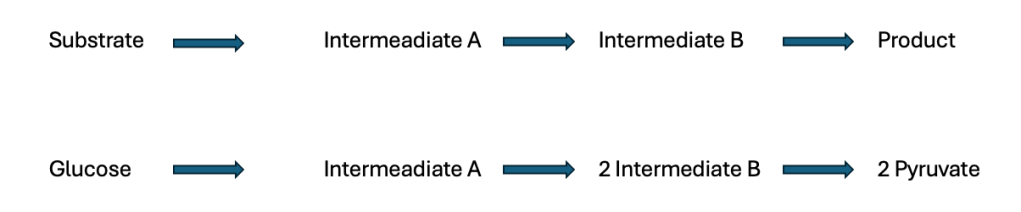
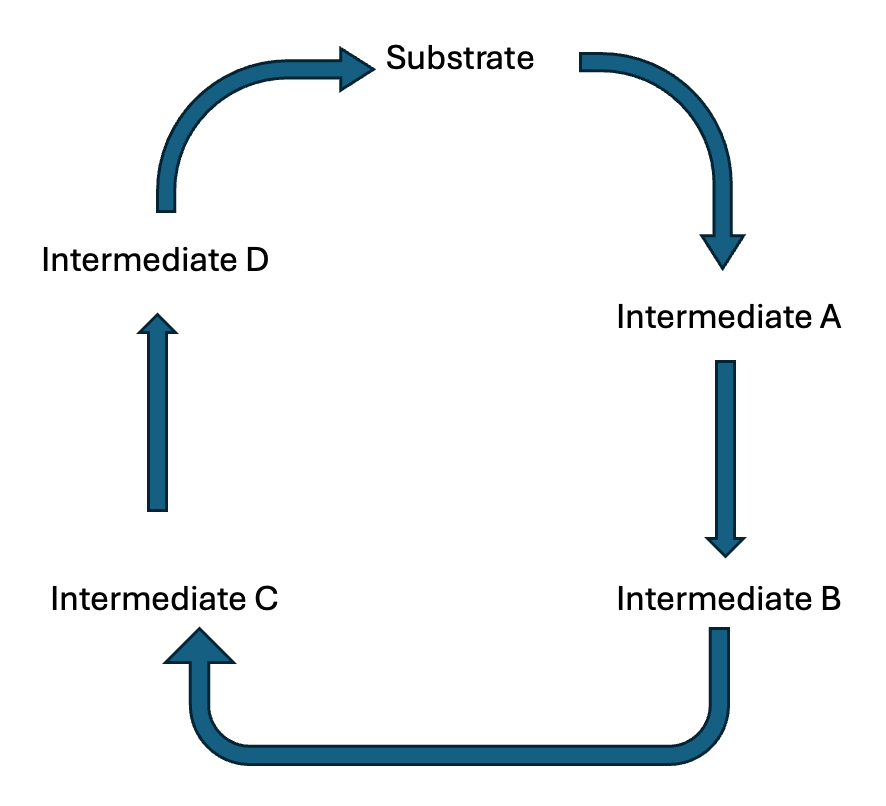
Cyclic metabolic pathway refers to series of reactions where the last step or last reaction produces the first substrate and whole process can be started again and again (in a loop). Krebs cycle is an example of a cyclic metabolic pathway.
Competitive and Non-Competitive Inhibitions
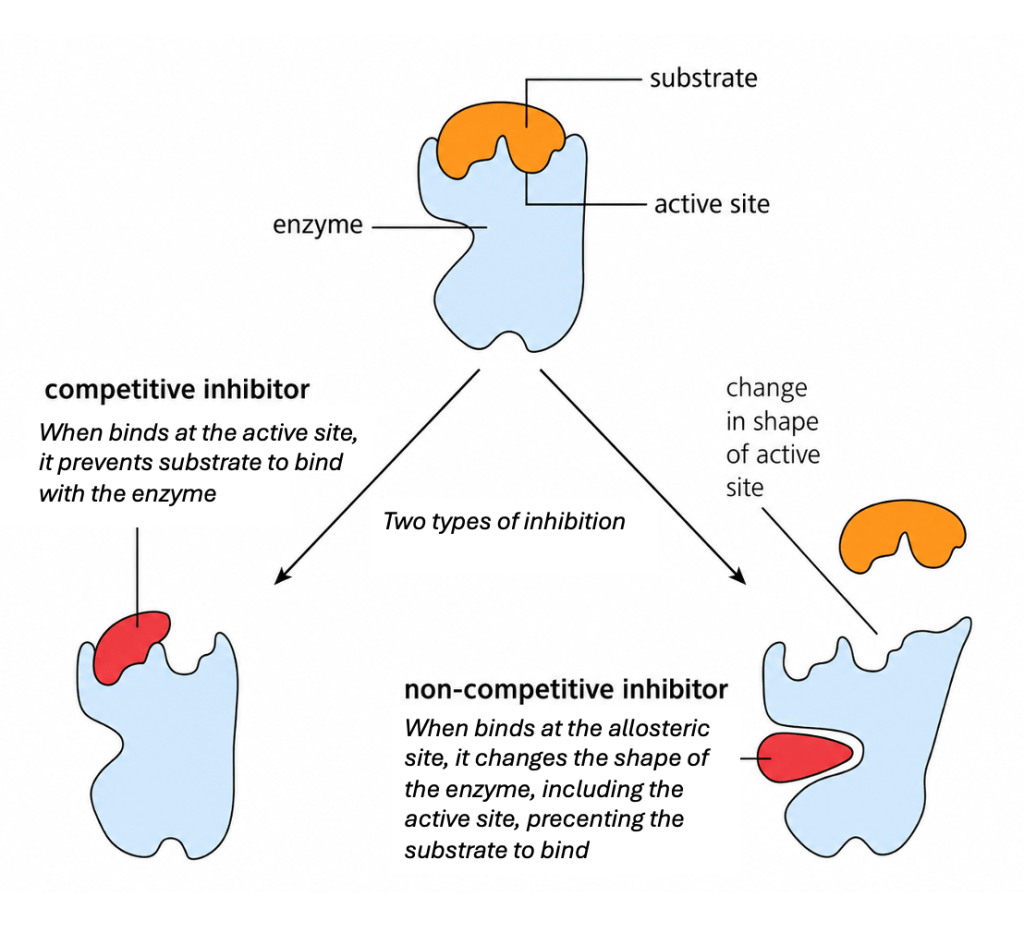
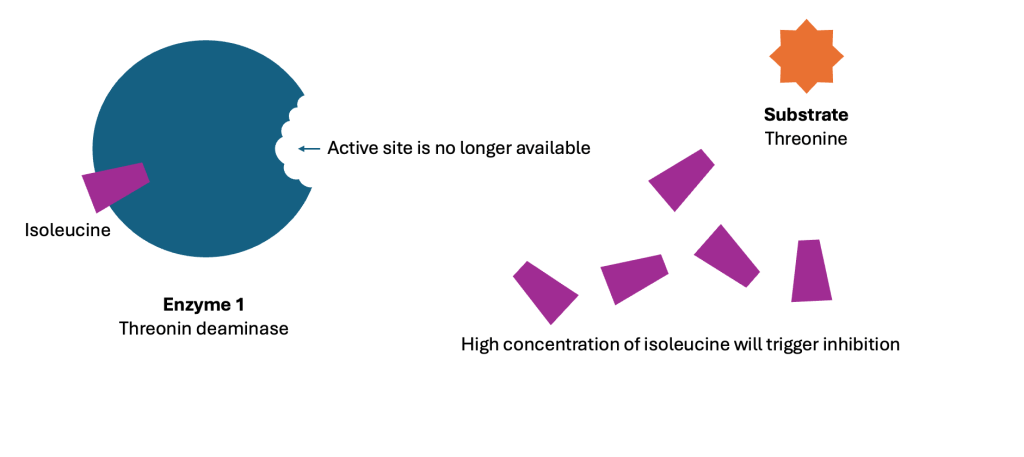
As we already know, when an enzyme binds with its substrate, there is change in shape in the enzyme (and even the substrate). That being said, when other molecules bind with an enzyme, it can also cause changes in the shape of the enzyme. If the new shape causes the active site to be unavailable to the substrate, the enzyme is known to be inhibited. This is called enzyme inhibition. As the result, the rate of enzymatic reaction is lowered and sometimes to zero rate.
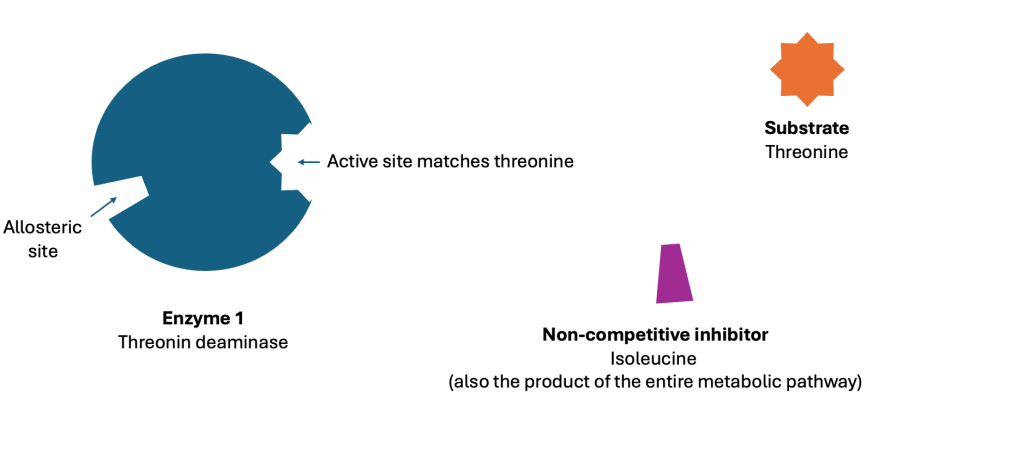
An enzyme inhibitor is a substance that slows or blocks enzyme action, either by directly interfering with the binding site or by modifying the enzyme’s structure. These molecules are broadly classified based on their specific site of interaction. A competitive inhibitor is a substance that binds to the active site of an enzyme, physically obstructing the substrate and thereby slowing or blocking enzyme action. In contrast, a non-competitive inhibitor is a substance that does not bind to the active site but to another part of the enzyme (called allosteric site); this interaction alters the enzyme’s configuration, which ultimately slows or blocks enzyme action regardless of substrate availability.
How do inhibitions affect the rate of enzyme activity?
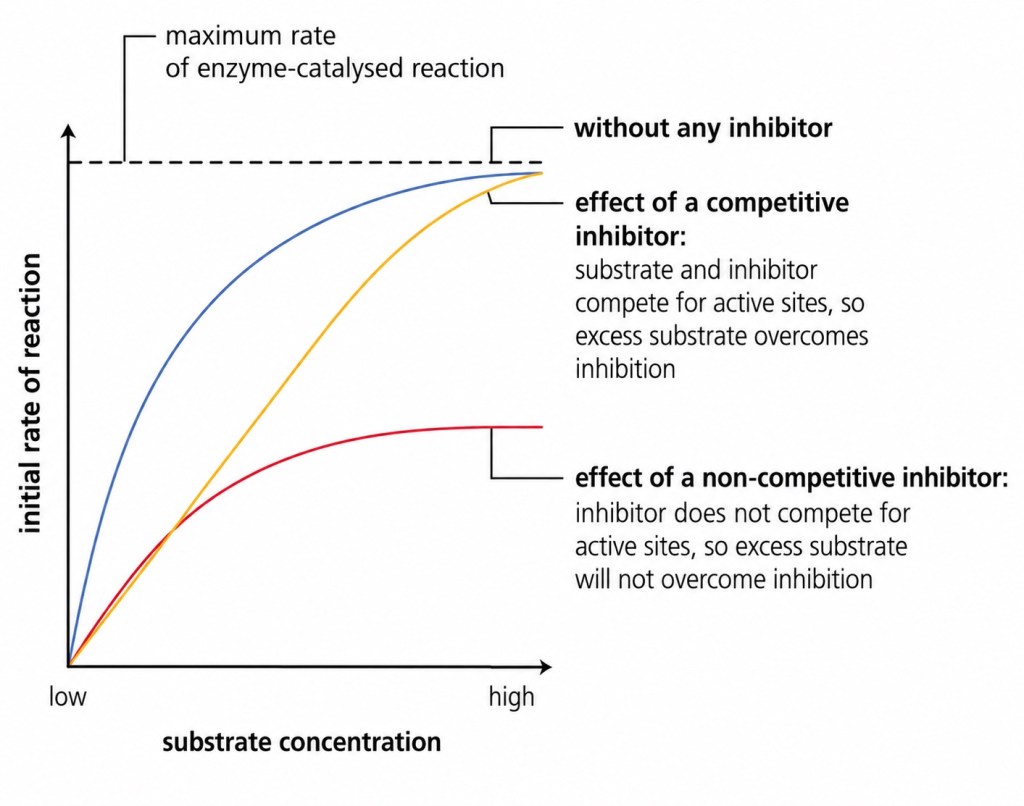
Because a competitive inhibitor competes with the substrate for the active site, it only lowers the rate of reaction. The full enzyme activity can still be obtained by increasing substrate concentration. In contrast, non-competitive inhibitors do not compete for the active site. Full enzyme activity cannot be achieved even by adding more substrate into the reaction mixture.
What is an example of competitive inhibition?
Some pharmaceutical products are designed to act as a competitive inhibitor in human body. For example, statins are drug used to lower the level of low density lipoprotein level in blood. This is achieved by blocking the production of cholesterol in the liver.
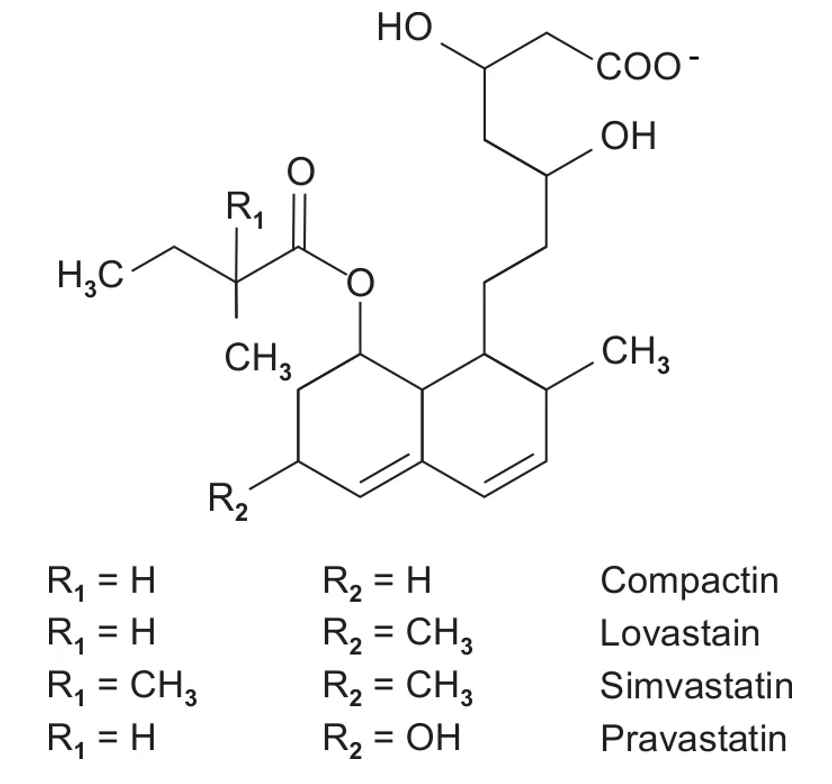
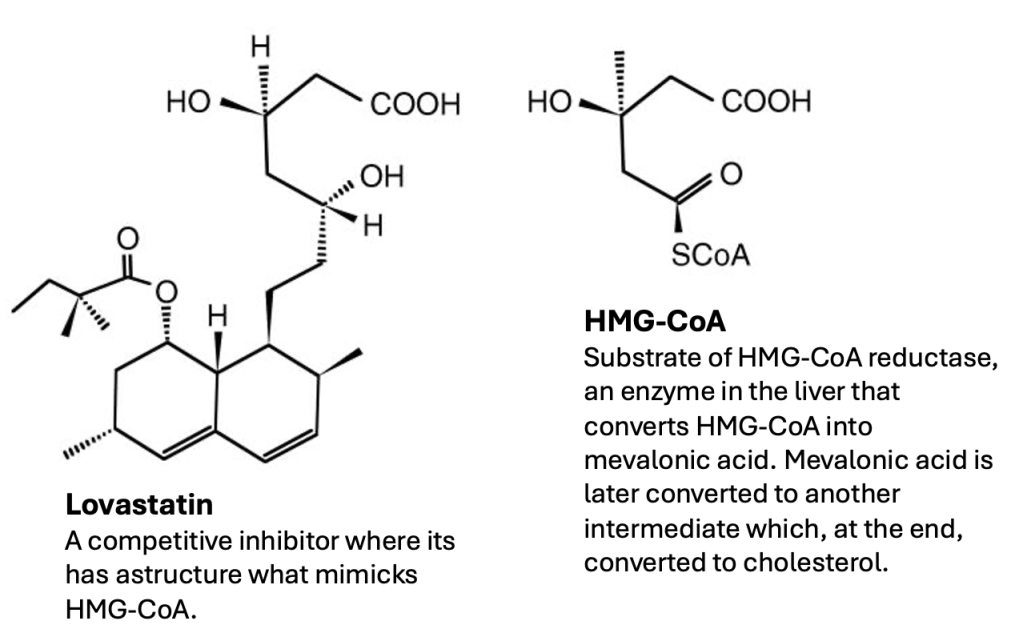
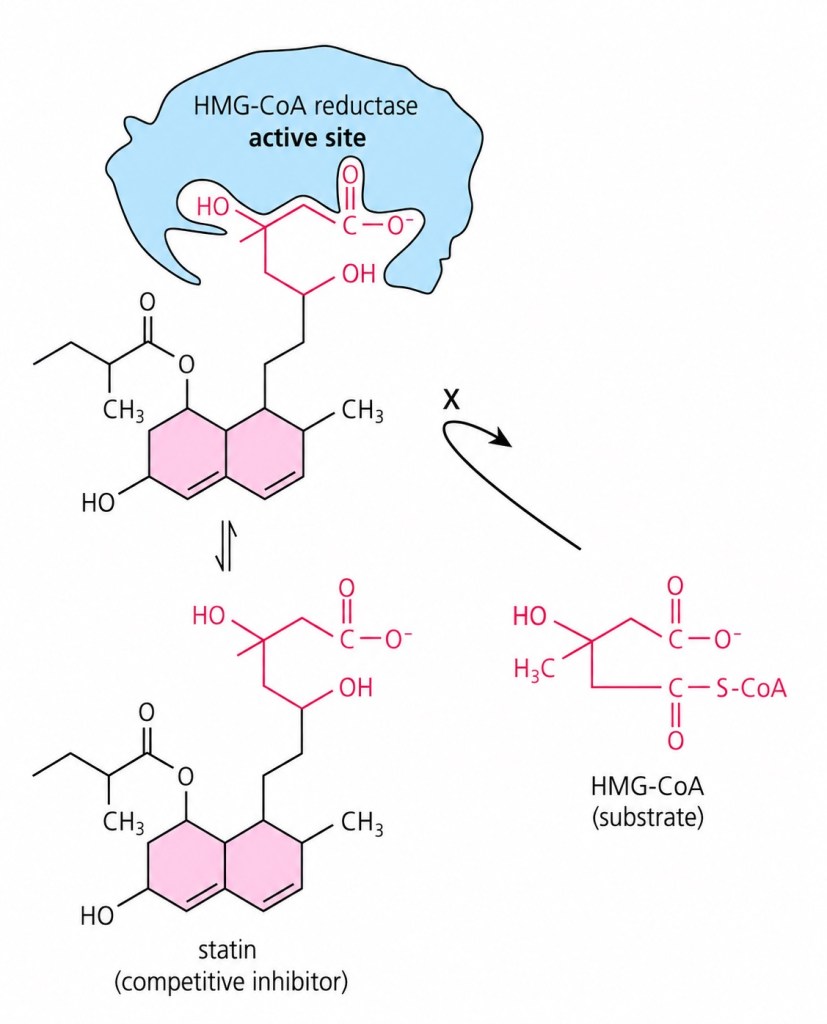
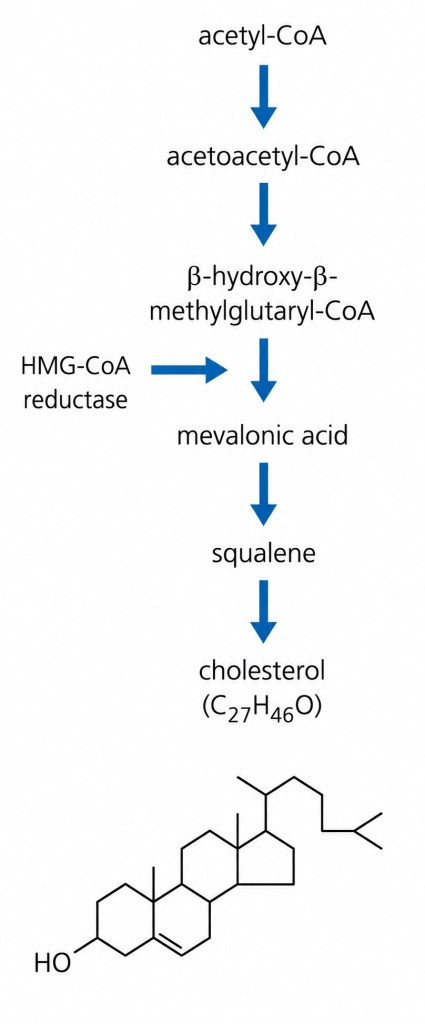
As the result, the metabolic pathway that takes place in the liver to produce cholesterol is halted by statins. This metabolic pathway of cholesterol production in liver can be simplified as follow:
Is binding at the allosteric site always causing non-competitive inhibition?
The term comes from the Greek words allos (meaning “other”) and stereos (meaning “space” or “solid”), literally translating to “other space.”
Apparently, an enzyme also has another site for binding, but not for the substrate. This other site is available to other substances. A binding always changes the conformational shape of the enzyme. If the change deactivates the enzyme in the way it inhibits the enzyme activity, then it is called allosteric inhibition. Changes in the enzyme shape does not always deactivate the enzyme. Sometimes, the enzyme are not in the right shape for its substrate to begin with. There are other molecules that can also bind at the allosteric site, change the shape of the enzyme and make the active site available for the substrate. These molecules are called the activator. Other names of enzyme activator include cofactor and coenzyme depending on their natures.
| If the activator… | It is called a… | Example |
| Binds to the allosteric site to turn it on | Positive Allosteric Modulator (PAM) | AMP (regulates energy pathways) |
| Is a metal ion needed for the reaction | Inorganic Cofactor | Magnesium (Mg²⁺) in glycolysis |
| Is an organic molecule helper | Coenzyme | Vitamin-derived molecules |
Feedback & Mechanism-Based Inhibition
Metabolic reactions can be regulated by two approaches:
- Feedback inhibition
- Mechanism-based inhibition
How does feedback inhibition work?
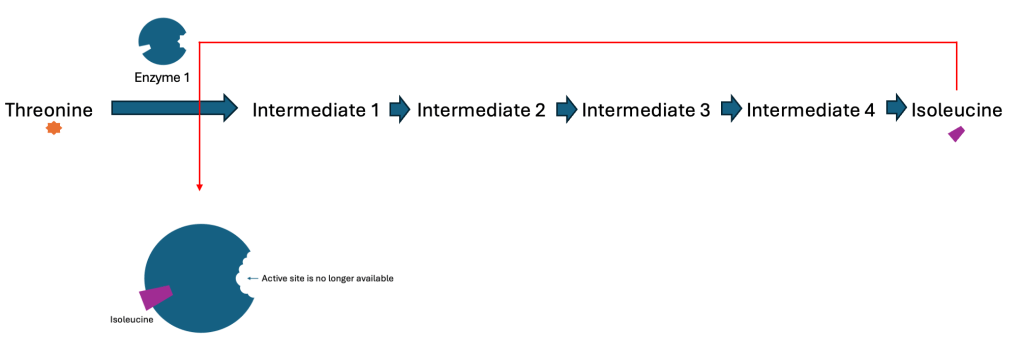
End-product inhibition when the product of the last reaction in a metabolic pathway inhibits the enzyme that catalyses the first reaction of the pathway.
For example, isoleucine production in bacteria can be inhibited by isoleucine as it acts as a non-competitive inhibitor to the enzyme in the first step of this metabolic process.
How does mechanism-based inhibition work?
Mechanism-based inhibition is a process in which an initially unreactive molecule is converted into an active inhibitory form through an enzyme-catalysed reaction. The resulting active molecule inhibits the enzyme, typically by forming a covalent bond with a group within the active site. Because covalent bonds are strong, the enzyme shape is permanently modified. This type of inhibition is generally irreversible.
The most common example of mechanism-based inhibition is the action of penicillin. Bacteria have an enzyme responsible in strengthening its peptidoglycan (also known as murein) cell wall. This enzyme is called DD-transpeptidase. When penicillin binds to the active site of DD-transpeptidase, the enzyme modifies the penicillin. This prevents the formation of cross-link between polysaccharide chains of peptidoglycan. As the result, the bacterial cell wall integrity is compromised and cause the cell to undergo cell lysis.
Bacteria can counter the work of penicillin by mutation. When mutation happens, the transpeptidase will have a different shape which will not be recognised by penicillin. This is the reason why physicians will rare use antibiotic as the first course of action. If they do, they will remind you to finish the course to make sure that all bacteria are killed and none survives to mutate.
Exercise
Try answering the following questions
- Distinguish between competitive and non-competitive enzyme inhibition.
- Compare and contrast cyclical and linear pathways in metabolism.
- Explain why isoleucine can cause a negative feedback inhibition in its own production process
- Explain the type statin inhibition and why the inhibition is not permanent


Leave a Reply